Who Actually Books Massage, and Why: Turning the 2026 Fact Sheet Into a Mobile Client Strategy
Published on October 22, 2026
Your Service Area Is Probably an Accident
Most mobile therapists never choose their market. They draw a circle around their own front door, set a travel fee that feels fair, and describe their ideal client as anyone who wants a massage. The circle sits wherever they happened to live when they were licensed, and a description that fits everyone guides nothing.
The American Massage Therapy Association’s industry fact sheet runs to two pages, and most solo therapists skim it once and move on. The 2026 edition deserves a slower read. It breaks down who had a massage in the past year by household income, gender and whether there are children at home, and it reports why people book and where therapists already work. None of it tells you who lives on your streets. Each figure does map onto a decision a mobile practice has to make anyway, though: where to draw travel zones, which hours to protect, how to word a service page, and where the competition already sits.
This guide takes the numbers one at a time. Tactics such as gift certificates, community events and a campaign calendar are covered in our marketing playbook for mobile therapists. This piece is about deciding whom those tactics should reach.
What the Fact Sheet Measures, and How Far to Trust It
The fact sheet summarizes AMTA’s 2026 Massage Profession Research Report, which the association says rests on four benchmark surveys it ran in 2025. Its consumer research comes from an annual online poll that AMTA describes as a demographically representative sample of 1,000 U.S. adults. The latest ran in July 2025.
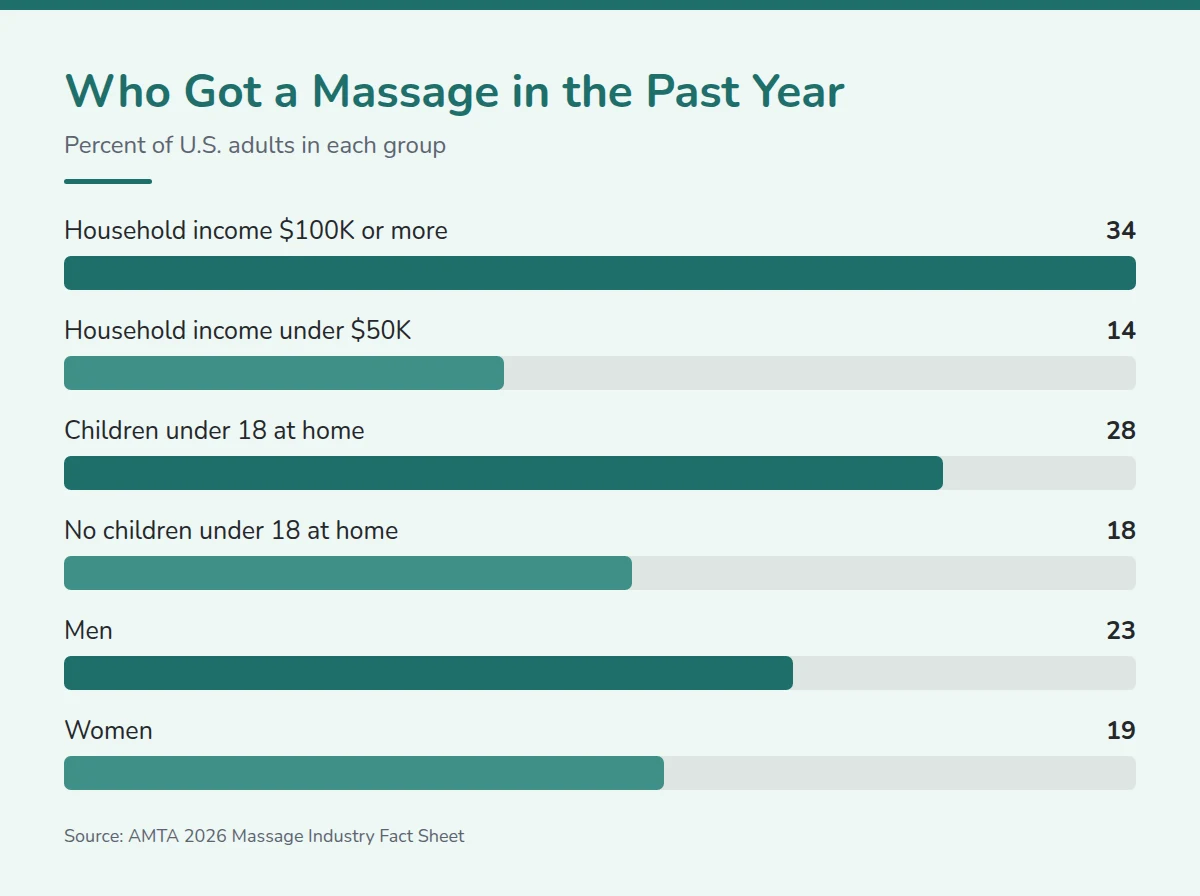
Two cautions shape how to use it. First, AMTA’s levels run well above the government’s. In AMTA’s survey, 23 percent of men and 19 percent of women said they had a massage in the past year. The National Center for Complementary and Integrative Health, a federal agency, cites national survey data showing that 10.9 percent of U.S. adults used massage therapy in 2022. The two surveys ask different questions in different ways, so AMTA’s percentages are no basis for estimating how many clients live in your zone. Use them for comparison instead: which households are more likely to book than which.
Second, a poll of 1,000 people cannot settle small gaps. Once the sample is split by gender or into income bands, a difference of a few points is within the range chance alone can produce. The large gaps below are worth building a practice around. The small ones are worth noting and then testing against your own bookings.
Income: Draw Your Zones Around Households, Not Just Miles
Income produces the steepest gradient in the fact sheet. In its downloadable chart, 34 percent of people in households earning $100,000 or more had a massage in the past year, against 23 percent of those earning $50,000 to $100,000 and 14 percent of those below $50,000. Someone in the top band is almost two and a half times as likely to have had a massage as someone in the bottom band.
The top band is not a sliver of the very rich. The Census Bureau put national median household income at $83,730 in 2024, so a household clearing $100,000 is comfortably off rather than wealthy.
Income matters more to a mobile practice than to a spa, because a home visit costs more to deliver. Your price has to carry the drive, either as a travel fee or folded into an all-inclusive rate, and the households most likely to buy massage at all are also the ones best able to absorb that premium.
So build your zones from two layers rather than one:
- The demand layer. Pull median household income for each ZIP code around you from the Census Bureau’s American Community Survey. Use the five-year estimates, which the Bureau publishes for every area down to census tracts and rates as its most reliable ACS data. ZIP-level figures come as ZIP Code Tabulation Areas, the Bureau’s mapped version of postal ZIP codes.
- The cost layer. Draw drive-time rings from where most of your days start, as our guide to vehicle setup, routing and travel zones explains.
Your inner zone is where the two overlap: high-likelihood households a short drive away. That is where your local search profile, referral asks and community work should concentrate. A high-income area forty minutes out belongs in an outer ring with a higher fee and a minimum session length, not at the center of your plan.
Two cautions keep this honest. Income predicts the odds that a household books, not whether a particular person needs the work, so a lower-income ZIP is not a no-go area. It may simply suit a different offer, such as a shorter session or a workplace chair massage day that an employer pays for. And well-off areas carry their own hidden costs: condo towers with no visitor parking, gated streets with guest lists, long carries from the curb. Count those minutes before you call a zone profitable.
Parents: The Client Who Cannot Easily Leave the House
The parent figure is the most useful number in the fact sheet for a mobile practice, and the easiest to undersell. AMTA’s web summary says consumers with children under 18 at home are “10% more likely” to get a massage. The downloadable chart shows what that means: 28 percent of people with children at home had a massage in the past year, against 18 percent of those without. That is a gap of ten percentage points, and in relative terms parents were more than half again as likely to have had one.
The fact sheet does not say why, though the stress data point the same way. The U.S. Surgeon General’s 2024 advisory on parents’ mental health reports that in 2023, 48 percent of parents said that on most days their stress was completely overwhelming, against 26 percent of other adults.
Stress may be the motive, but the constraint is what makes parents a natural in-home client. For many parents the barrier to a spa massage is leaving the house: finding a sitter, the drive each way, and ninety minutes out of reach of a child who might need them. A home visit removes every part of that. The session happens during school hours, during a nap, or after the children are asleep.
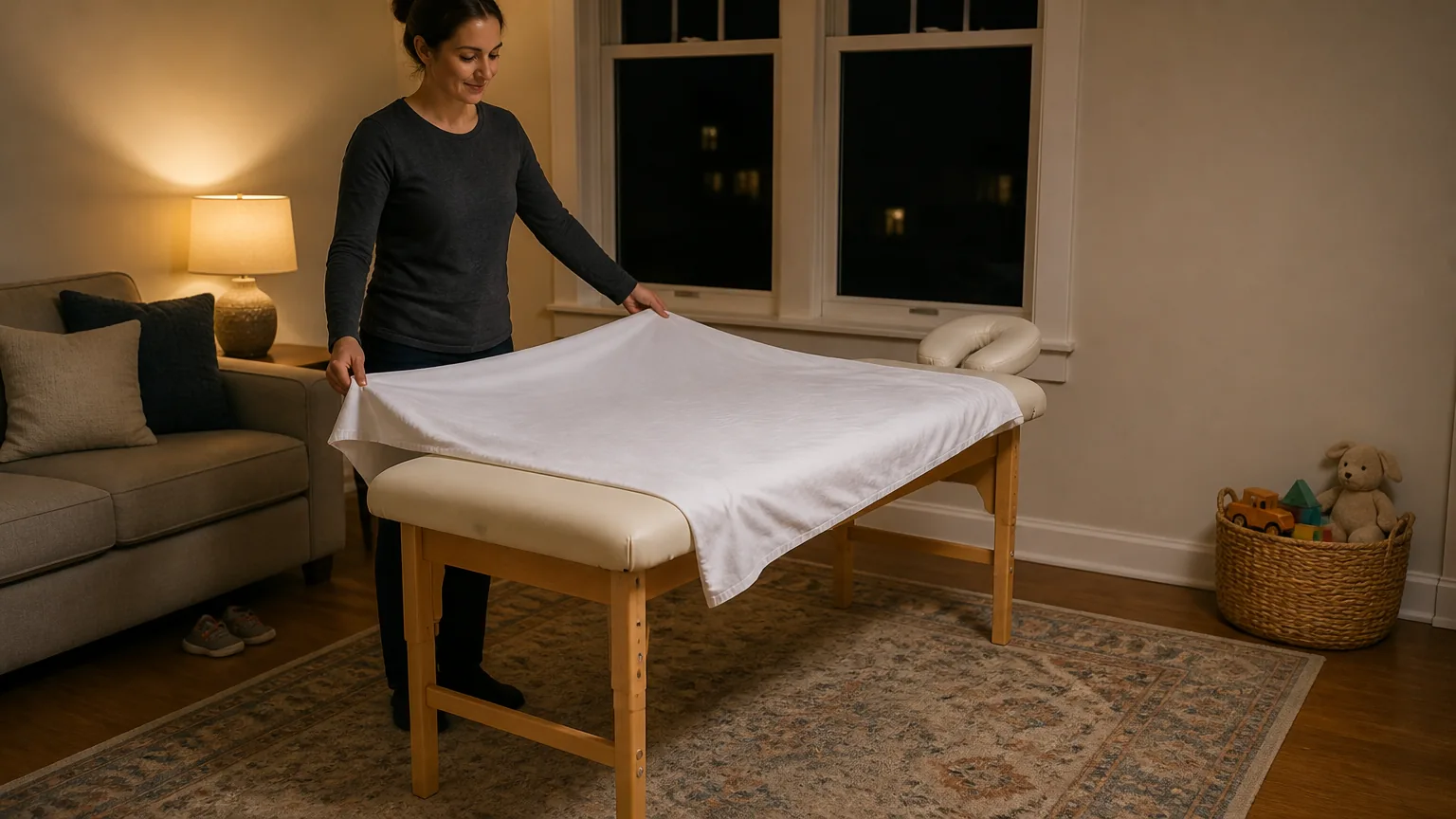
That turns into three practical decisions:
- Protect the windows parents can use. Weekday school hours and the hour or two after children’s bedtime are the slots a family household can actually book. If your inner zone is family-heavy, hold those slots for family clients rather than letting flexible clients fill them first.
- Ask who will be home. A house with children in it is a different treatment room. At booking, confirm that another adult will be looking after the children for the whole session and that nobody will wander into the room.
- Expect devices. Family homes are where you are most likely to find a baby monitor or an indoor camera running. Agree before the client undresses what is switched off, using the approach in our guide to phones, cameras and smart speakers in a client’s home.
To find family-heavy areas, the same five-year ACS data also report how many households in each ZIP Code Tabulation Area include children under 18. A ZIP that ranks high on both income and children at home is the closest the fact sheet comes to an ideal client profile for home visits.
Men Book Massage Too, Whatever the Website Photos Suggest
AMTA’s survey found men slightly more likely than women to have had a massage in the past year, 23 percent against 19 percent. Treat the direction with care. In a poll of about 1,000 adults, a four-point gap between men and women is within the range chance can produce, and an analysis of the 2012 federal health survey by Sundberg and colleagues, covering more than 34,000 adults, found the opposite: people who had used a massage practitioner in the past year were more likely to be women.
The safe conclusion is not that men outbook women. It is that men make up something like half the market, which is not how many massage websites read. Look at your own pages through the eyes of a skeptical man with a stiff back. If every photo is candles and petals and every service is named for pampering, you are writing to half your likely clients. The language of soreness, training, desk-bound necks and shoulders, and recovery speaks to both.
Marketing to everyone does not mean booking everyone sight unseen. The same screening applies to every new client, whatever their gender: a full name, a confirmed address, a booking confirmation in writing, and a check-in with someone who knows where you are, as set out in our personal safety protocol for mobile therapists. Whether a solo therapist may lawfully limit their book by gender is a separate question that turns on state law.
Why They Book: Write for Pain and Recovery, Not Pampering
AMTA’s consumer research is blunt about motive. Only 29 percent of the adults it surveyed believe massage is only a form of pampering, and 86 percent agree it should count as a form of health care. Asked the main reason for their last massage, 49 percent named health or wellness and 30 percent named stress. AMTA’s health and wellness group covers pain relief, soreness and stiffness, injury recovery, migraines, prevention, pregnancy and general well-being. Over the year to June 2025, 71 percent of massage consumers used massage for a health or medical reason.
The fact sheet adds detail. Among consumers who had discussed massage with a doctor or other provider, the concerns behind that conversation were led by soreness, stiffness or spasms (49 percent), relaxation and stress reduction (43 percent), chronic pain (42 percent) and injury recovery or rehabilitation (36 percent), with mental health support at 26 percent. AMTA’s web summary presents these as the top reasons people get massage, but the chart in the downloadable fact sheet labels them as the concerns that prompted a conversation with a provider, which is a narrower group.
The federal analysis splits motives differently but points the same way. Among massage users in 2012, 56.3 percent had used it mainly for general wellness or disease prevention, and 41.9 percent for a specific health problem, usually musculoskeletal.
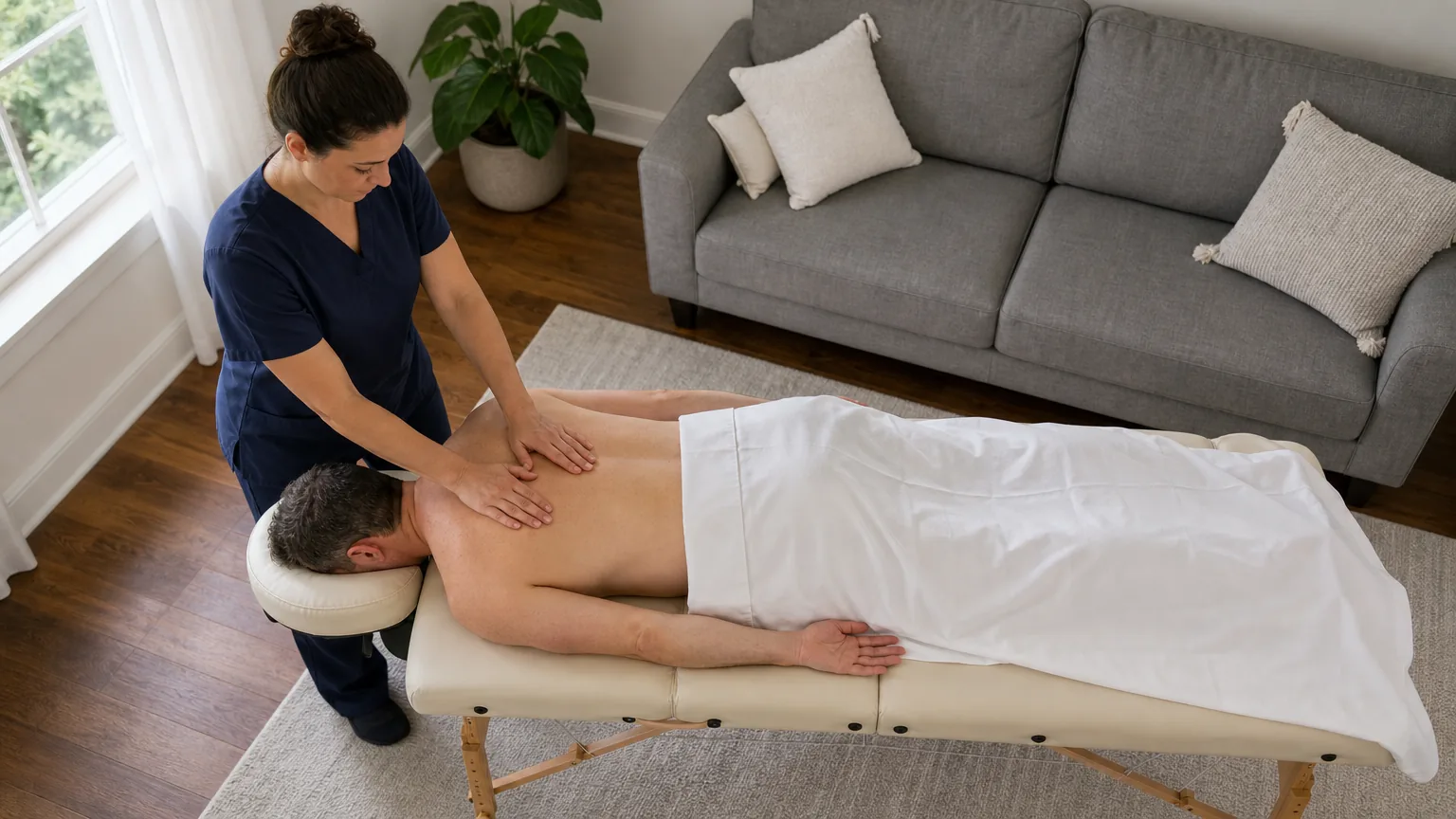
For a mobile practice, this changes the service page. Lead with the problems people actually bring: stiffness after a week at a desk, soreness after training, a back that has not felt right since a fall, stress that settles in the shoulders. Then make the case for home visits problem by problem. A client who is sore, injured or living with chronic pain gains the most from not driving home afterward, because the session ends where they can rest.
Stay inside the lines while you do it:
- Describe what massage does, not what it cures. Scope of practice and advertising rules vary by state, so check what your board allows before you put a condition’s name on a service page.
- Screen the clinical clients harder. The pain and injury clients this marketing attracts are the ones most likely to need a physician’s clearance before you work: a recent fracture or surgery, calf pain or swelling that could be a blood clot, new numbness or weakness, pain with fever or unexplained weight loss, or active cancer treatment. Do not assume the doctor already knows about the massage. In the 2012 federal data, 59.1 percent of massage users had not told their health care provider. Our guide to neck pain, red flags and desk workers shows what that screening looks like for one common complaint.
- Insure for the work you advertise. Professional liability insurance is non-negotiable for every practicing therapist, and a menu built around injury and pain raises the stakes. Confirm in writing that your policy covers treatment in clients’ homes.
The mental health figure needs the same care. Massage can help a client relax, but it is not treatment for depression or anxiety, and a page that implies otherwise invites a scope complaint.
Where the 37 Percent Leaves Room
The fact sheet’s therapist data deflate one assumption: home visits are not a niche. Thirty-seven percent of therapists said they work in clients’ homes, second only to their own office at 40 percent, and a therapist can work in more than one setting. Consumers rank the home lower. In the fact sheet’s chart of top locations for massage, the client’s own home or the home of someone they know scored 19 percent, behind a therapist’s office (41 percent), a spa (39 percent) and a franchise or chain (27 percent), and level with hotels, resorts and cruises.
The two figures come from different surveys and cannot be compared directly, but together they say something useful. Plenty of therapists already offer home visits, and the on-demand apps add more, so being mobile is not a selling point on its own. Most massage still happens somewhere else, though, which means the biggest pool of potential home clients is people who currently drive to an office, a spa or a chain. You win them by being specific about whom home visits suit: the parent who cannot get out, the client in pain who should not drive afterward, the desk worker who wants an evening slot with no commute at either end.
Frequency sets the scale of the job. AMTA’s consumers averaged 2.7 massages in the past year. A practice built on occasional buyers needs a great many households inside its inner zone. A practice built on regulars needs clients with a standing reason to come back, which is the pain, recovery and stress group described above, and it competes on continuity: the same therapist, who already knows the client’s history, every visit.
Your own background is a map as well. Eighty-two percent of therapists in AMTA’s data said massage was not their first career. A former teacher knows where the young families are. A former personal trainer knows the runners and lifters. A former nurse understands post-surgical clients and the clearance conversation that comes with them. Start your inner zone’s outreach where you already have credibility.
A Five-Step Plan From the Numbers
Put together, the figures reduce to five moves you can make this month.
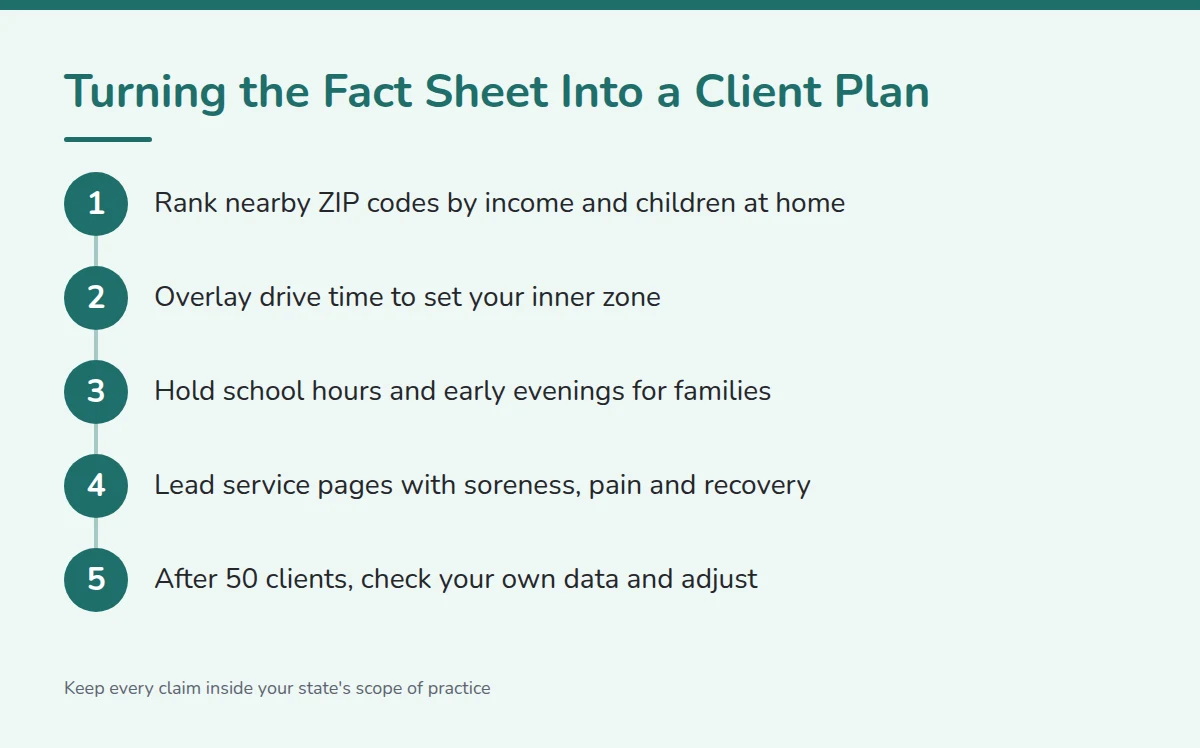
- Rank your ZIP codes. Pull median household income and the share of households with children for every ZIP code within an hour of home from the ACS five-year estimates, and sort them.
- Overlay drive time. Mark which of the top-ranked ZIPs fall inside a short drive of where your day starts. That overlap is your inner zone, and everything else gets a travel fee tier or a minimum session length.
- Protect the family windows. Hold weekday school hours and early evenings for family households in your inner zone.
- Rewrite the service page. Lead with soreness, stiffness, recovery and stress, in the words a client would use, and keep every claim inside your state’s scope of practice.
- Check your own data. After your first 50 clients, tally where they live, whether they have children at home and why they booked. Where your book differs from the fact sheet, trust your book.
The fact sheet describes the country. Your intake forms describe your streets. Use the first to decide where to start and the second to decide where to stay.
Sources
- American Massage Therapy Association with its 2026 fact sheet on who gets massage by income, gender and children at home and its consumer survey on why people book and how they view massage
- National Center for Complementary and Integrative Health on how many U.S. adults used massage therapy in 2022
- Sundberg and colleagues for the national survey analysis of who uses massage practitioners, and why
- U.S. Census Bureau with national median household income for 2024 and when to use five-year ACS estimates for small areas
- Office of the U.S. Surgeon General on how parents’ stress compares with that of other adults
Further reading
- Soothe, Zeel, or Your Own Book? A Mobile Therapist’s Guide to Platform vs Independent Work
- State Licensing and Scope of Practice: A Mobile Therapist’s Compliance Guide
- Launching a Mobile Massage Business From Scratch: Your First Year Roadmap
- Mobile Massage Prices: What an In-Home Massage Costs Near You, by State, City and Type
- Teaching Infant Massage in the Family Home: Scope, Safety, and the Newborn Niche