Soothe, Zeel, or Your Own Book? A Mobile Therapist's Guide to Platform vs Independent Work
Published on September 2, 2026

The Question Underneath the Question
Newly licensed therapists usually frame this as a choice between two business models. It is really a choice about which scarce resource you are short of. Platforms sell you demand and charge you margin. Independent practice hands you the margin and charges you the work of creating demand yourself. Whichever one you pick, you pay. The only useful question is which currency you can afford this year.
That framing matters because the honest answer changes over a career. A therapist six weeks out of school with no reviews, no website and an empty calendar is short of demand, and a platform solves a real problem. The same therapist three years later, turning away repeat requests because the app keeps routing them to somebody else, is short of margin and control. Most of the therapists I know who are happy with their working lives passed through both stages deliberately rather than getting stuck in the first one.
What the Platform Actually Keeps
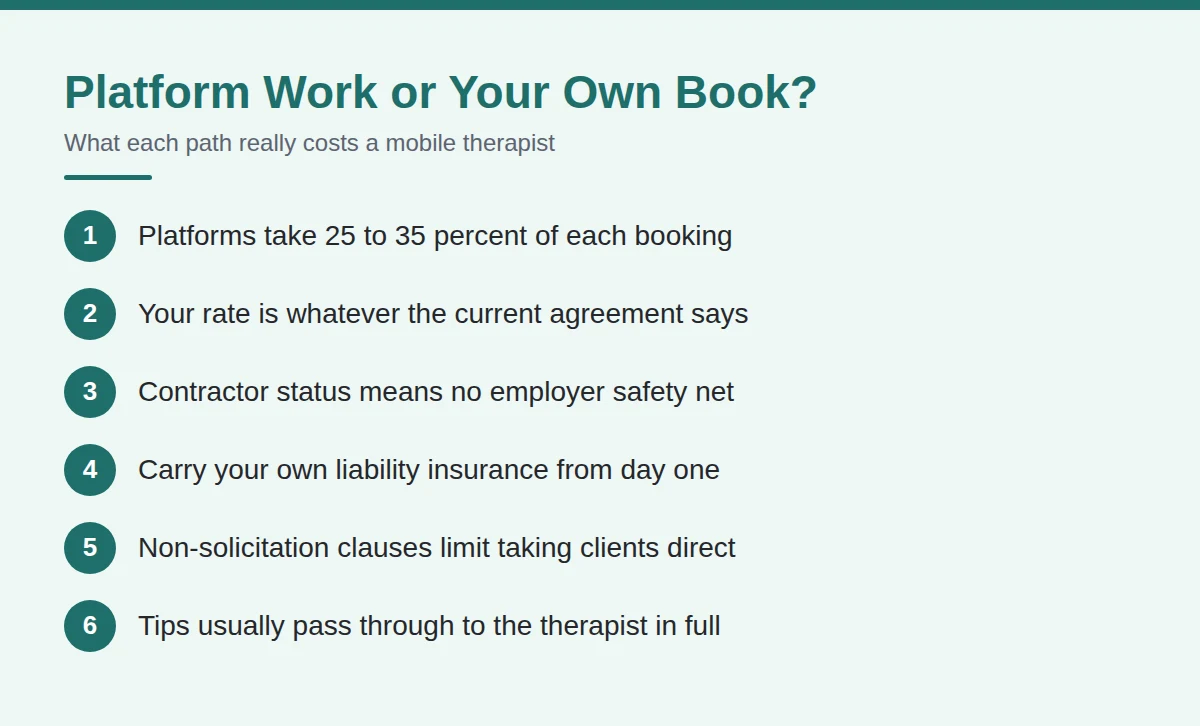
Start with the number nobody puts on the recruitment page. On-demand booking platforms take a commission on every session, and practitioners working across several of them report the band landing somewhere between 25 and 35 percent of what the client pays. James Thompson, a remedial massage specialist working between Edinburgh and Glasgow, put it plainly: once he factored in travel time, equipment costs and taxes, his real take-home on platform bookings was sometimes less than minimum wage for highly skilled therapeutic work.
Published splits move around, so do not trust a number you read on a forum, including this one. The rate that governs your income is the one in the provider agreement you are being asked to sign this month, and it can change with an emailed policy update. Read it before you read anything else.
Then run the door-to-door math on a session you would actually accept. Take a 60-minute in-home appointment where the client pays 150 dollars. At a 30 percent commission you are paid 105. Now add the parts of the job the clock does not count: 20 minutes of driving each way, 10 minutes hauling and setting up the table, 10 minutes breaking it down and getting back to the car. That is roughly two hours of your day for 105 dollars, or about 52 an hour before fuel, parking, linens, laundry, oil, insurance premiums and self-employment tax. It is not a bad wage. It is also not the number on the app.
The same two hours booked independently at 130 dollars plus a 20 dollar travel fee pays you the whole 150, minus card processing of roughly three percent. The difference per session is about 45 dollars. At twelve sessions a week that is a little over 28,000 dollars a year, which is the real price of the demand the platform is providing. If your own marketing can fill those twelve slots for less than that, the platform is costing you money. If it cannot, the platform is earning its cut. Our breakdown of how mobile massage services are priced shows what independent rates the market actually supports in most metros, which is the input that decides the comparison.
One thing platforms usually do get right: tips pass through to the therapist in full. Do not let a good tip policy distract you from a bad commission.
Who Controls the Schedule, the Price, and the Client
Money is the visible difference. Control is the one that decides whether you can still do this at 55.
On a platform you do not set the session price, the length options, the modality list, the cancellation window or the refund policy. You accept or decline requests inside a system that quietly scores you for accepting, and acceptance rate, response time and star average feed algorithms that decide how much work you see next week. Declining a 9pm booking 40 minutes across town is your right, and it may still cost you visibility. Deactivation, when it comes, often arrives without a hearing.

You also do not own the client. The person on your table is the platform’s customer, matched to you this time and to somebody else the next. You cannot text them a reschedule, cannot build a rebooking rhythm, and in most cases cannot legally invite them to book you directly.
Independent practice inverts every one of those. You choose your service radius, your minimum booking length, your surcharge for evenings, your late-cancellation policy and which modalities appear on the menu at all. That freedom is why the service menu guide is a business decision rather than a clinical one. It also means an empty Tuesday is entirely your problem.
The Liability Gap a Brooklyn Lawsuit Made Visible
In August 2022 a New York woman sued Soothe Inc. and Evident ID, the vendor that performs the platform’s identity verification and criminal background checks, after she was allegedly raped by a therapist the app dispatched to her Brooklyn home on Valentine’s Day. The complaint accused both companies of negligence and negligent hiring, retention and supervision. The man had reportedly worked under a false name, and her attorney said he had previously been arrested for assaulting another Soothe customer. Soothe’s public response described its therapists as “independent contractor therapists using our app.”
That phrase is the whole legal architecture in five words, and every therapist on a platform should understand what it means for them. Marketplaces are structured so the practitioner is a contractor, not an employee. When something goes wrong, the fight is about whether the company owed anyone a duty at all, and the practitioner sits outside the employer protections a spa job would carry: no workers’ compensation if you are hurt, no unemployment cover if you are deactivated, and no employer liability policy standing behind you if a client makes a claim.
Whatever coverage a platform advertises exists primarily to protect the platform and its customers. Carry your own professional liability and general liability insurance, in your own name, at full limits, from your first session on any app. This is not optional and it is not something to add later once the work is steady.
The safety exposure runs both directions, and the client-facing failure in that lawsuit does not exempt you from your own screening. An app booking hands you a first name and an address you have never seen, with no phone contact beforehand and no colleague in the building. Everything in the personal safety protocol for mobile therapists applies to a platform job exactly as it does to a cold inquiry: confirm the address in daylight, tell somebody where you are, keep your phone on you, and leave the moment a session turns. You are always allowed to end an appointment. An app rating is not worth your safety.
What Platform Work Is Genuinely Good For
Used deliberately, platform work is a decent apprenticeship, and it is the closest thing this profession has to paid reps under real conditions.
Volume builds hands. New therapists need hundreds of sessions on unfamiliar bodies in unfamiliar rooms before their assessment and pacing become automatic, and an app supplies that faster than any other route. You also learn the logistics that classroom hours skip entirely: what a walk-up with no lift does to your back, how long a real setup takes, which neighbourhoods eat your afternoon in traffic.

It is market research you get paid for. After sixty bookings you know which postcodes book most, what people ask for, which hours actually fill and what the local ceiling on price feels like. That intelligence is exactly what you need to price an independent practice, and most people guess at it instead.
It is also a legitimate source of word of mouth, as long as you keep it clean. You cannot poach the platform’s client, but you have no obligation to hide that you exist. A card with your own business name, given when someone asks who you are, is the referral engine. Their neighbour, their colleague and their sister were never the platform’s customers.
Read the Clause About Taking Clients With You
Before you plan any transition, find the non-solicitation language in your provider agreement and read it twice. Most on-demand marketplaces prohibit soliciting platform clients for direct booking, some for a defined period after you leave, and some claim any client first matched through the app indefinitely.
Comply with it. The reputational and legal downside of a solicitation dispute is far worse than the year it costs you to build a book cleanly, and the therapists who get burned are usually the ones who assumed nobody was watching. Build the independent side from sources the platform has no claim to: your own local search presence, community events, referral partners such as gyms and chiropractic clinics, corporate contacts, and the friends and family of people who found you on the app and asked. The marketing playbook for mobile therapists is written for exactly this position, where you need clean demand and do not yet have a brand.
A Staged Plan for Coming Off the Apps
Nobody should quit a platform in one move. Overlap the two for as long as it takes, and treat the transition as four stages rather than a date.
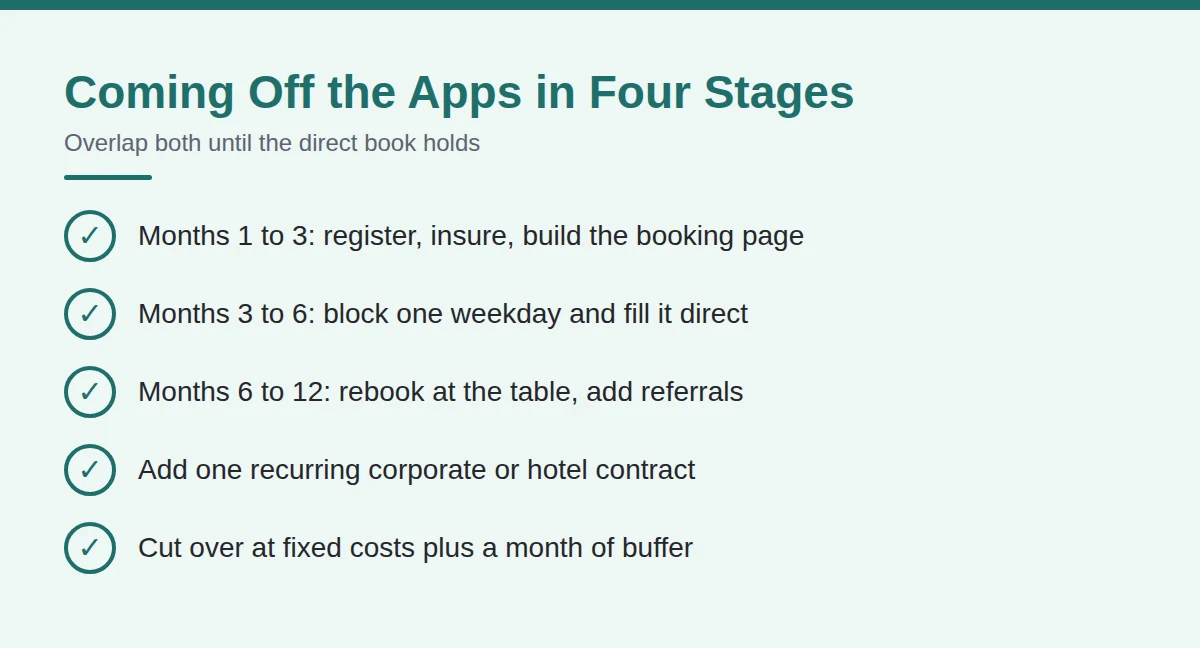
Stage one, months one to three: infrastructure while the app pays the rent. Register the business, get your own insurance in force, claim and complete a Google Business Profile as a service-area business, and stand up a one-page site with your licence details, modalities, service area and a real booking link. Set your independent price now, at what you intend to charge rather than a discount, and put your intake and health-history forms in place. The first-year roadmap for launching a mobile practice covers this stage in detail.
Stage two, months three to six: fill one day a week direct. Pick a single weekday, block it from the app, and treat filling it as your target. One day is enough to test whether your rate holds, whether your booking flow works and whether you can generate demand at all, without risking the income that pays your bills.
Stage three, months six to twelve: build the compounding sources. Rebooking at the table is the highest-leverage habit in the business, because a client booked before you leave the house costs nothing to acquire. Add a referral offer, then add one B2B relationship, because a single recurring corporate or hotel contract fills more hours than months of residential marketing. Our guide to on-site and corporate contracts explains how those are quoted and what procurement will ask you for.
Stage four: cut over when the direct book covers your fixed costs plus a month of buffer. Not when you are annoyed with the app. That is the only threshold worth using, and it is worth writing down in advance so a bad week does not make the decision for you.
Which Path Fits Where You Are Right Now
If you are newly licensed with no book and no local reputation, take the platform work, carry your own insurance, keep meticulous records of your hours and earnings, and start stage one in your first month rather than your second year. If you have been on apps long enough to recognise the commission as the largest line item in your business, the transition is overdue and the staged plan above is the low-risk version of it. If you are already independent and quiet, a platform is a reasonable way to fill gaps without discounting your own rate, which is the more expensive mistake.
Whichever path you take, licensing, scope of practice and insurance obligations are yours personally. A marketplace does not hold your licence for you, and it will not be standing next to you at a board hearing. The therapists who come through the app era with a career intact are the ones who treated platform work as a channel, and never as an employer.
Sources
- NBC News on the negligence suit filed against Soothe and its background-check vendor
- ABC7 New York for how the platform responded and what its contractor vetting claims covered
- London Post with therapist accounts of 25 to 35 percent platform commissions and the marketing burden of going solo
- PRLog on an independent mobile and in-call practice launching across Greater London
- Issuewire for a premium on-demand mobile massage and nails operator building direct in Miami
Further reading
- Launching a Mobile Massage Business From Scratch: Your First Year Roadmap
- The Complete Marketing Playbook for Mobile Massage Therapists
- Understanding the Price Range of Mobile Massage Services
- Personal Safety for Mobile Massage Therapists: A Comprehensive Protocol
- From Massage School to Licensed Mobile Therapist: The Complete Career-Entry Guide