State Licensing and Scope of Practice: A Mobile Therapist's Compliance Guide
Published on August 9, 2026

Compliance Looks Different When the Practice Travels
A therapist working in a clinic inherits most of their compliance from the building. Somebody else pulled the business license, somebody else confirmed the zoning allows a massage establishment, and the license on the wall matches the address on file with the board. A mobile therapist inherits none of that. You are the establishment, the address changes every ninety minutes, and every regulatory assumption baked into the clinic model has to be rebuilt deliberately.
That is not a reason to avoid mobile work. It is a reason to know exactly which rules apply to you, because the ones that bite mobile practitioners are rarely the obvious ones. Nobody loses a license for forgetting the MBLEx. They lose it for practicing three miles over a municipal boundary that requires its own permit, for a website sentence that reads as a medical claim, or for letting a renewal lapse while the calendar stayed full. This guide is the day-to-day reference for an already-licensed therapist: where your authority comes from, where it stops, and what changes when you drive.
Your Authority Comes From a Practice Act, Not a Diploma
Massage therapy in the United States is regulated at the state level through a massage therapy practice act. That statute defines who may practice, what services fall inside the profession, and which agency oversees licensure. Most states run this through a dedicated board of massage therapy, though some place it under a health department or a broader professional-licensing agency. The practice act and its accompanying regulations set education hours, examination requirements, sanitation standards, professional conduct rules, and continuing education obligations.
The practical consequence is that training and legal authority are two different things. A weekend certification in a technique gives you skill. It does not automatically give you permission, because permission comes from what your state’s statute allows a licensed massage therapist to do. As Massage Magazine puts it in its scope-of-practice explainer, a therapist may study pain science, movement, or nutrition, but interest alone does not establish the right to practice another profession.
Alongside your legal scope sits your scope of competence, which is the narrower and more honest question: am I qualified to deliver this safely for this client today? Legal permission is the ceiling. Competence is where you should actually be working.
Verify Your Own State Board Before You Trust Any Summary

Every compliance article on the internet, this one included, is a starting point rather than an authority. The only binding source is your state board’s own published rules. Find the board’s official site, which is almost always a .gov domain, and locate three things: the current practice act text, the license renewal page with its exact cycle and fee, and the public license-lookup tool.
Read the practice act at least once. It is shorter than you expect, usually well under an hour of reading, and it is the document a complaint would be judged against. Bookmark the renewal page rather than relying on the board to email you, since board notices are notorious for landing in spam or going to an address you changed three years ago.
State chapters of the American Massage Therapy Association are a useful second channel. AMTA runs 51 volunteer-led chapters covering every state and the District of Columbia, and chapter leadership tracks pending legislation and rule changes in that jurisdiction closely. When a practice act is being amended, the chapter usually knows before the newsletter does.
Scope of Practice Decides What You Can Offer in a Living Room
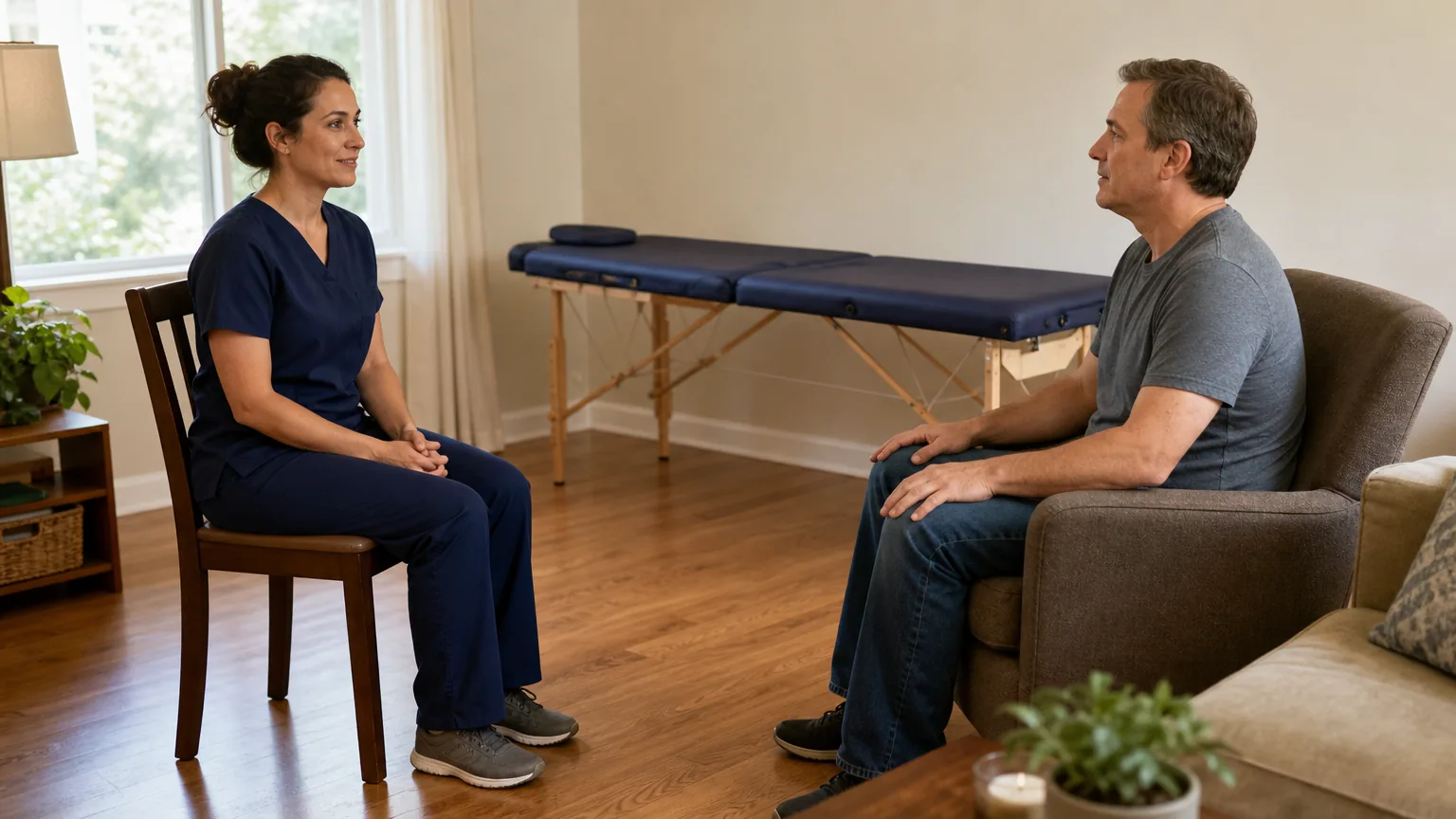
Scope determines your service menu more directly than client demand does. Licensed massage therapists work with soft tissue, comfort, relaxation, mobility, and body awareness. Across essentially every jurisdiction, therapists cannot diagnose conditions, prescribe medication or supplements, tell a client to stop care from a physician or physical therapist, claim to cure disease, or perform spinal adjustments, joint manipulation, dry needling, or any invasive procedure without a separate license authorizing it.
Those limits do not soften because you are in someone’s home. If anything, the in-home setting invites more scope pressure, because the informality of a living room encourages clients to ask questions they would not ask across a clinic reception desk. When a client points at a hip and asks whether it is sciatica, the compliant answer is a version of: I cannot diagnose that, we can work the soft tissue around your low back and hips today, and if the pain continues or limits your movement a medical evaluation is the right next step.
Referral is the other half of scope. Pause the session and refer out for calf swelling with heat, shortness of breath, dizziness, fever, sudden numbness or weakness, unexplained severe pain, or recent surgery without clearance. Document what you observed and what you recommended. That record protects the client first and you second. When you are deciding which modalities to add, our modality-by-modality service menu guide covers what each one demands in training before you advertise it.
The Language Test: Facilitating, Not Fixing
Most scope violations that reach a board arrive through marketing copy rather than hands-on work. “I’ll fix your sciatica” is a promise you have no authority to make. “We can focus on the muscles around your low back and hips to support comfort and ease tension” describes the same session and stays inside scope.
Apply the same standard to every public surface: website, booking page, service descriptions, social posts, and printed cards. “Massage for relaxation and muscle tension” is defensible. “Treatment for herniated discs, migraines, and nerve pain” invites a complaint. Advertising rules are set at state level and several boards have disciplined therapists over implied medical claims. The positioning chapter of our marketing playbook for mobile therapists works through how to be specific and compelling without drifting into treatment language.
Crossing County and State Lines
Two separate layers apply once you drive, and mobile therapists routinely miss the second one.
The state layer is licensure. Your license authorizes practice in the issuing state only. There is no national massage license and no automatic nationwide reciprocity. Some states offer licensure by endorsement or reciprocity for therapists holding a license in a state with comparable requirements, but the terms vary widely, and several states will require additional hours, a jurisprudence exam, or a fresh application regardless of how long you have practiced. If your service area touches a border, or you are relocating, apply in the second state before you accept a single booking there. Processing frequently takes weeks.
The local layer is municipal. Many cities and counties impose their own massage establishment permits, practitioner permits, background checks, or business licenses on top of state licensure. AMTA’s own career guidance flags this explicitly, directing therapists to meet the requirements of their state or municipality. For a mobile practice, the question is which jurisdiction’s rules apply at the client’s address, not yours. Map your service radius against the municipalities it covers and check each one. This is dull work you do once, and it is far cheaper than a cease-and-desist.
Home-Business Zoning and the Address on File
Even if you never treat a client at home, your residence is usually your business address of record, and that carries zoning implications. Most residential zoning permits a home occupation limited to administrative work with no client visits, no signage, and no additional traffic. Storing a table, running the booking software, and doing your paperwork from a spare room is nearly always fine. Treating clients there generally is not, without a home-occupation permit and sometimes an establishment permit.
Keep the boundary clean and keep the address on file with the board current, because a mismatch between your licensed address and your actual operating base is an easy administrative violation to trip over. Business structure and insurance decisions sit alongside this, and our first-year roadmap for a new mobile practice covers how they fit together.
The Unlicensed Bodywork Question

Most practice acts carve out exemptions for modalities that are not massage: energy work such as Reiki, certain movement or somatic education traditions, and in some states specific structural or Asian bodywork disciplines. The exemptions are narrow and jurisdiction-specific, and they exist to define what falls outside the act, not to create a parallel unlicensed route into hands-on soft tissue work.
For a licensed therapist the risk runs in a particular direction. If you hold a license and also offer an exempt modality, regulators will generally treat everything you do under your professional identity as within the board’s reach. Describe each service accurately, keep exempt modalities clearly labelled and separately documented, and confirm with your liability carrier that they are covered. Blurring the two is how a therapist ends up defending a technique that their license never authorized.
Renewals, CE, and the Public Record
Renewal cycles run one to two years depending on the state, with continuing education hour requirements attached and frequently a mandated ethics component. Two rules keep this from becoming a crisis. First, verify that a course is accepted by your board before you pay for it, since approval requirements differ and an unaccepted course is wasted money and wasted hours. AMTA vets its online CE catalog against state requirements, and state chapters run in-person classes that count. Second, build a compliance calendar with the renewal date, the CE deadline, and your insurance renewal on it, set a reminder ninety days out, and keep every completion certificate in one folder.
Choose CE that does double duty where you can. Courses on body mechanics and injury prevention satisfy hours while extending your working life, which matters more in mobile practice than in clinic work. Our guide to self-care and injury prevention on the road covers why that trade is worth making deliberately.
Finally, treat public verifiability as an asset rather than a burden. Every state board publishes a license-lookup page showing current status and disciplinary history, and national directories such as AMTA’s Find a Massage Therapist locator give clients an independent way to confirm you are a member in good standing. Clients letting a stranger into their home have every reason to check, and the therapists who benefit most from that habit are the compliant ones. Check your own record annually for accuracy. As our personal safety protocol discusses, the same verification systems that expose bad actors are what make your good standing findable.
Compliance is not a phase you complete. It is a short annual loop: reread the act when it changes, confirm the municipalities you serve, renew on time with accepted CE, keep your advertising honest, and keep your record clean. Done once a year, it takes an afternoon. Skipped, it is the fastest way to lose a practice you spent years building.
Sources
- Massage Magazine on what massage therapists can and cannot legally do
- American Massage Therapy Association for meeting your state or municipality’s practice requirements
- AMTA with 51 state chapters running local CE and legislative advocacy