Low Back Pain and In-Home Massage: What the Guidelines Actually Support
Published on September 18, 2026
The Client Who Read the Headline
Low back pain is the single most common reason anyone books a mobile massage. It is also the reason a growing number of clients now arrive sceptical, because in March 2025 a large review landed in the press under headlines announcing that only about one in ten non-surgical treatments for back pain actually beat a placebo. Plenty of people read that, decided the whole field was theatre, and booked anyway because their back still hurts.
That client deserves a straight answer rather than a sales pitch. The good news for anyone giving one is that the straight answer is better than the headline suggests, and considerably narrower than most massage marketing claims.
What the 2025 Review Actually Found
The study behind those headlines pooled 301 randomized trials covering 56 different non-surgical treatments, all compared against placebo or sham. The authors found one efficacious treatment for acute low back pain (non-steroidal anti-inflammatory drugs) and five for chronic low back pain (exercise, spinal manipulative therapy, taping, antidepressants, and TRPV1 agonists), with small effect sizes and moderate certainty. A handful of treatments were shown not to work: exercise for acute pain, glucocorticoid injections, paracetamol, antibiotics, anaesthetics.
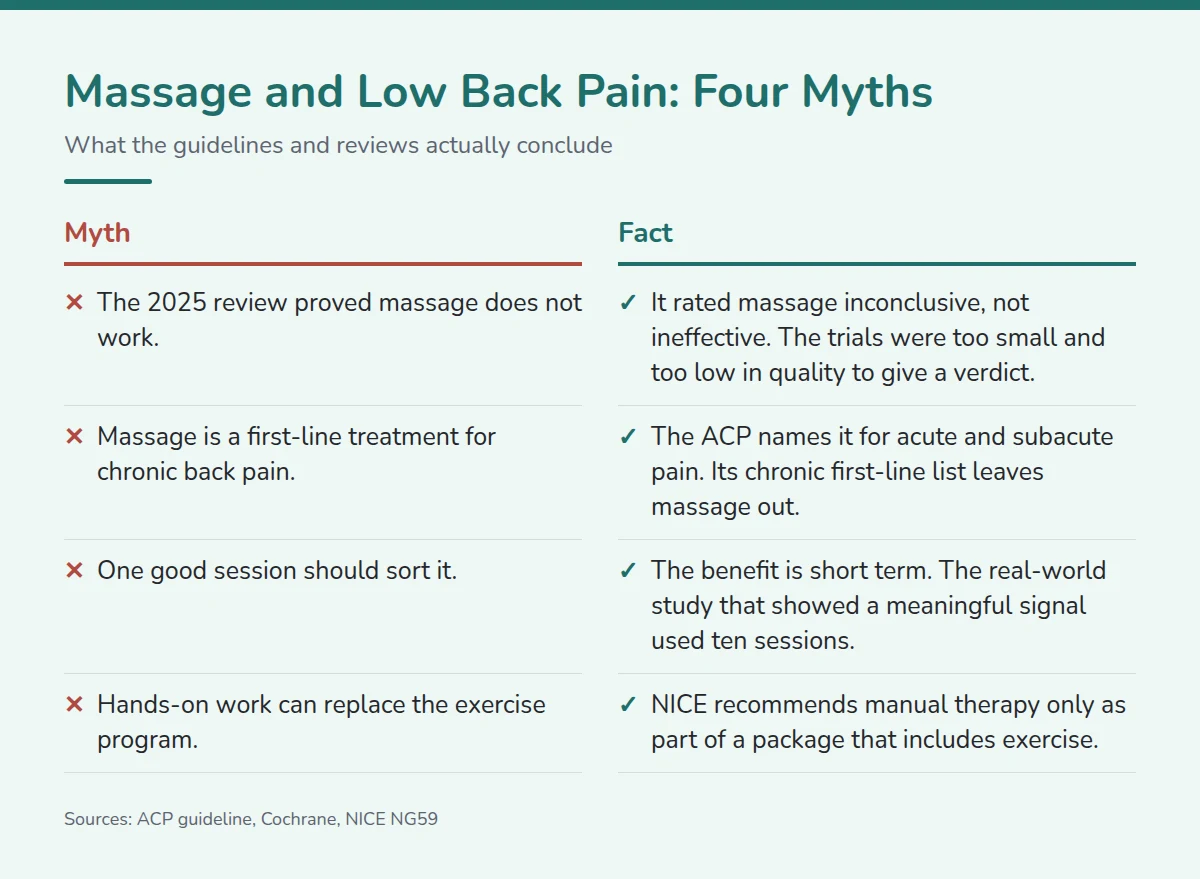
Everything else, massage included, landed in a third bucket the headlines skipped entirely. The evidence was rated inconclusive, meaning the trials were too small, too imprecise, or too low in quality to give a verdict either way. That is a meaningfully different finding from “it does not work.” It is closer to “nobody has run a trial good enough to tell you,” which is an indictment of the research funding in this field rather than of the hands doing the work.
Where Massage Sits in the ACP Guideline
The American College of Physicians published the guideline most US clinicians still work from, and it is unusually friendly to manual therapy. For acute and subacute low back pain, the ACP recommends starting with non-drug treatment, and names superficial heat, massage, acupuncture, and spinal manipulation as the options. That is a strong recommendation, which matters, because the ACP issued it while openly rating the underlying evidence for massage as low quality. The reasoning is that most acute back pain improves on its own regardless of treatment, so the sensible first move is the one least likely to hurt you.
Read the second recommendation and the picture changes. For chronic low back pain, the ACP’s first-line list runs to exercise, multidisciplinary rehabilitation, acupuncture, mindfulness-based stress reduction, tai chi, yoga, motor control exercise, progressive relaxation, biofeedback, low-level laser, operant therapy, cognitive behavioural therapy, and spinal manipulation. Massage is not on it.
The evidence review underneath the guideline explains why. Across the nonpharmacologic options, the magnitude of pain benefit was small to moderate and generally short term, and the effects on function were consistently smaller than the effects on pain. A therapist who quotes the acute recommendation without mentioning that the chronic list leaves massage out is telling half the story, and chronic pain clients are the ones most likely to have already read the other half.
The Cochrane Verdict, Read Honestly
Cochrane’s dedicated review of massage for non-specific low back pain, updated by Furlan and colleagues, pooled 25 trials with 3,096 participants. Against inactive controls, massage improved both pain and function in subacute and chronic cases in the short term, with a moderate to large effect on pain. Against active treatments such as exercise or physical therapy, massage was better for pain at both short and long follow-up, though it made no difference to function. The long-term advantage over doing nothing disappeared.
The reviewers’ own summary sentence is the one worth memorising: they have very little confidence that massage is an effective treatment for low back pain, and the improvements they did find were short term. They downgraded the evidence for risk of bias and imprecision, mostly because you cannot blind anyone to whether they are being massaged. Our guide to reading massage research covers why that blinding problem caps the quality rating of almost every study in this field.
One finding in that review gets less attention than it deserves. Adverse effects were minor. A 2025 Cochrane overview of 31 reviews, covering 644 trials and more than 97,000 adults with low back pain, found no measurable safety difference between massage and usual care. A treatment with small short-term benefits and a clean safety record is a reasonable thing to try early, which is precisely the logic the ACP used.
Massage Plus Exercise Is the Shape That Works
The most useful framing comes from the UK’s NICE guideline on low back pain and sciatica, which tells clinicians to consider manual therapy, explicitly including soft tissue techniques such as massage, but only as part of a treatment package that includes exercise. Not instead of exercise. Alongside it.
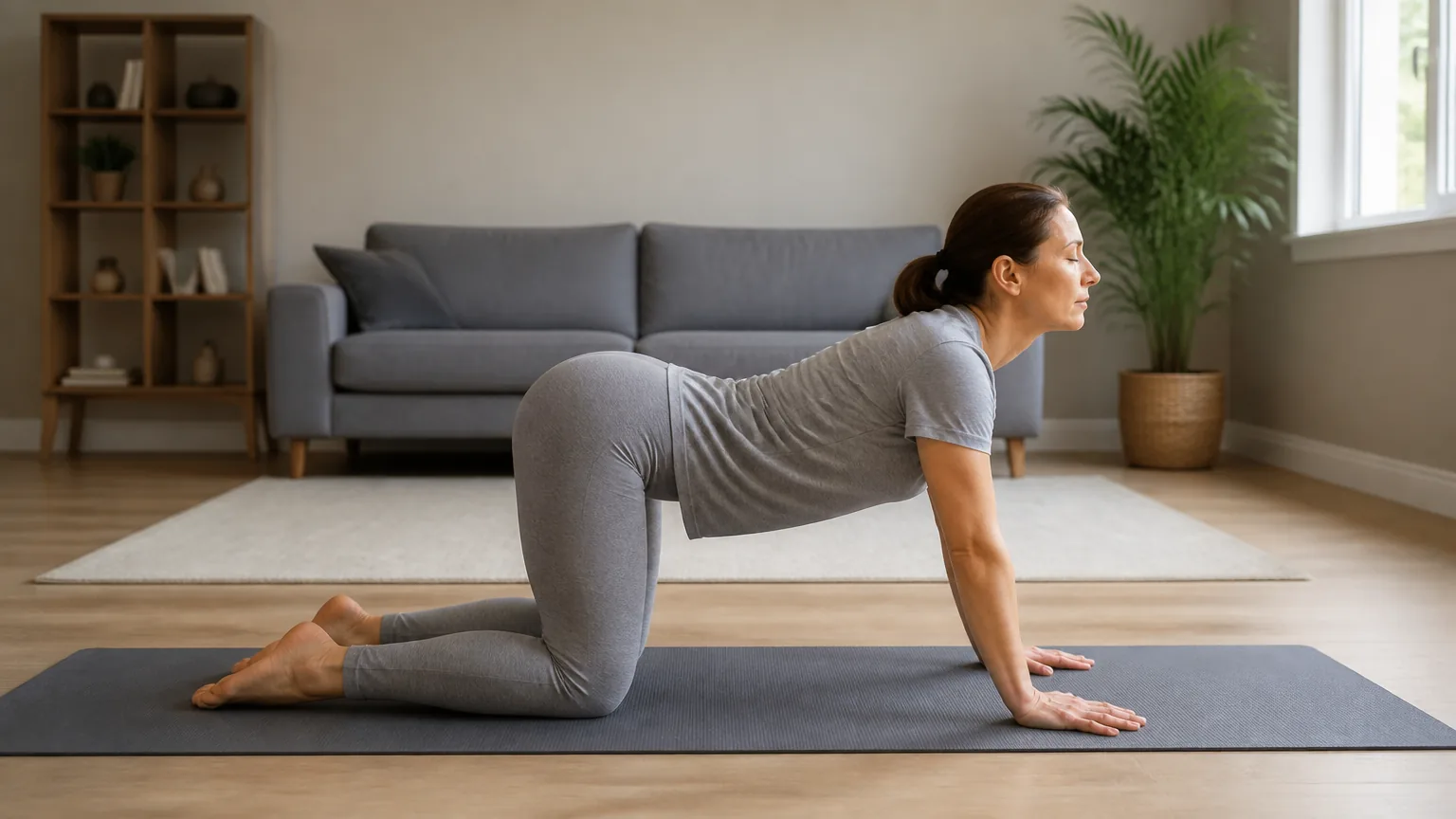
The research supports that framing. A 2025 systematic review in the Journal of Bodywork and Movement Therapies looked specifically at whether adding manual therapy to exercise beats exercise alone in chronic low back pain. Of ten qualifying trials, eight reported better short-term pain, function, or disability with manual therapy added, and two found no benefit. An umbrella review with meta-analysis, pooling 21 systematic reviews and 35,711 participants with chronic non-specific low back pain, found manual therapy outperformed comparison treatments on pain and disability in the short term, with the effect fading as follow-up lengthened.
So the defensible claim is narrow and genuinely useful. Hands-on work gives a real short-term reduction in pain and disability, it adds something on top of an exercise program, and it does not substitute for one. A therapist whose advice to a back pain client is “rest until it settles” is contradicting the evidence, which favours staying active. Reinforcing the exercise the client’s physiotherapist or doctor prescribed is part of the job.
How Many Sessions, Honestly
Clients want a number, and one study gives a defensible one. The Kentucky Pain Research and Outcomes Study sent 104 primary care patients with chronic low back pain to community licensed massage therapists for ten sessions each, then measured them at 12 and 24 weeks. Around half showed clinically meaningful improvement in bodily pain at 12 weeks, and 40 percent were still improved at 24 weeks. Of those whose disability scores improved meaningfully at 12 weeks, three quarters held that improvement at 24. Patients over 49 did better than younger ones.
Ten sessions is the honest expectation to set, not one. That has a practical consequence for a mobile practice: back pain work should be sold and booked as a course rather than a single visit, which means the cancellation and deposit terms on a multi-session block need to be written down before the first appointment rather than negotiated after a missed one.
What the Home Visit Protects
Sitting in a car is one of the higher-load positions a lumbar spine can be in, which makes driving home the single worst way to spend the thirty minutes after a back session. That window of loose, warm, slightly sleepy calm is the part clients most want to keep, and an in-home visit is the only format that lets them keep it. They stand up, walk to their own bed, and lie down.
The home setting has a second advantage specific to backs. You can set the table height to your own body rather than accepting a clinic’s, and if the client genuinely cannot get onto a table, you can work them side-lying on their own bed or seated in their own chair without turning it into a production. Our pain management guide covers positioning and pressure scaling across painful conditions in more detail. The physiology of why the post-session window feels the way it does sits in our explainer on how touch changes the nervous system.
What You Cannot Say About Discs and Sciatica
Back pain draws more scope-of-practice pressure than any other complaint, because clients arrive with a self-diagnosis and want it confirmed. Somebody points at a hip and asks whether it is sciatica, or whether a disc has slipped.
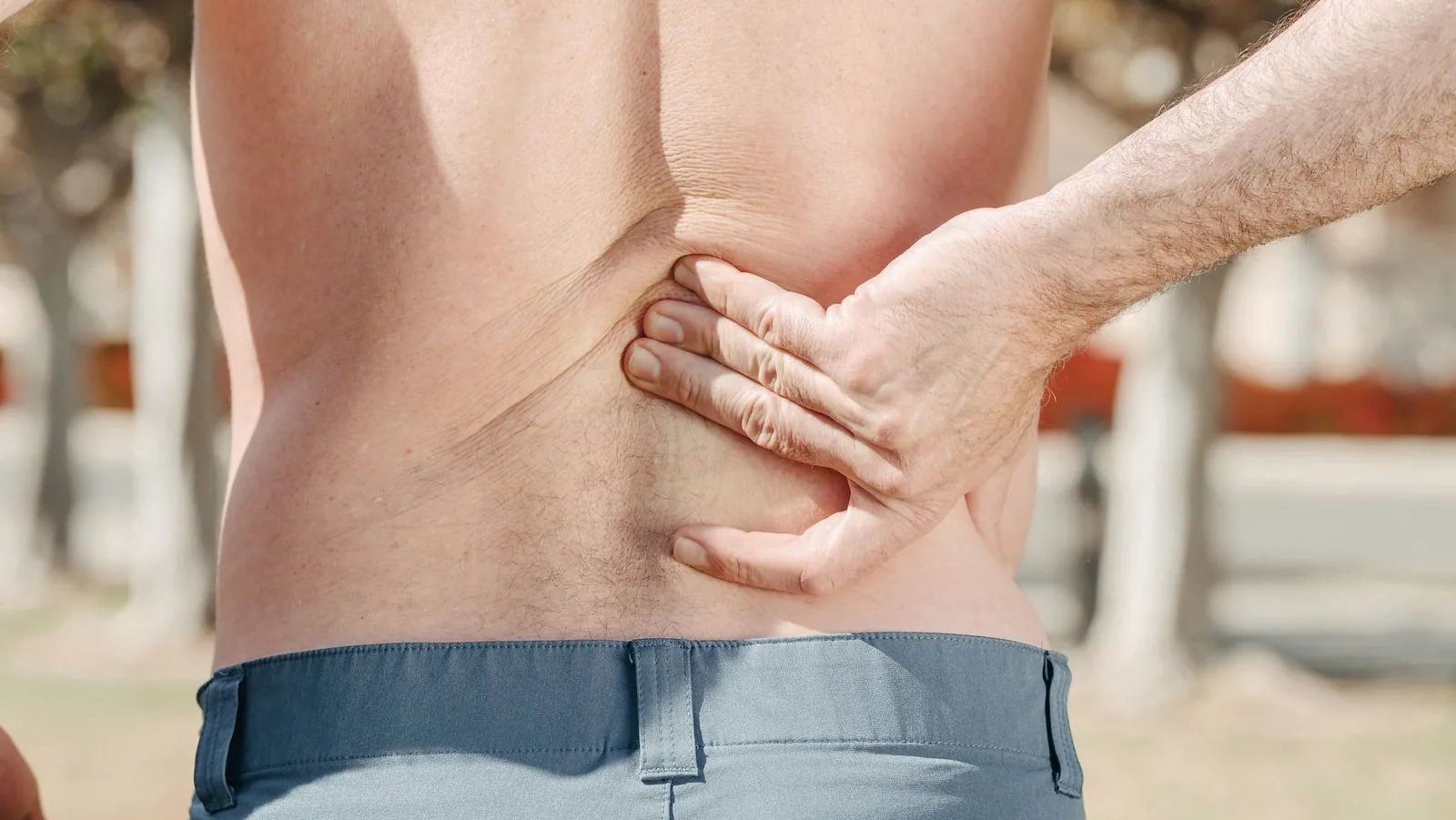
A licensed massage therapist does not diagnose, so the honest answer is that you cannot say. You cannot attribute leg pain to a disc, you cannot tell anyone which nerve root is involved, and you cannot claim that soft tissue work will resolve either. What you can say is what you are doing and what the evidence shows: you are working the muscles around the low back, hips, and glutes, that most people report short-term relief from it, and that persistent or worsening leg symptoms belong in front of a physician. Scope, title protection, and the line between licensed massage and unlicensed bodywork all vary by state, and our licensing and scope compliance guide explains how to verify yours.
Red Flags That End the Session
Most back pain is non-specific and benign. A small fraction is not, and the mobile therapist working alone in someone’s living room is sometimes the only person who will notice.
Stop and refer for physician clearance, urgently, if a client reports numbness in the groin or inner thighs, any new loss of bladder or bowel control, or leg weakness that is getting worse. That cluster suggests cauda equina syndrome, a surgical emergency in which compression of the lumbosacral nerve roots can cause permanent incontinence, sexual dysfunction, and paralysis if decompression is delayed much beyond 24 hours. It is rare. It is also the one you cannot afford to massage through.
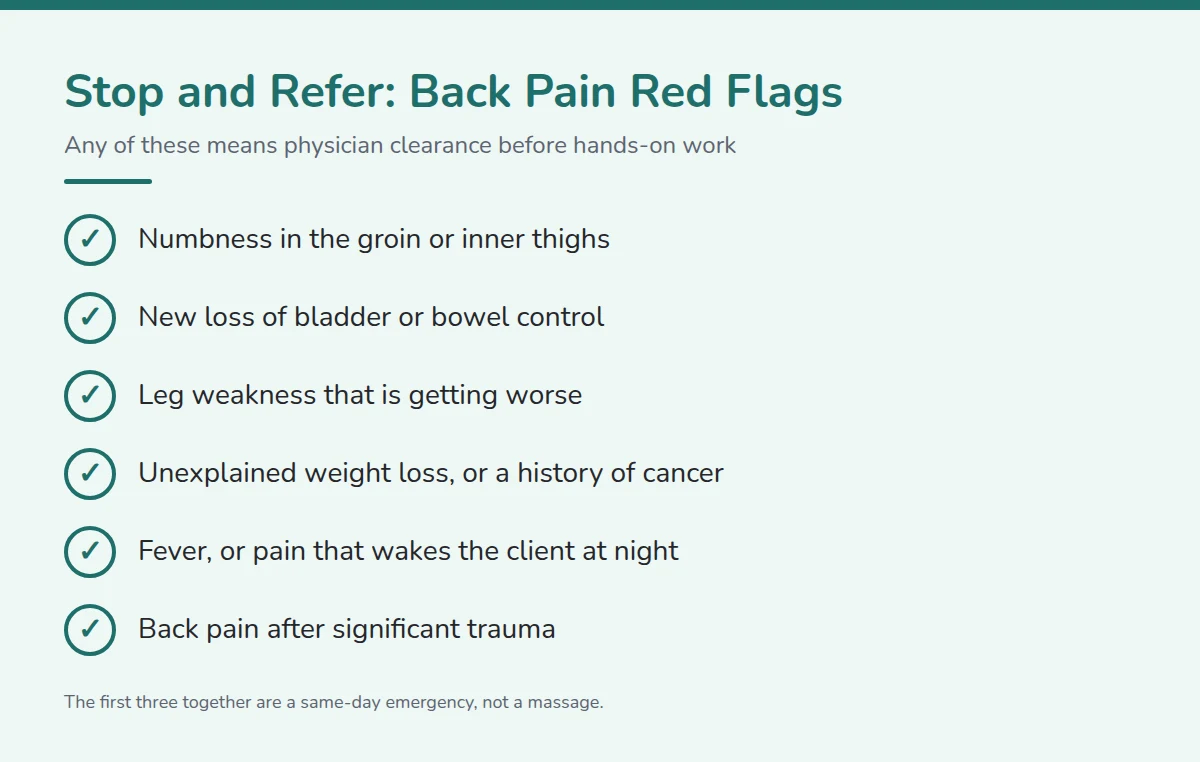
Refer, without the same urgency, for unexplained weight loss alongside back pain, a history of cancer, fever, pain that wakes the client at night or does not ease with any position, back pain following significant trauma, and any pain nobody has assessed. The Cochrane review of red flags for spinal malignancy is worth knowing about for an honest reason: most individual red flags are poor at ruling disease in on their own, and a history of cancer is the one that carries real weight. That is an argument for referring on the pattern rather than panicking about any single item, and for never being the practitioner who decided it was probably nothing.
The Honest Pitch
Here is the whole thing in a paragraph you can say out loud to a sceptical client. Massage for low back pain has modest, real, short-term evidence behind it, a clean safety record, and a place in the ACP’s first-line list for acute and subacute pain. It works better as part of a package that includes exercise than it does alone. The benefit fades, which is why a course of sessions beats a one-off. Nobody should promise to fix a disc, and anybody who does is making a claim their licence does not cover.
That is less than the marketing promises and considerably more than the headline suggests, and it is the version that holds up when the client goes home and reads the research for themselves.
Sources
- Qaseem and colleagues for the ACP clinical practice guideline on noninvasive treatment of low back pain
- Chou and colleagues on the AHRQ evidence review of nonpharmacologic therapies underpinning that guideline
- Furlan and colleagues with Cochrane’s review of 25 massage trials in non-specific low back pain
- Cashin and colleagues reporting the placebo-controlled analysis behind the “only one in ten treatments works” coverage
- Peer-reviewed research in a Cochrane overview of 31 reviews on non-drug treatments for back pain
- NICE on when manual therapy is worth considering for low back pain and sciatica
- Peer-reviewed research asking whether adding manual therapy to exercise improves outcomes
- Peer-reviewed research pooling 21 reviews on manual therapy in chronic non-specific low back pain
- Elder, Munk and colleagues for what ten real-world massage sessions did for primary care back pain patients
- Henschke and colleagues on how well red flags actually screen for spinal malignancy
- Peer-reviewed research reviewing why cauda equina syndrome is a same-day surgical emergency
Further reading
- Mobile Massage for Pain Management: Bringing Relief Home
- What the Research Actually Says About Massage: An Evidence Guide for Clients
- State Licensing and Scope of Practice: A Mobile Therapist’s Compliance Guide
- The Science of Touch: How Mobile Massage Affects the Nervous System
- The Mobile Massage Policy Handbook: Cancellations, Deposits, No-Shows, and House Rules