Neck Pain and Mobile Massage: Evidence, Red Flags, and Aftercare for Desk Workers
Published on October 3, 2026

The Office Is the Kitchen Table Now
The booking request tends to arrive midweek. Neck and shoulders, please, and could you come at lunchtime? The client works from home, which means a laptop on the kitchen table, a dining chair built for meals rather than nine-hour days, and a phone that takes over when the laptop closes. By Wednesday the right shoulder has crept toward the ear, and turning to reverse out of the driveway hurts.
They have plenty of company. The Global Burden of Disease collaborators estimate that neck pain affected 203 million people in 2020, more women than men, and project 269 million cases by 2050 as the population grows and ages. A BMJ review by Cohen and Hooten ranks it among the top five chronic pain conditions for prevalence and years lost to disability, yet it gets a fraction of the research funding that low back pain does. In studies of people sent home to work during the pandemic, neck pain was the most commonly reported complaint, affecting anywhere from a fifth to three quarters of respondents.
This is the neck companion to our guide to massage for low back pain: what the reviews support, the dose that worked in trials, the red flags that need a doctor first, how to position a sore neck without a face cradle, and the aftercare with evidence behind it.
What the Reviews Actually Say
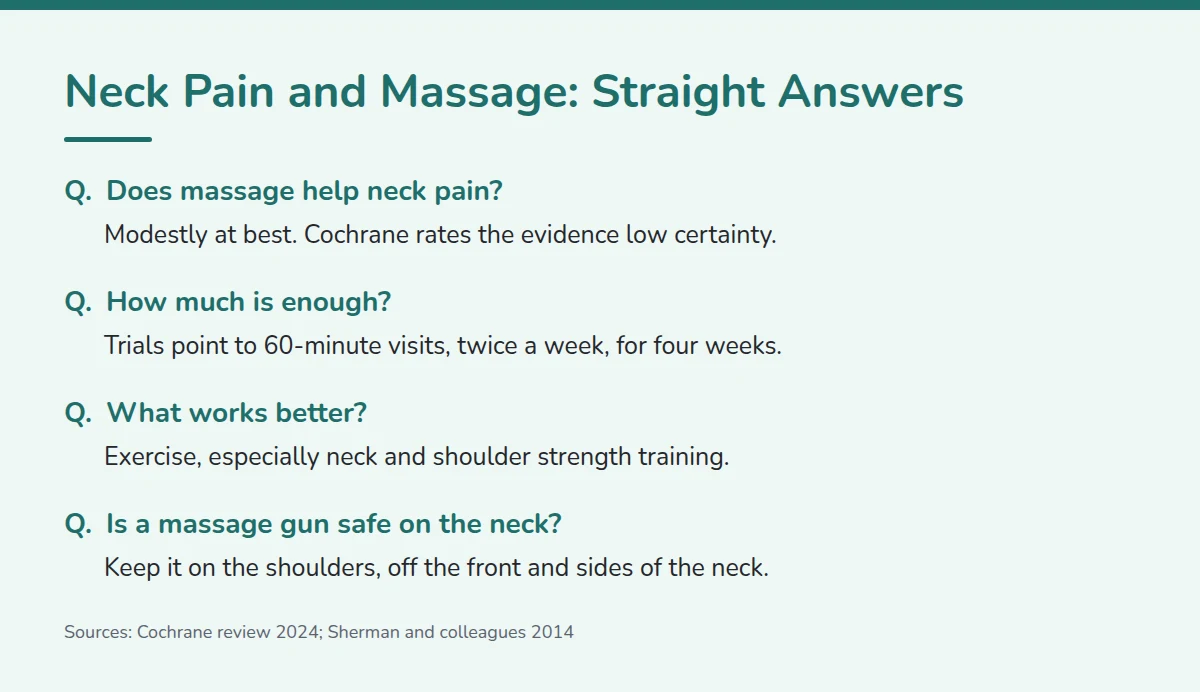
Start with the least flattering result, because a well-read client may have seen it. Cochrane’s 2024 review by Gross and colleagues pooled 33 trials with 1,994 participants and found, on low-certainty evidence, that massage probably makes little to no difference to pain, function or quality of life compared with a placebo for subacute and chronic neck pain at up to 12 weeks. The reviewers’ own verdict is that what massage adds to neck pain care “remains uncertain.”
The downgrading notes change the shape of that verdict. Most of the placebo-controlled trials gave a single session, which the reviewers called a suboptimal dose, and when they split the trials by dose, a clinically important difference appeared for a high dose: at least eight sessions over four weeks, each lasting 30 minutes or more. One massage is no more a test of massage than one gym visit is a test of exercise. Our evidence guide for clients explains the other ceiling on these ratings: nobody can be blinded to whether they are being massaged.
Exercise is the comparison that matters. Cohen and Hooten found that among complementary treatments, the strongest evidence is for exercise, with weaker evidence for massage, acupuncture, yoga and spinal manipulation. In a small head-to-head trial by Kang and Kim, 41 adults with chronic neck pain did either resistance exercises for the neck and shoulder blades or trapezius massage, five times a week for four weeks. Both groups improved, and the exercise group improved significantly more on pain, neck rotation, disability and quality of life.
Dose Is the Whole Argument
The best evidence on dose comes from a Seattle trial built to answer exactly that question. Sherman and colleagues randomised 228 people with chronic neck pain to one of five four-week massage schedules (30-minute visits two or three times a week, or 60-minute visits once, twice or three times a week) or to a waiting list. At five weeks, the 30-minute visits were not significantly better than waiting, however often they happened. Sixty-minute visits two or three times a week made a clinically meaningful improvement in neck function three to five times as likely as waiting, and more than doubled the chance of a meaningful drop in pain.
A follow-up by Cook and colleagues gave some participants six more weekly hour-long sessions. Their neck function was better at 12 weeks, but the advantage had faded by 26 weeks, and the extra sessions only helped people who had started on 60-minute visits.
The translation is blunt. A 30-minute neck and shoulders add-on is pleasant, but the trials do not support it as a treatment dose. What worked was an hour, twice a week, for a month: eight home visits, then a conversation about boosters, knowing the gains fade unless something else holds them. The mobile format makes that schedule realistic and removes the drive. The NHS advises against driving when you cannot move your neck freely, which describes many neck pain clients on the day they book.
Where Exercise and Other Adjuncts Fit
If massage opens a short window of less pain, the evidence says to fill it with exercise.
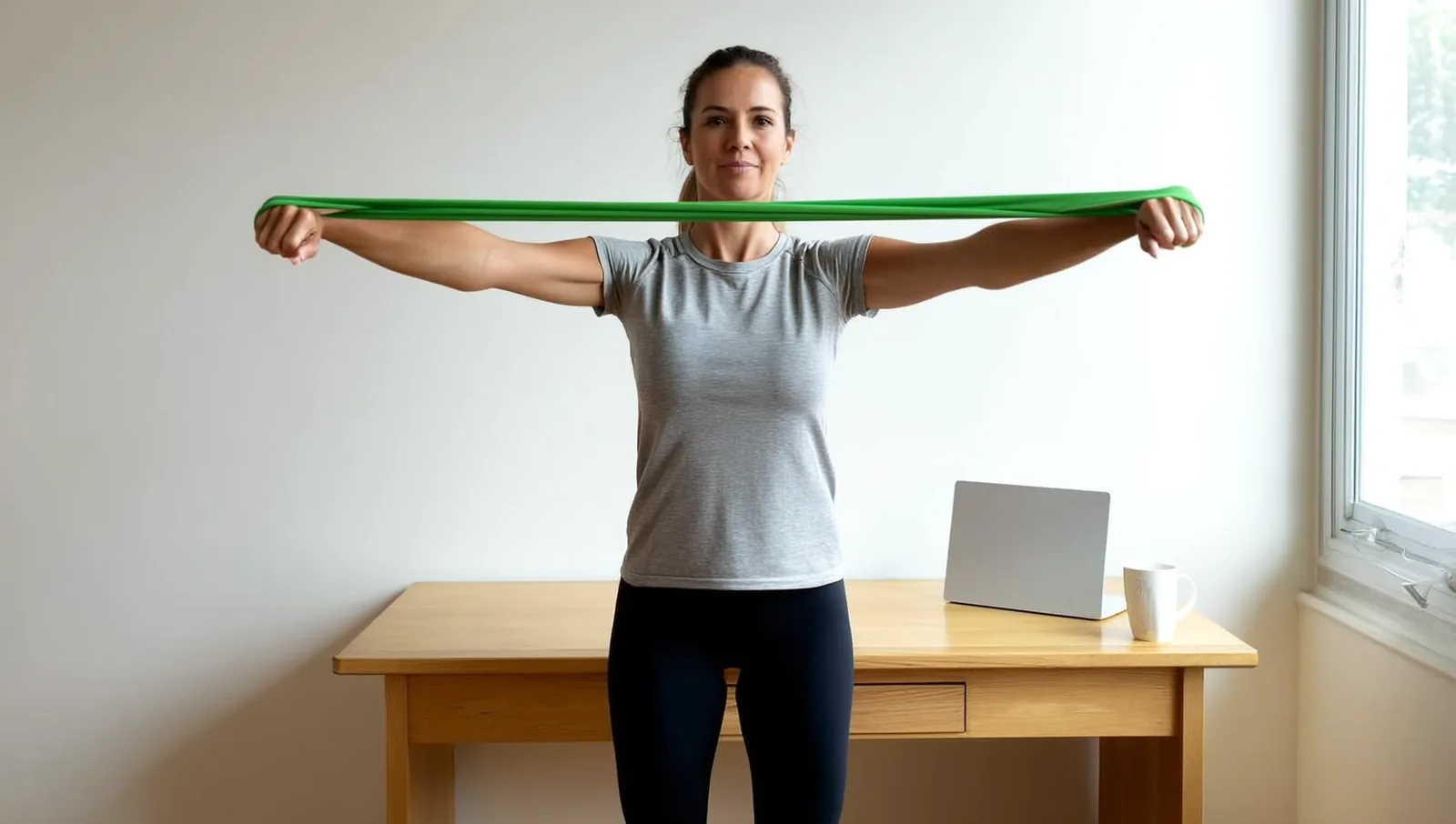
Exercise first. In a trial of 447 office workers, Andersen and colleagues found that one hour a week of supervised strength training for the neck and shoulder muscles reduced neck pain over 20 weeks, whether the hour came as one session, three 20-minute sessions or nine 7-minute ones. A 2024 meta-analysis of eight trials by Jones, Jadhakhan and Falla agreed, on low-certainty evidence: strengthening the neck, shoulder and shoulder blade muscles reduces pain and disability in office workers with chronic neck pain. Your state’s practice act may let you teach general self-care, but designing a strengthening programme is a physical therapist’s job, so refer.
Acupuncture. Ko and Kim followed 23 women with chronic neck pain through four weeks of waiting and then four weeks of acupuncture. Nothing changed during the wait; afterwards, pain and disability scores improved and blood levels of substance P, a pain-signalling molecule, fell. Without a control group it is a signal rather than proof, and acupuncture needs its own licence, so it is a referral, not a menu item.
Percussion and instruments. A 2025 trial by Menek and colleagues added either a percussion massage device or stainless steel soft tissue tools to physiotherapy for 57 people with cervical disc herniation, three times a week for three weeks. Both additions beat physiotherapy alone on pain, fear of movement and the sense of where the head sits in space. The effect sizes were far larger than manual therapy trials usually report, a reason for caution in a trial this small, and the work was a clinician treating the muscles along the back of the neck, a few minutes at a time, within a rehabilitation programme.
That is a long way from a client running a massage gun over their own neck on the sofa. Sulkowski and colleagues described a 27-year-old woman with headache, neck pain and dizziness who was found to have a vertebral artery dissection after repeated use of a handheld massage gun. One case cannot establish cause, as the authors note, but it backs the advice in our guide to handheld massage tools: keep the device on the shoulders and upper back, and off the front and sides of the neck.
Dry needling and taping have thinner evidence, much of it from the low back: in one small study of 48 bodybuilders, massage gave the bigger immediate gain in range of motion and dry needling the better pain scores three days later. Dry needling, like acupuncture, needs its own licence.
Red Flags That Need a Doctor First
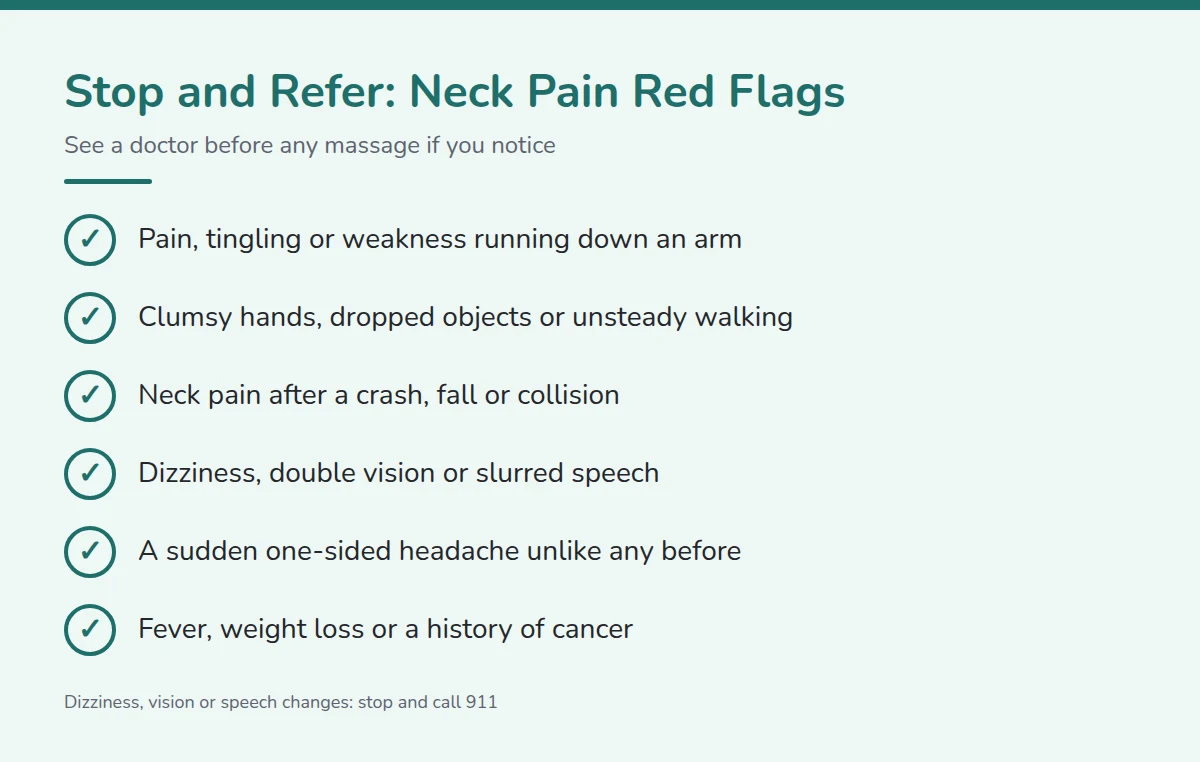
Most acute neck pain settles on its own. A small fraction is something else, and a mobile therapist alone in a client’s living room may be the first to hear about it. The international physiotherapy frameworks admit there is little high-quality evidence for how accurate most individual red flags are, so the job is to notice a pattern and refer, not diagnose. The IFOMPT cervical framework adds that rare vascular problems of the neck may be recognisable if the right questions are asked, which is the case for a neck-specific intake.
Symptoms that travel down an arm. A pinched nerve root in the neck, cervical radiculopathy, typically causes burning or sharp pain that runs from the neck down the arm, with pins and needles, numbness, or weakness in the arm, shoulder or hand, and it can get worse when the neck extends or the head turns. The American Academy of Orthopaedic Surgeons notes that most cases improve with time, but the client needs a diagnosis before you work on it. With a known disc herniation, get written clearance and a note of which positions to avoid. It is not a rare conversation: Cohen and Hooten report that nearly half of people with chronic neck pain have mixed or predominantly nerve-type pain.
Clumsy hands or unsteady feet. Pressure on the spinal cord itself, cervical myelopathy, looks different: numbness or tingling in the hands, trouble gripping, difficulty with handwriting or buttons, and balance problems or falls, often alongside neck pain or stiffness. The same academy describes it as progressive. Fumbling with buttons plus neck pain means a doctor before a massage.
A recent crash, fall or collision. Recent trauma heads the list of risk factors in the dissection data reviewed by the IFOMPT framework, and Cleveland Clinic identifies head and neck injury, such as a car crash or whiplash, as the leading cause of cervical artery dissection. Neck pain after any significant impact needs a medical assessment before hands-on work.
Dizziness, visual changes, or a headache unlike any other. Cleveland Clinic counts cervical artery dissection, a tear in the lining of a carotid or vertebral artery, among the common causes of stroke in younger and middle-aged adults. Warning signs include sudden one-sided head or neck pain that does not go away, often behind one eye; a drooping eyelid with a smaller pupil on that side; and dizziness, double or blurred vision, slurred speech, limb weakness or loss of balance. The early phase can look like an ordinary booking: in ten published cases of undiagnosed vertebral artery dissection seen by chiropractors, every patient had neck pain or headache, half had visual disturbance and four had dizziness. If these symptoms appear before or during a session, stop, do not let the client drive, and call 911. Ask at intake about any past dissection too, since a clinical review in Mayo Clinic Proceedings advises people who have had one to avoid deep neck massage.
Fever, weight loss, cancer, or pain that never eases. The general warning signs from our low back guide apply to the neck as well. Fever, unexplained weight loss, a history of cancer, or pain that wakes the client at night and eases in no position all go to a physician before any massage.
Positioning a Sore Neck Without a Face Cradle
Plenty of home neck work happens without a face cradle: the client who cannot get onto a table, the bedside session, the half hour at the client’s own desk. Face-down is not always kind to a painful neck even with a cradle, and the improvised version, face-down on a bed with the head turned to one side, parks the neck at the end of its rotation, a movement that can aggravate an irritated nerve root. The NHS’s own neck pain advice includes not sleeping on your front.
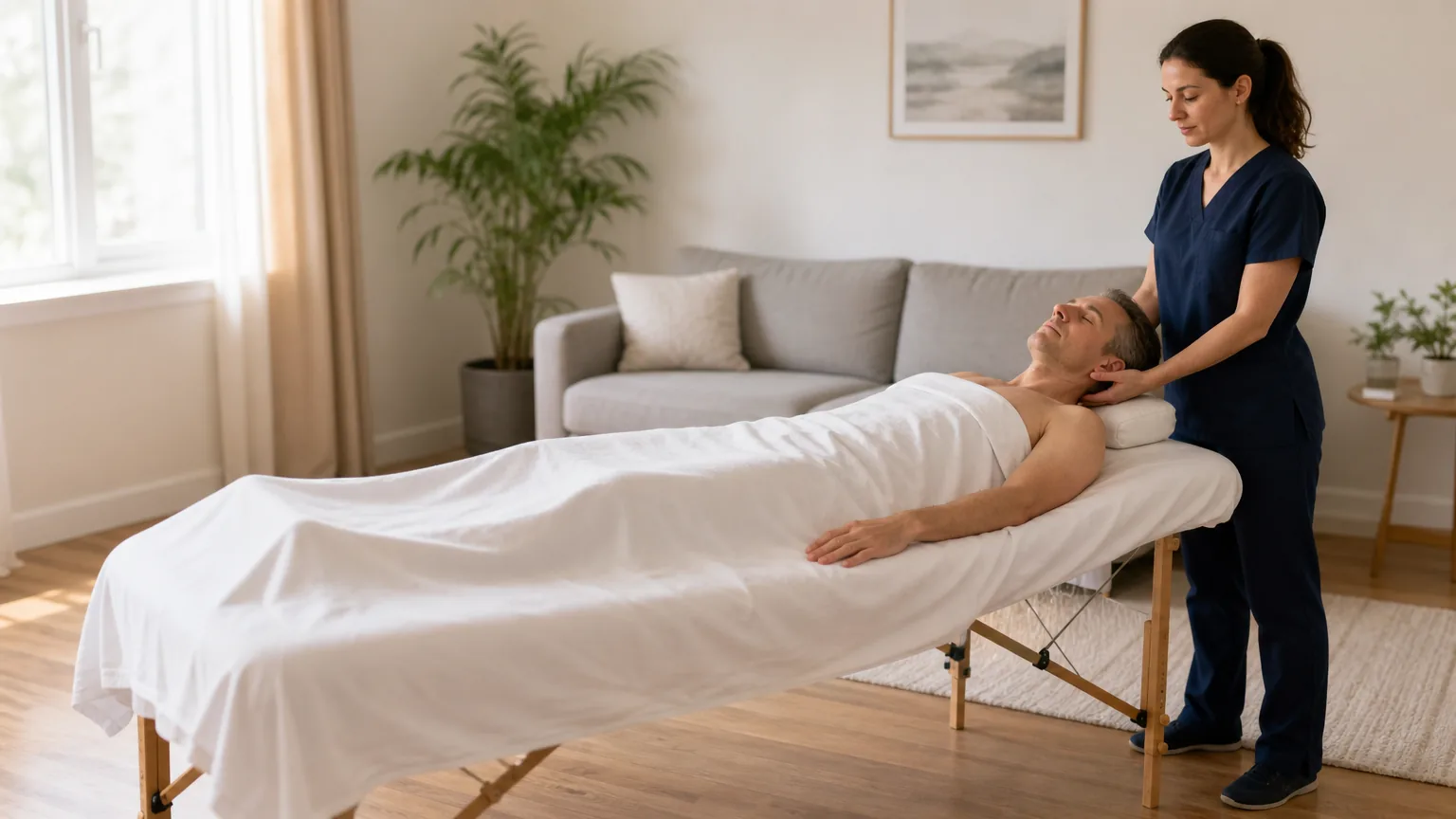
Face-up is the neck position. With a small pillow or folded towel under the head, so the chin is neither tucked nor tipped back, and a bolster under the knees, you can sit or stand at the head of the table or bed and work the neck with the head resting in your hands. Gravity does part of the work, you control every degree of movement, and you can watch the client’s face.
Side-lying for the shoulders and upper back. Use a pillow thick enough to keep the head level with the spine instead of sagging toward the table, the same principle the NHS gives for sleeping, plus a second pillow between the knees.
Seated at the client’s own table. A client who cannot lie down can lean forward onto a stack of pillows on the kitchen table, forehead resting on folded forearms. Keep the neck long rather than sharply bent and it works as a stand-in for a massage chair.
In any position, some things stay off the menu: sustained end-of-range rotation or extension, stretches that combine the two, any sudden or forceful movement, and deep or sustained pressure on the front and sides of the neck, where the carotid arteries run. A 2025 case report described an older adult with heavily calcified arteries who developed difficulty speaking and weakness on one side straight after a neck massage, with a carotid dissection on imaging. Joint manipulation sits outside massage scope without a separate licence, as our licensing and scope guide explains. Ask clients to tell you at once about arm tingling, dizziness or any change in vision, and if it happens, stop that technique and do not go back to it.
Aftercare for Desk and Remote Workers
The home visit has one advantage no clinic can match: you see the actual workstation, from the laptop flat on the kitchen table to the sofa where evening emails get answered on a phone. That is useful, provided the advice that follows has evidence behind it.
Workstation changes, with modest expectations. When Jun and colleagues reviewed prospective studies of office workers, only a handful of physical factors predicted new neck pain: low satisfaction with the workplace environment, a keyboard placed close to the body, little variety in work tasks, and the worker’s own sense of high muscle tension. Other factors had limited or conflicting evidence. You are not an ergonomist, so describe what you notice and suggest the client raise it with their employer or physical therapist.

Breaks are fine; just do not oversell them. The 2025 Cochrane review of work-break schedules rated all of its evidence very low certainty, with extra breaks possibly making little to no difference to new neck pain. Getting up from the desk is pleasant and harmless, but it is not a treatment.
Protect the hours after the session. Suggest an easy return to the afternoon rather than four straight hours at the laptop, a low, firm pillow that night as the NHS recommends, and a check-in a day or two later so the next visit can be adjusted.
Building a Neck Service That Matches the Evidence
For therapists, the research sketches an unusually specific service:
- Sell a course: 60 minutes, twice a week, for four weeks, then a review. A single hour is a sample, not a treatment.
- Screen at booking and again at the door, and get written clearance for radiating arm symptoms, a known disc herniation or recent trauma.
- Keep neck work face-up, gentle at the end of range, and off the front of the neck.
- Pair every course with a referral for strength work, and record neck pain and function at the start and end so you can both see whether it helped.
Employers are another route to desk workers. Chair massage at a workplace wellness day, covered in our corporate and on-site contracts guide, runs ten to twenty minutes: a welcome perk rather than a treatment dose, but a good way to meet the people whose necks would benefit from a proper course at home.
The Honest Pitch
Here is the version that survives a client reading the research. Massage for neck pain rests on low-certainty evidence with a clear dose signal: 30-minute visits did not beat a waiting list, and an hour twice a week for a month did. Exercise has the stronger evidence, so a course of massage should come with a referral for strength work rather than replace it. Arm symptoms, clumsy hands, recent trauma, dizziness and a sudden new headache go to a doctor first. And the most underrated thing a home visit offers a sore neck is the one nobody advertises: no drive there and no drive home.
Sources
- GBD 2021 Neck Pain Collaborators on how many people live with neck pain worldwide and the 2050 projection
- Cohen and Hooten for a clinical review of neck pain diagnosis and management
- Gomez and colleagues with a rapid review of musculoskeletal pain while working from home
- Gross and colleagues on Cochrane’s 2024 review of massage for neck pain and its dose subgroup
- Kang and Kim comparing resistance exercise with trapezius massage for chronic neck pain
- Sherman and colleagues for the dosing trial that tested 30 and 60 minute massage schedules
- Cook and colleagues on whether booster sessions extend the benefit to 26 weeks
- Andersen and colleagues with one weekly hour of neck and shoulder strength training in office workers
- Jones, Jadhakhan and Falla on exercise for office workers with chronic neck pain
- Ko and Kim for acupuncture, pain and substance P in chronic neck pain
- Menek, Dansuk and Gorguluer on percussion and instrument-assisted work in cervical disc herniation
- Sulkowski and colleagues reporting a vertebral artery dissection after massage gun use
- Papoli and colleagues with single sessions of dry needling, massage, stretching and tape in bodybuilders
- Finucane and colleagues on the international framework for spinal red flags
- Rushton and colleagues for the IFOMPT framework on screening the neck for vascular problems
- American Academy of Orthopaedic Surgeons on cervical radiculopathy symptoms and cervical myelopathy symptoms
- Cleveland Clinic for the causes and warning signs of cervical artery dissection
- Trager and colleagues reviewing symptoms of undiagnosed vertebral artery dissection seen by chiropractors
- Keser, Meschia and Lanzino with a concise clinical review of craniocervical artery dissection
- Zhao and colleagues reporting a carotid dissection and stroke following neck massage
- Jun and colleagues on which physical factors predict neck pain in office workers
- Luger and colleagues with Cochrane’s 2025 review of work-break schedules
- NHS for self-care advice on neck pain, pillows and driving
Further reading
- Low Back Pain and In-Home Massage: What the Guidelines Actually Support
- What the Research Actually Says About Massage: An Evidence Guide for Clients
- Handheld Massage Tools Worth Recommending Between Sessions: A Therapist’s Picks
- State Licensing and Scope of Practice: A Mobile Therapist’s Compliance Guide
- On-Site and Corporate Mobile Massage: The Complete Guide to Workplace and Event Contracts