Phones, Cameras, and Smart Speakers: Privacy in a Treatment Room You Do Not Own
Published on October 16, 2026
Two Phones, Two Sessions, and a Conversation Nobody Had
In January 2024, a woman in Pickering, Ontario, booked a mobile massage at her home. While she was undressing, she told police, she noticed the therapist’s phone propped up and recording her. She confronted him, and he left before officers arrived. Two weeks later Durham Regional Police took him into custody on a charge of voyeurism and said they were concerned there could be more victims. The allegation had not been tested in court when police announced the arrest.
The second case involves no recording at all. A registered massage therapist in Prince George, British Columbia, held his phone in one hand while massaging face-down clients with the other, at first to message his front desk and later to play puzzle games. His purpose, in the regulator’s words, was “to remain alert and awake.” One client felt the corner of the phone poke her wrist two or three times. Another suspected something worse and reported him for sexual misconduct. The regulator sent in an undercover investigator, who timed 15 minutes and 24 seconds of phone use in a 45-minute treatment.
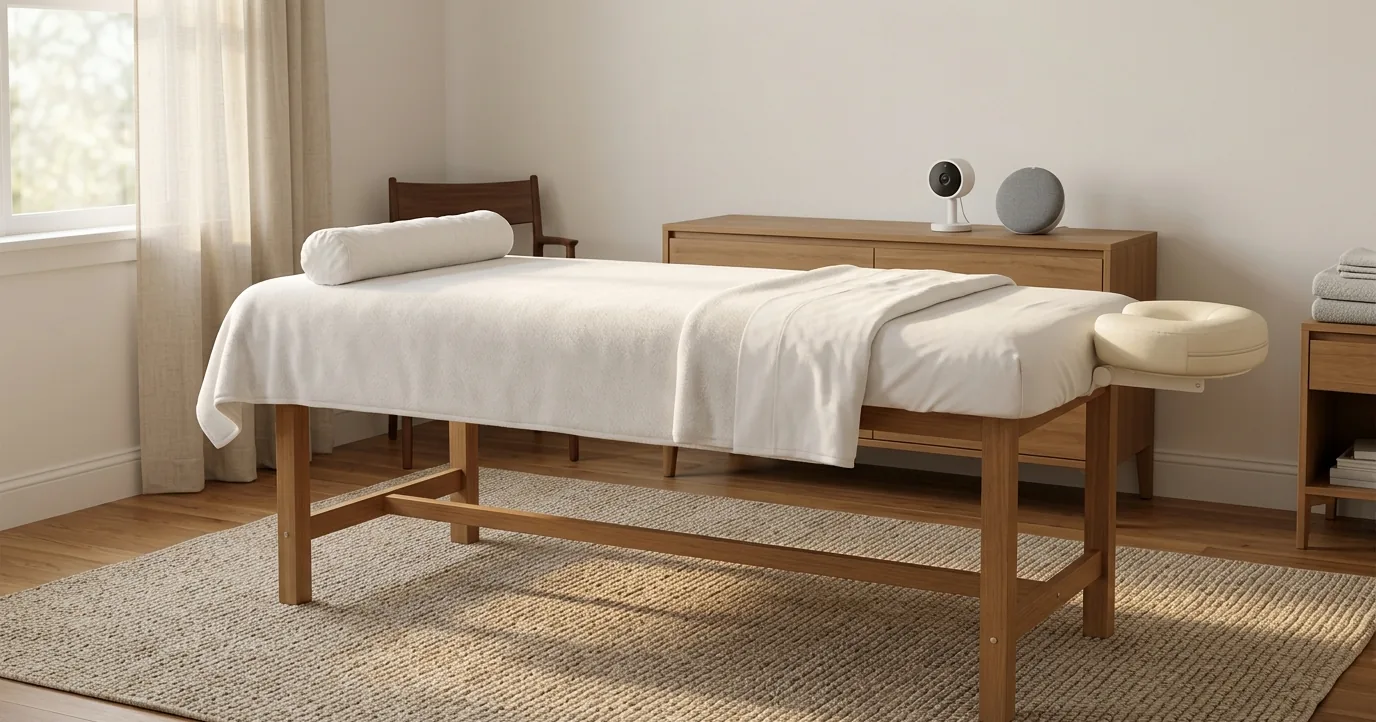
That case happened in a clinic, but a home makes both failures easier. In a clinic, the room and its rules belong to the employer. In mobile work the room belongs to the client, and on a typical visit it holds two phones, perhaps a doorbell camera, a baby monitor or a smart speaker, and no agreement about any of them. This guide works through both directions: what a therapist does with their own phone, what covert recording amounts to in law, and how to handle the client’s devices, including the honest case for a recording the client controls.
Your Phone Lives in the Bag
The B.C. therapist accepted two five-day suspensions in January 2021, along with fines, investigation costs, ethics coursework and a permanent condition that his phone may not be “present in any treatment room during a massage therapy treatment.” The regulator’s reasoning travels well. A client who sees their therapist on a phone while they are unclothed “is likely to become distressed and upset,” it wrote, and a massage given with one hand while the other scrolls is neither respectful nor reliably safe.
The province has since written the lesson into a standard for every licensee. The College of Complementary Health Professionals of BC, which replaced the massage regulator in a 2024 amalgamation, counts phones, tablets and laptops as electronic recording devices in its practice environment standard, in force since April 1, 2026. It allows them during care only for intake, assessment, treatment, charting, education and voice recording. You must explain the use, document the client’s verbal consent, and make sure the device is “not positioned in a manner that would enable video, photographic or audio recording of the patient without the patient’s knowledge and consent.”
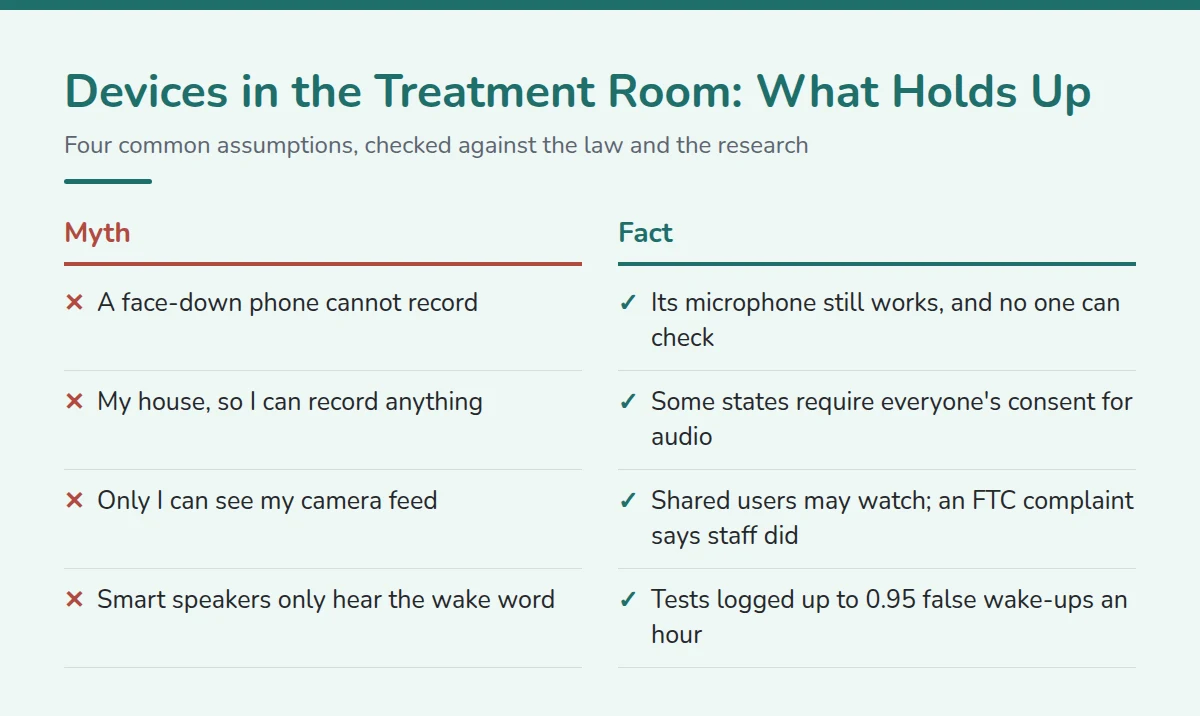
That last clause rules out more than it seems to. A phone lying screen-down on the client’s dresser still has a working microphone, and its main camera now faces the ceiling. The client cannot tell whether it is recording, and neither could a board, a police officer or a court months later. “It was face-down on the dresser” is a sentence you cannot prove, which is why the only defensible place for the phone is out of sight in a closed bag.
A phone policy that holds up:
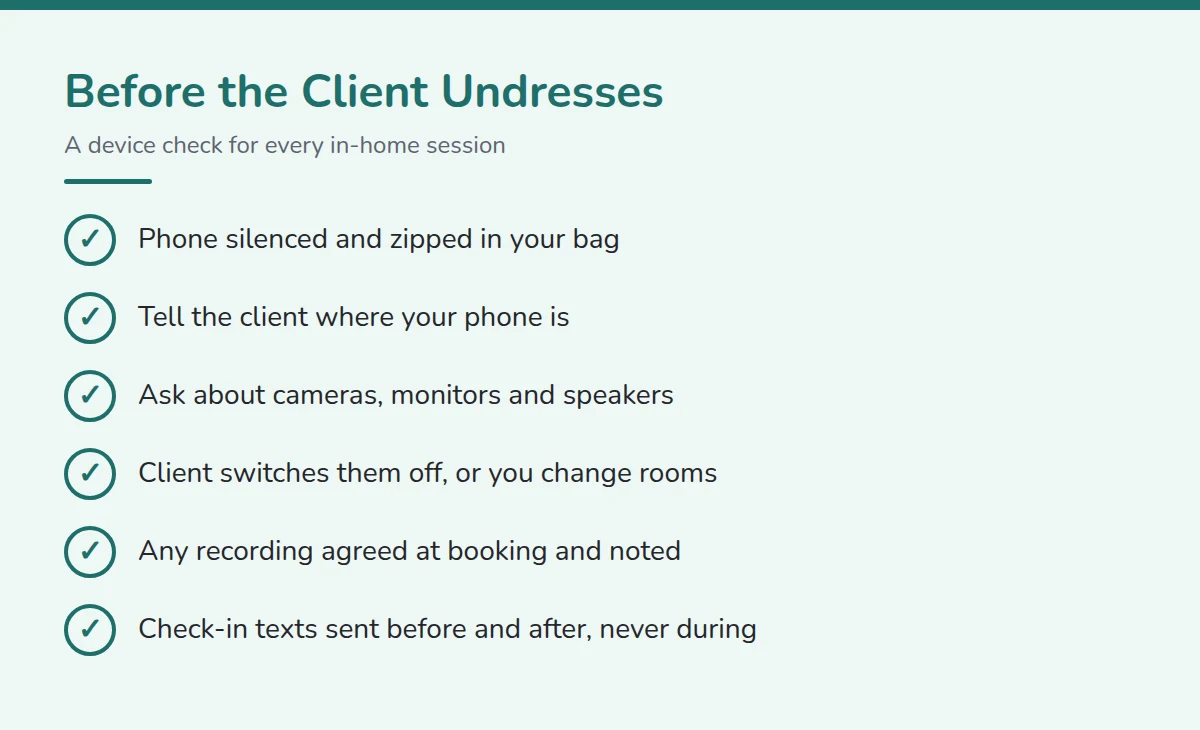
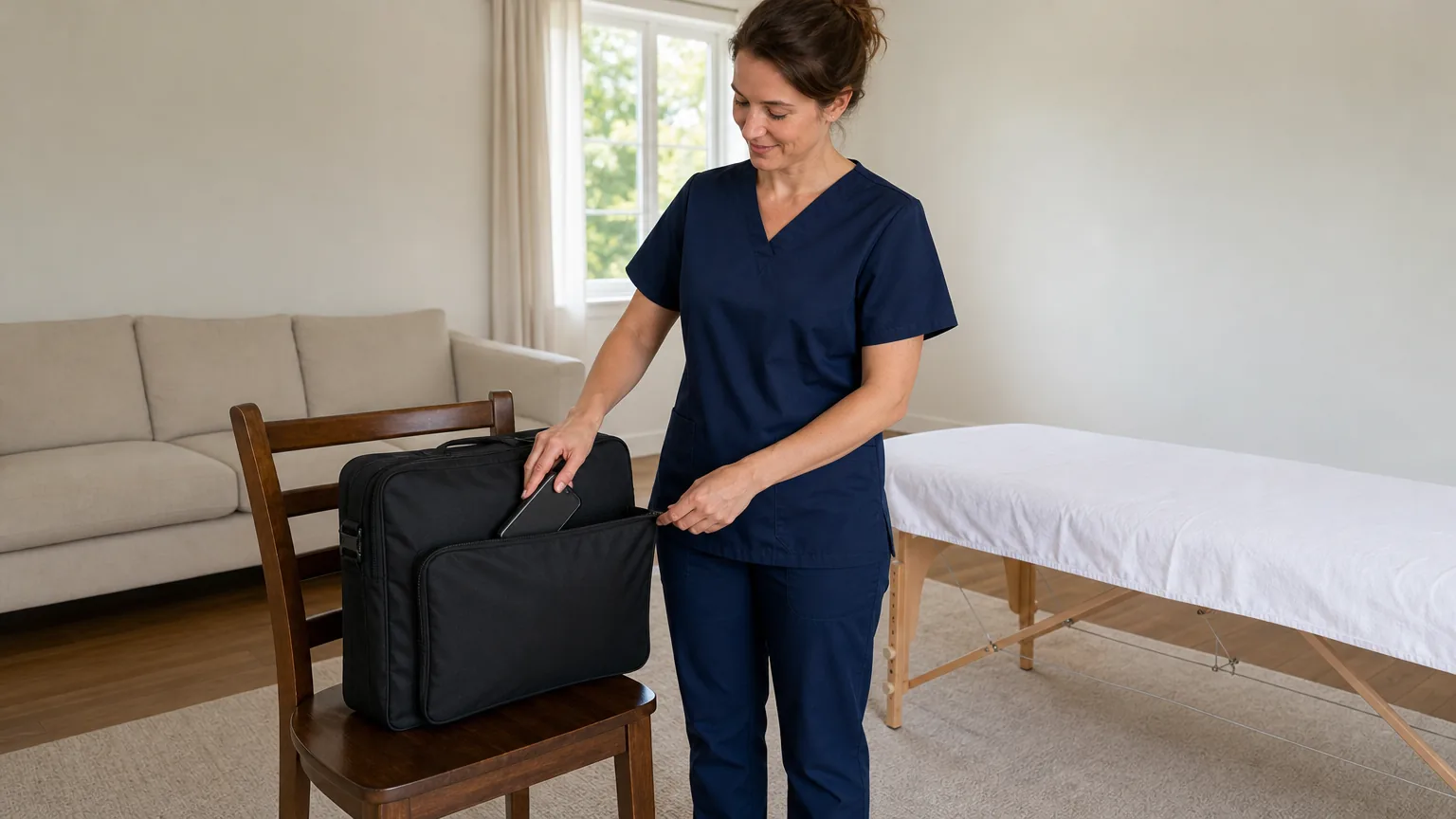
- Before the client undresses, silence the phone, put it in your bag and zip it. The bag can sit within reach of the table, as our personal safety protocol recommends. The phone just lives inside it.
- Say where it is. “My phone is silenced and zipped in my bag for the session.” One sentence answers a question most clients would never ask aloud.
- Start the music first. Queue a playlist longer than the session and let it stream from the bag. If it stops halfway, let it stop.
- Time the session with a watch or a small clock, not a phone screen.
- Keep check-ins outside the session. Send the arrival text before the client undresses and the all-clear once they are dressed. Live location sharing keeps running from inside the bag, and a check-in deadline fifteen minutes after the booked end time means nobody expects to hear from you mid-massage.
- Finish intake paperwork while the client is dressed, and close the tablet before they change.
What Covert Recording Amounts To in Law
Secretly filming a partly undressed client is not a boundary lapse for a board to tidy up quietly. In Canada and in many US states it is a serious crime, written in language that fits a home massage closely.
- Canada. Section 162 of the Criminal Code makes it a crime to secretly watch or film someone who can reasonably expect privacy, and it names the obvious case: a place where people can be expected to be “nude or nearly nude.” Since July 2026 the maximum sentence is 10 years, up from five, when it is prosecuted as an indictable offence, and distributing the recording is a separate offence.
- New York. Unlawful surveillance in the second degree covers secretly using an imaging device to view or record a person “dressing or undressing” where they have a reasonable expectation of privacy, without their knowledge or consent. It is a class E felony.
- Florida. The digital voyeurism statute covers secretly recording a person who is dressing or undressing, and its definition of a reasonable expectation of privacy names “the interior of a residential dwelling.” For an offender aged 19 or older it is a third-degree felony, and each recording, broadcast or transfer counts as a separate offence.
Sound follows its own rules. Federal wiretap law allows a person to record a conversation they are part of, or one where a participant has consented. Some states go further and require everyone’s agreement, the rule often called two-party consent: Florida treats an interception as lawful when “all of the parties to the communication have given prior consent.” In those states a secret audio recording of a session can be a crime with no camera involved, and the rule cuts both ways. A client who secretly records you needs your consent there too.
The professional consequences arrive separately, and they do not wait for a recording. The B.C. investigation found no evidence that the therapist had photographed or filmed anyone. He was suspended for the phone in his hand.
The Client’s Devices: Doorbells, Monitors, and Speakers
The other devices in the room belong to the client. Most are harmless, a few deserve a question, and the therapist and the client usually want the same answer.
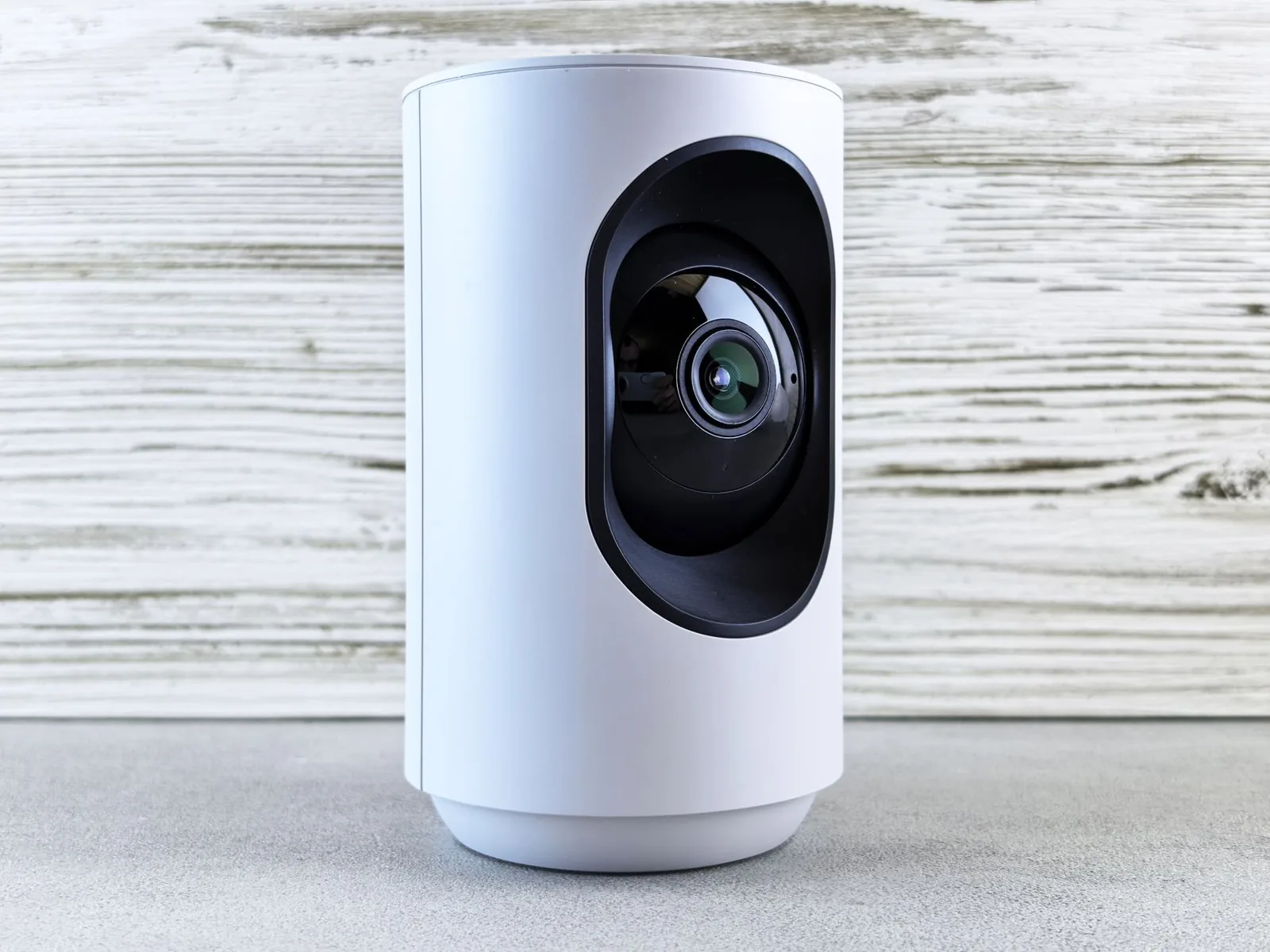
Doorbell cameras. Expect to be filmed arriving and leaving. The camera is not in the treatment room, and its timestamps back up the same record your check-in texts make. There is nothing to discuss.
Indoor and pet cameras. A camera that covers the room where the client will undress is a different matter, for the client as much as for you. The account holder controls the footage, but anyone they have shared the app with may be able to watch live, whether that is a partner at work or a relative across town. The clips also sit on the maker’s servers under the maker’s terms. In 2023 the Federal Trade Commission charged one large home camera company with letting any employee or contractor view customers’ private videos. According to the complaint, one employee spent several months viewing thousands of videos from female customers’ cameras that watched intimate spaces such as bathrooms and bedrooms.
Baby monitors. Sessions often end up in a bedroom, and a family bedroom may hold a monitor that streams to a parent unit or an app in someone else’s hand. Ask for it to be switched off, or pointed at the crib rather than the table, for the hour.
Smart speakers. A smart speaker listens constantly for its wake word, and it sometimes wakes when nobody said it. Researchers at Northeastern University and Imperial College London played 134 hours of TV dialogue to seven popular speakers and logged up to 0.95 misactivations an hour. Most were brief, but on some devices one in ten lasted 10 seconds or more, which the authors note is “enough time to record sensitive parts of private conversations.” TV dialogue is not a massage room, and the researchers found no evidence that the misactivations were intentional. Still, an intake conversation about medications and health history is exactly the talk nobody wants on a server. Ask the client to press the microphone-off button, or to unplug the speaker for the session.
The client presses the button. It is their house and their device, so ask and let them do it. Do not unplug, cover or turn anything yourself.
Why asking is reasonable. The client is about to undress in front of a lens, and you are about to spend an hour on a recording you never agreed to. The NCBTMB code of ethics asks certificants to drape and treat “in a way that ensures the safety, comfort and privacy of the client,” which is hard to promise with a live camera trained on the table. The law will not settle it for either of you: Florida’s voyeurism statute exempts a surveillance device whose presence is “clearly and immediately obvious,” so a camera in plain view is usually a matter for conversation, not the police. If a client will not switch one off or move rooms, the same code recognizes your right to refuse treatment “for just and reasonable cause.”
A script works best when it is plainly not personal:
“Before you change, could we switch off the camera in here, or set up in the spare room? I ask everyone, and my own phone is already zipped away.”
The Honest Tension: A Recording Can Protect You Both
Everything so far treats a recording as the threat. It can also be the best evidence anyone ever has.
Look at the B.C. case from the other side. The client who suspected sexual misconduct had no way to show what happened, and neither did the therapist. While the regulator investigated, it ordered him to have a chaperone present at every appointment with a female patient. It sent an undercover investigator, and complaints made in March and April 2019 were resolved in January 2021. Even then, asked about that client’s sessions, the therapist had no specific recollection and accepted only that it was possible he had been playing with his phone. A recording would have settled her complaint in minutes, one way or the other.
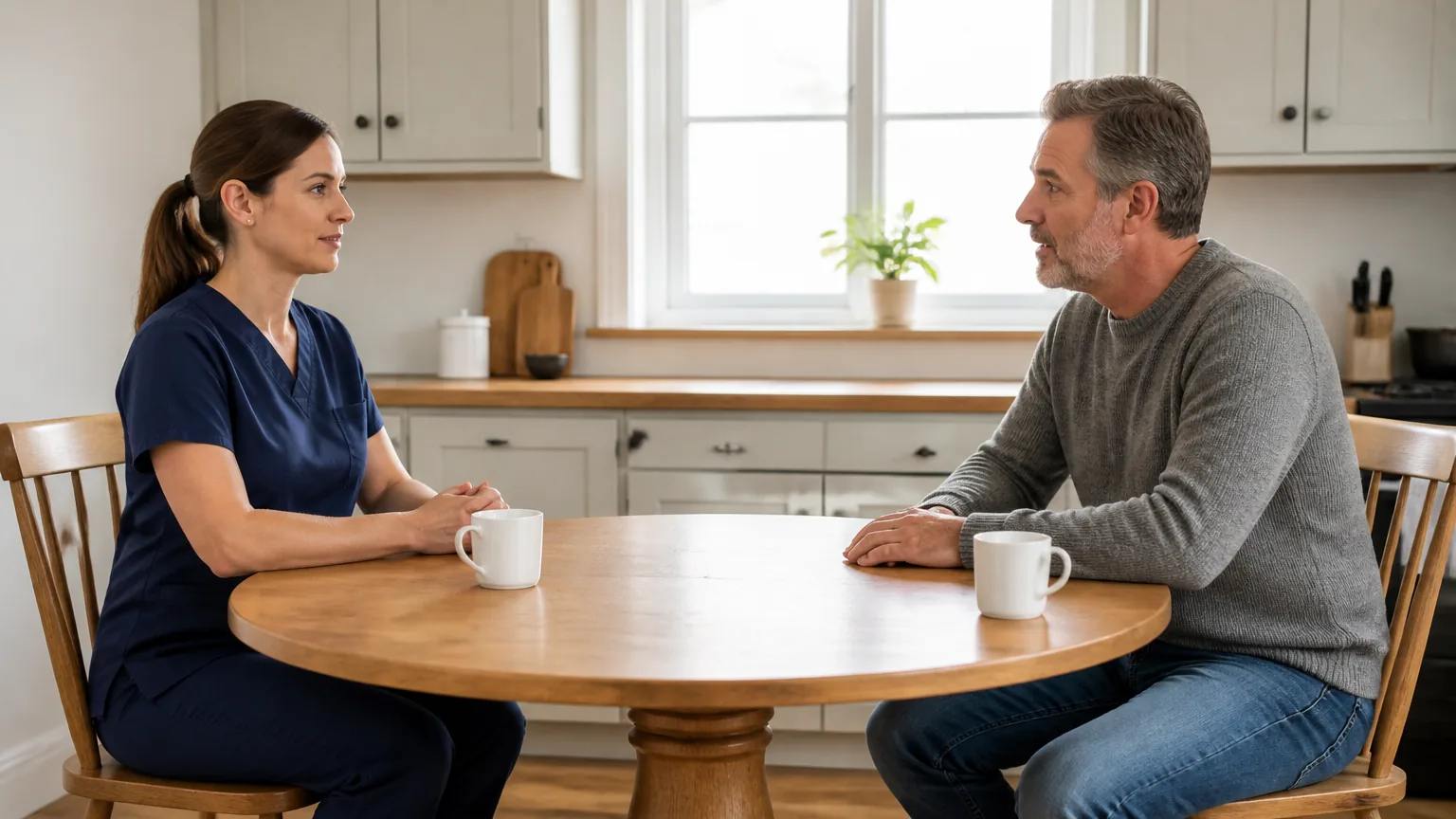
So a client who asks to record is not necessarily hostile. Some have been hurt by a practitioner before. Some are adult children who keep a camera running for every visitor to an older parent. Treat the request as a conversation at booking, not a standoff at the table:
- Agree on what is captured: audio only, or video that starts once the client is under the sheet.
- The client keeps the file. You do not need a copy, and nobody posts it.
- Write it in your session notes: what was recorded, on whose device, and that you agreed.
- Decline if you are not comfortable, briefly and without an argument.
Keep your own devices out of it. Some regulators, B.C.’s among them, allow a recording for a clinical purpose such as assessment once the purpose is explained and consent documented. A solo mobile practice gains little from that and takes on a file of a partly undressed client to keep secure. Your protective record is written: what the client asked for, what they consented to, what you did and what you avoided, noted the same day, as our ethics, consent and draping guide sets out. If a complaint ever lands, those notes, your check-in texts and the client’s own doorbell footage of when you arrived and left are evidence you can stand behind. When the problem runs the other way, our guide to documenting and reporting client misconduct covers what to save.
A Device Clause for Your Booking Terms
The house rules in our mobile massage policy handbook already say “No photo, audio, or video recording.” That covers your phone and a client who deliberately records. It says nothing about the speaker that was already on the shelf when you arrived. A fuller clause:
During your session my phone is silenced and zipped in my bag, and I never photograph or record clients. If there is a camera, baby monitor or smart speaker in the room we will use, I will ask you to switch it off or turn it away for the session, or we can set up in another room. If you would like to record your session, please tell me when you book so we can agree how. If we cannot agree, I may reschedule or decline the appointment.
Then add one question to your booking form: “Are there any cameras, baby monitors or smart speakers in the room where we will work?” The answer arrives before you do.
If You Are the Client
A careful therapist tells you where their phone is before you undress. If yours does not, ask: “Where will your phone be during the session?” A good therapist has the answer ready and does not mind the question.
A phone propped up, angled at the table or in the therapist’s hand during the massage is a reason to stop. You can sit up, cover yourself and end the session there. If you think you were recorded, call the police, as the Pickering client did, and then complain to the therapist’s licensing board. Our guide to checking a mobile massage therapist’s license shows how to find the right board and look the therapist up.
Your own devices are yours to settle before the appointment, not during it:
- Switch off or turn away any camera in the room you will use, and tell anyone who shares the app that it is off for the hour.
- Mute or unplug the smart speaker.
- Leave the doorbell camera alone. It is useful to you both.
- If you want the session recorded, say so when you book.
Settle the Devices Before the Drape
Every device question in this guide has the same answer: raise it before the client undresses, never halfway through the session. Recording, privacy and eavesdropping laws vary by state and province, and nothing here is legal advice. A therapist whose phone is zipped away, and who asks about the room’s devices out loud, has given everyone in the house a reason to trust the hour that follows.
Sources
- Durham Radio News on the Pickering voyeurism charge against a mobile massage therapist
- College of Complementary Health Professionals of BC with the consent agreement over phone use during treatments and its practice environment standard on recording devices
- CBC News for the misconduct complaint, the chaperone order and the therapist’s response
- Justice Laws Website on the Criminal Code voyeurism offence and its penalties
- New York State Senate with the unlawful surveillance statute covering dressing and undressing
- Florida Senate for the digital voyeurism statute and its home and visible-camera provisions and the all-party consent rule for recording conversations
- Cornell Legal Information Institute on the federal one-party consent rule in the Wiretap Act
- Federal Trade Commission with charges that a camera company let staff view customers’ private videos
- Dubois and colleagues, writing in Proceedings on Privacy Enhancing Technologies, on how often smart speakers wake and record without their wake word
- National Certification Board for Therapeutic Massage and Bodywork for the code of ethics clauses on client privacy and the right to refuse treatment
Further reading
- Personal Safety for Mobile Massage Therapists: A Comprehensive Protocol
- Ethics, Consent, and Draping in the Client’s Home: A Professional Boundaries Guide
- When the Client Is the Problem: Reporting and Documenting Client Misconduct as a Solo Mobile Therapist
- The Mobile Massage Policy Handbook: Cancellations, Deposits, No-Shows, and House Rules
- Before You Let Them In: How to Verify a Mobile Massage Therapist’s License and Training