Sports Massage Explained: Pre-Event, Post-Event, and Maintenance Work Across a Training Season
Published on November 5, 2026
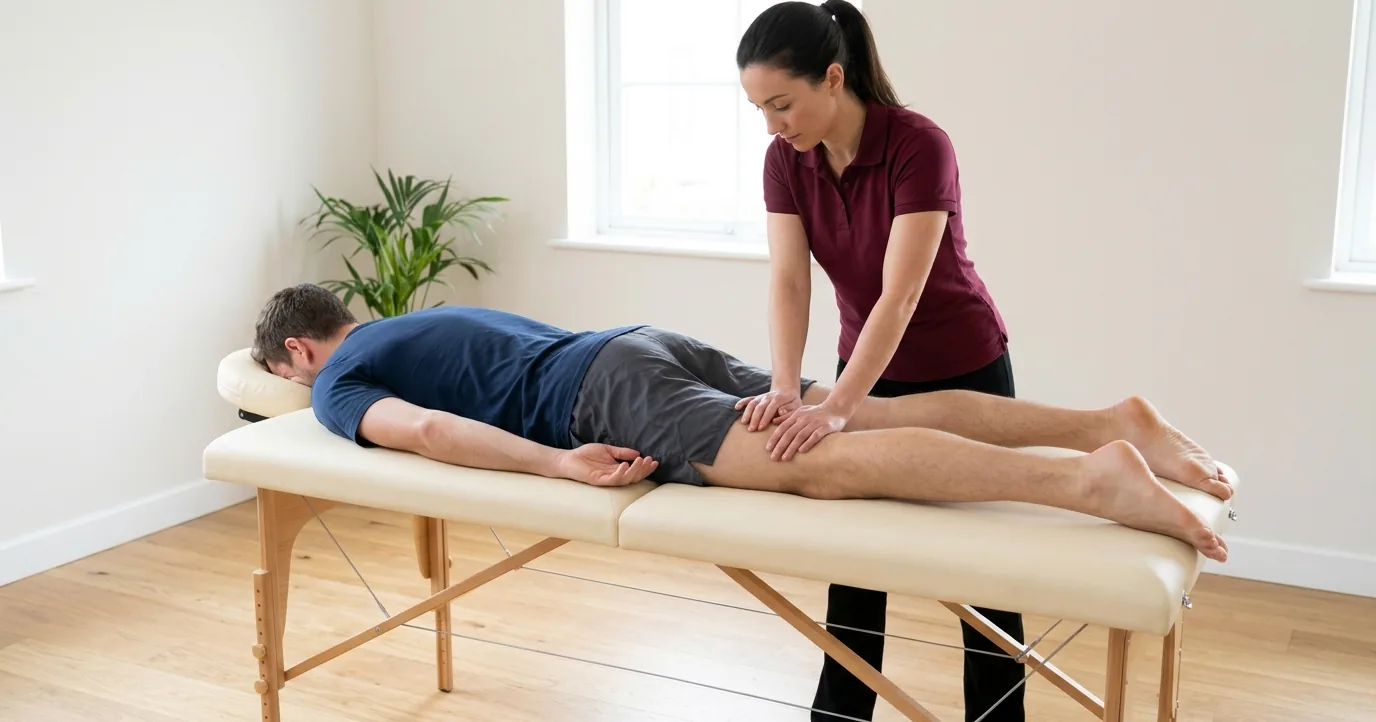
One Booking Name, Three Different Sessions
Two days before her first half marathon, a runner books a sports massage and gets exactly what her training partner raved about: seventy-five minutes of slow, deep work through the calves and hamstrings. It feels wonderful on the table. On race morning her legs are heavy and tender, and she spends the first three miles wondering what went wrong.
Nothing went wrong with the massage. She booked the wrong one. Sports massage is less a single technique than a family of sessions, each defined by where it falls against the race calendar. Florence Penny, a consultant musculoskeletal physiotherapist who spoke to Runner’s World, lists four reasons a runner might book one: before a race, after a race, for maintenance, and to help treat an injury. Each comes with its own pace, pressure and length, and the research behind each is different too.
This guide covers the three that fill an ordinary massage practice (pre-event, post-event and maintenance): how each differs from a relaxation session, where each belongs in a training season, and what the evidence does and does not support. It is written for athletes deciding what to book, and for mobile therapists who want to build a maintenance service instead of waiting for the weekend after a race.
How a Sports Session Differs From a Relaxation Massage
The strokes are mostly the ones every licensed therapist learns: long gliding effleurage, kneading petrissage, compression, friction, and passive stretching through a joint’s range of motion. What changes is the brief. A relaxation massage is planned around how the client feels today. A sports massage is planned around a calendar: what the athlete did yesterday, what they are racing on Saturday, and how many weeks remain before the event that matters.
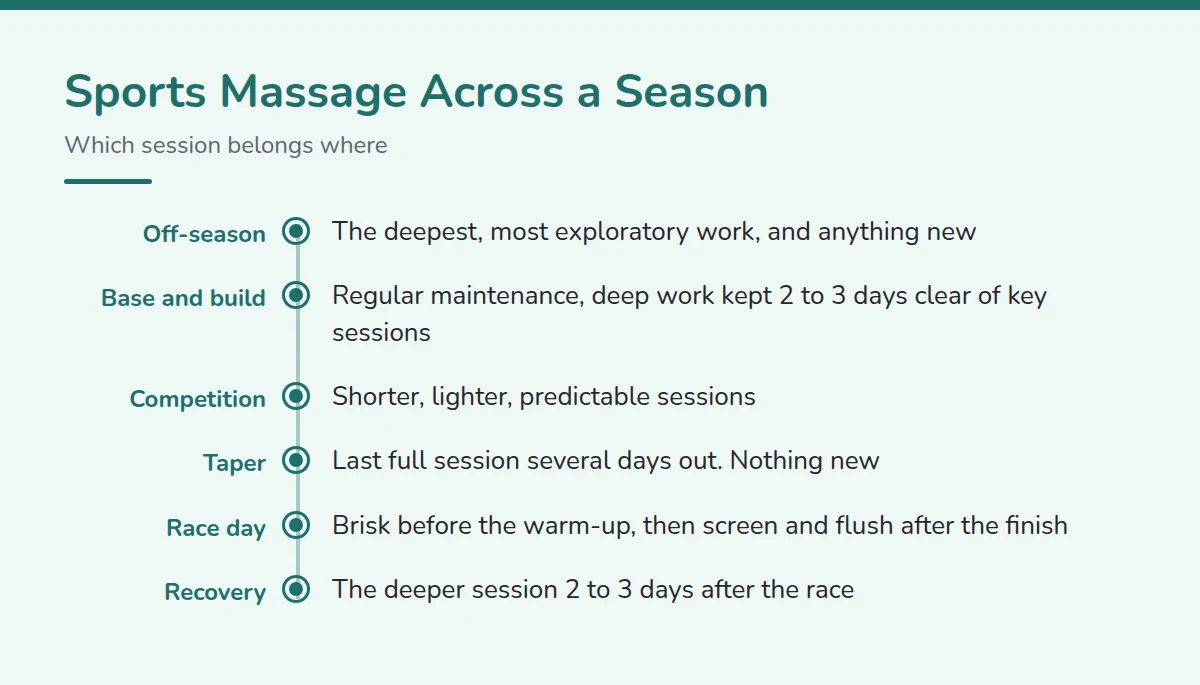
That calendar decides three things a relaxation session leaves to taste.
Pressure. Sports massage is not another name for deep tissue. Penny says its techniques run “from gentle and relaxing to deep and intense, depending on the goals of the session,” and that a session should never be excessively painful or unbearable. She separates the two by purpose: deep tissue work targets chronic tension, posture and overuse, while sports massage is built around performance, prevention and sports injuries. In practice the deepest sports work happens furthest from competition, and the lightest happens closest to it.
Length. On event days, sessions usually run ten to fifteen minutes. Maintenance is an ordinary sixty or ninety. The short event format is more than a logistics compromise: when Poppendieck and colleagues pooled 22 randomized trials of massage for performance recovery, sessions of five to twelve minutes tended to produce larger effects than those lasting longer than twelve.
Intake. A sports intake covers the training plan as well as the health history: the next hard session, the next race, recent injuries, and how the athlete’s legs usually feel the day after a massage. That last question matters more than it sounds. Some people are reliably sore for a day or two after deeper work, and Penny advises those athletes to leave more room before a race so the soreness is gone by the start.
Pre-Event Massage: Brisk, Brief, and Never Deep
A pre-event massage is about readiness, not repair. Penny’s description for runners is the right one: a fast, brisk pace that is not too deep, used as a supplement to the taper. On race day the therapist uses quick rhythmic strokes, compression and gentle movement through the muscles the event will load, and then gets out of the way of the athlete’s own warm-up.
That last point is where the research is clearest. Goodwin and colleagues gave 37 university players from repeat-sprint sports fifteen minutes of lower-limb massage before their standard warm-up, and their 30-meter sprint times were no different from those recorded after placebo ultrasound or plain rest. Fletcher tested the fast, superficial style that pre-event massage is supposed to use. On its own it produced slower 20-meter sprints than a traditional warm-up, and adding it to the warm-up gave no benefit over the warm-up alone.
Longer, slower work can take something away. In a ten-man study, Hunter and colleagues found that thirty minutes of leg massage lowered knee extensor force at the slowest test speed compared with lying at rest. Arroyo-Morales and colleagues recorded lower peak torque at higher speed after pre-event massage than after a sham treatment, and suggest the massage may have shifted the nervous system toward rest. Yet their massaged subjects also scored lower for tension on a mood questionnaire, and the authors see a possible role for pre-event massage in athletes prone to excessive pre-race nerves.
So the rules are simple. Keep it short and brisk. Finish before the active warm-up, never instead of it. No deep pressure, no trigger point work, and nothing the athlete has not had before. Sprinters, jumpers and throwers have the most to lose from a long, slow session on race day; the anxious marathoner who settles under familiar hands may have the most to gain.
The same logic holds in the days before the race, because a pre-race massage should mirror the taper. Bosquet and colleagues’ meta-analysis of 27 tapering studies found the best results came from a taper of about two weeks in which training volume fell by 41 to 60 percent while intensity and frequency stayed the same. Translated to massage, that means less of the familiar thing, not something new. Working the event itself, with a tent, per-hour rates and an organizer’s paperwork, is a different job, covered in our guide to on-site and event contracts.
Post-Event Massage: Screen First, Then a Gentle Flush
“Post-event” covers two different appointments. The first comes soon after the finish, at the event or at home that evening: slow, light strokes and gentle compression for ten to twenty minutes, aimed at comfort. Penny calls it a flush to prompt circulation, although, as the evidence section below explains, what it reliably changes is how the legs feel rather than what is in the blood. The second is a deeper session two to three days later, once the body has settled, to deal with lingering soreness and tightness. When to book that one is covered in our article on timing massage after a hard session. This section is about the first.
Screen Before Anyone Lies Down
A finish area is where real emergencies hide inside ordinary exhaustion, and none of them is treated with massage.
- Heat illness. Confusion, slurred speech, irrational behavior or a very high body temperature, sometimes with sweating that has stopped, are signs of heat stroke. The American College of Sports Medicine’s consensus statement calls exertional heat stroke a true medical emergency in which rapid whole-body cooling is essential. That athlete goes to the medical team immediately.
- Exercise-associated hyponatremia. Low blood sodium, most often linked to drinking more than thirst demands during a long event, causes vague symptoms such as bloating, vomiting, headache and altered mental state, and only a blood test confirms it. The Wilderness Medical Society’s guideline notes that it can develop up to 24 hours after a long effort and is easily confused with heat exhaustion.
- Exertional rhabdomyolysis. Severe exertion such as marathon running can break down muscle badly enough to damage the kidneys. Dark, red or cola-colored urine with muscle pain, tenderness or weakness needs a doctor, not pressure. A case report in Physical Therapy described a young woman with untreated iron-deficiency anemia who developed severe rhabdomyolysis after a cycling session, once her coach had worked her tired thighs with a percussion massage gun.
- Injury and clots. Sharp, localized pain, swelling, or a limb that will not bear weight is an injury to be assessed, not worked. A leg that is swollen, tender and painful to the touch can also signal a deep vein blood clot, and needs medical clearance before anyone massages it.
Then the Massage
Once an athlete is cleared to lie down, post-event work is the best supported of the three sessions, at least for how athletes feel. Nunes and colleagues randomized 74 Ironman finishers whose main complaint was pain in the front of the thigh. Those given quadriceps massage reported significantly less pain and fatigue than those who rested sitting down, although their pressure pain thresholds did not differ. A newer observational study led by the same author followed 738 triathletes who received one massage after Ironman races in Brazil. Pain and fatigue fell by clinically meaningful amounts, most of all in older athletes and in those who arrived hurting the most, while sex, body mass index and cramping made no difference. With no comparison group it cannot separate the massage from simple rest, but it supports the authors’ advice for big events: triage by symptoms, and give the table time to the people who need it most.
Between Rounds
Tournaments, heats and multi-event days blur the line between post-event and pre-event, and this is the one setting where the performance data look more encouraging. In a small study by Ogai and colleagues, eleven female student athletes performed two sets of all-out cycling sprints separated by 35 minutes of rest. With ten minutes of petrissage on the legs during that rest, they produced more power in the second set and recovered faster from muscle stiffness and perceived leg fatigue, while blood lactate behaved the same either way. Poppendieck’s meta-analysis points the same way: massage helped performance most when the recovery window was short and the exercise was intense and mixed, less after pure strength or endurance work, and less in trained athletes than in untrained people. Keep between-round sessions short, light and focused on the muscles the next round will use.
Maintenance Massage: The Work Between Races
Maintenance is what most athletes mean when they say they get regular massage, and it is the session with the most room in it. Penny describes it as work on the specific tissues that have become shortened, tight and painful during training, aimed at keeping that tightness from becoming an injury. It is a full table session of sixty to ninety minutes, with time to check range of motion, compare one side with the other, and go deeper where the calendar allows.
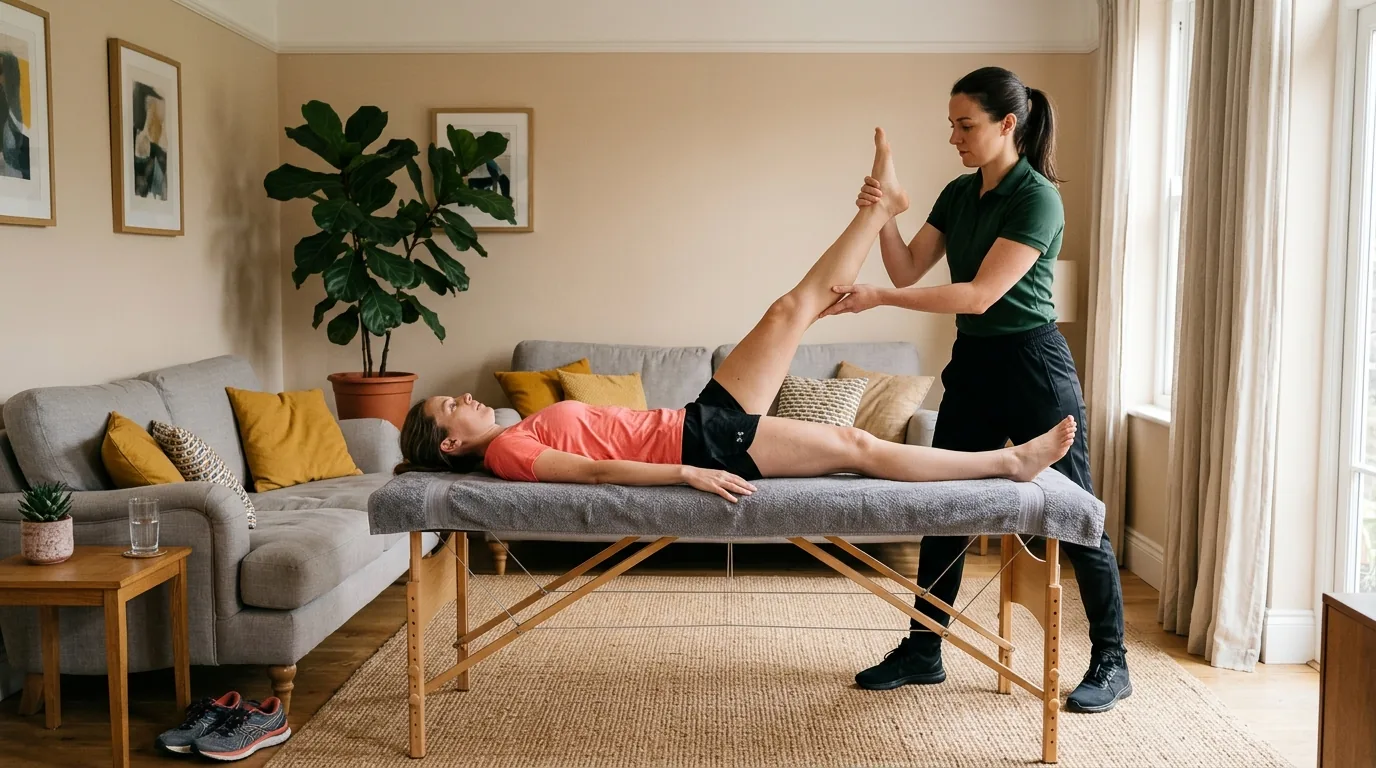
Julia Kirtland, a former U.S. marathon champion who now practices sports massage, told Runner’s World that massage helps athletes maintain muscle health by identifying areas of tension and addressing them before an injury occurs. The magazine likened the habit to checking a car’s oil and tire pressure. Her more important point is about patience: chronic problems take time, and athletes have to stay invested in muscle health over the long term, “not just waiting until they get hurt and can’t participate in their sport.”
The timing rule that matters most is distance from hard work. Book the deepest sessions at least two to three days before the next long run, interval day or race-pace workout, so any tenderness has faded by then; lighter work can sit closer. No trial has tested the ideal interval between maintenance sessions. In practice, many athletes settle on every two to four weeks during base training, closer together in the heaviest block, and further apart in the off-season, with budget deciding as much as physiology.
Keep massage in its place, too. Penny describes sports massage as one component of a plan that also includes strength training, mobility work, active rest, nutrition, hydration and a sensible running schedule. It is not a substitute for any of them.
Her fourth category, treating injuries, is where scope matters. A massage therapist does not diagnose. Pain that is sharp, worsening, or changing how an athlete moves needs a physician or physical therapist first, and massage can then work alongside their plan once they have cleared it.
What the Research Supports, and Where It Runs Thin
The largest review so far, Davis, Alabed and Chico’s 2020 meta-analysis of 29 randomized studies with 1,012 participants, looked for a performance benefit in strength, jump height, sprint speed, endurance and fatigue, and did not find one on any of those measures. The two outcomes that did move, by small but statistically significant margins, were flexibility and delayed onset muscle soreness. As Runner’s World noted, the flexibility gains were measured against doing nothing, not against stretching or light exercise.
Dakić and colleagues reached the same split in a 2023 review of 114 studies. Massage did not change motor abilities other than flexibility, and it did not change blood lactate clearance, muscle blood flow, muscle temperature or muscle activation. Where it did show up was in pain, soreness, perceived fatigue, mood, relaxation and the perception of recovery. Their conclusion fits the whole field: using massage purely to improve results looks questionable, but it supports performance indirectly, by helping athletes stay focused and relaxed and recover between efforts.
A small boxing study by Hemmings and colleagues captured that gap years earlier. Eight amateur boxers who were massaged between two bouts felt significantly more recovered than when they simply rested, yet performed no better in the second bout and cleared blood lactate no faster.
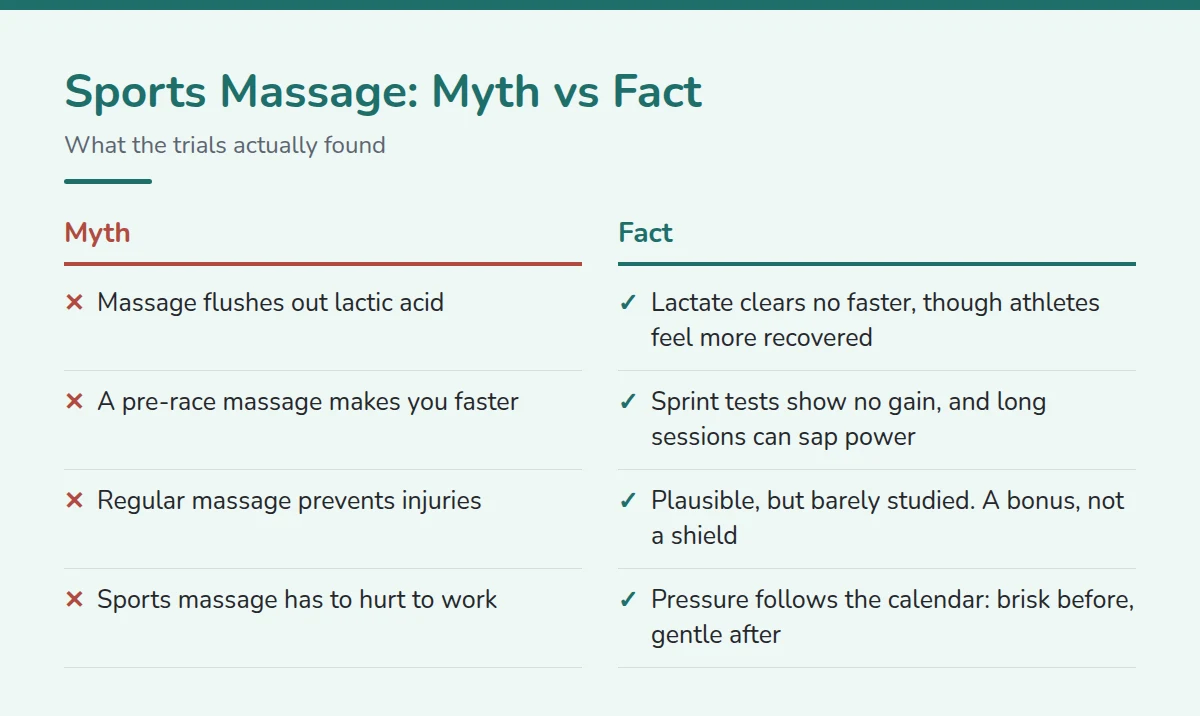
Two cautions keep these reviews from being the final word. Moraska’s review notes that many sports massage studies are limited by inadequate therapist training, treatment too short to matter, few subjects, or muscles worked too much or too little, so some trials test something quite unlike what a skilled therapist delivers. And the claim athletes most want to believe, that regular massage prevents injury, has barely been studied: Weerapong, Hume and Kolt found little research on whether massage prevents injury, and called the effects of massage type and timing unclear.
None of this makes sports massage pointless. Soreness, stress and the feeling of being recovered decide whether an athlete runs the session they planned, and those are exactly the things massage moves. The honest pitch is comfort and consistency, not speed.
Mapping the Three Sessions Across a Season
A training year moves through phases, and each one changes which session makes sense. No trial has tested this calendar as a whole; it applies the findings above to the way athletes actually train.
- Off-season. Light training and nothing at stake, so this is the time for the deepest and most exploratory work, a new technique or a new therapist, and whatever the last season left behind.
- Base and build. Volume climbs, then intensity follows. Maintenance runs at its regular rhythm on easy days, with deep work kept two to three days clear of key sessions.
- Competition phase. For athletes racing often, or team players with a weekly game, maintenance gets shorter, lighter and more predictable. Nothing new goes in while results count.
- Taper. Volume drops while intensity holds, and massage follows: the last full session several days out, lighter than usual, from a therapist the athlete already knows.
- Race day. An optional brisk pre-event session that ends before the warm-up, then screening and a gentle flush after the finish.
- Recovery. The deeper session two to three days after the race, then back to maintenance as training resumes.
For Therapists: Building a Maintenance Service
Event work is visible and seasonal. Maintenance is where a sports practice earns a steady living, and mobile work suits it, because an athlete in a heavy training block has little spare time for driving to appointments.
Plan the season with the athlete. Ask for the race calendar at intake along with the health history, then book the maintenance block around it, the way a coach plans training. The athlete gets sessions that respect the taper, and you get recurring work that does not depend on someone remembering to rebook.
Price the specialist time. In our survey of published mobile rates, the typical sixty-minute sports massage cost $120, level with deep tissue and above Swedish at $104, and the gap widened at ninety minutes ($175 against $150 for Swedish). The full price breakdown has the detail, and season packages fit neatly beside the bundles in our service menu guide.
Stay inside your scope. No state issues a separate sports massage license. Where massage is regulated, sports work falls under the same license as any other session, and sports massage certificates are private training credentials, not permission to diagnose or prescribe rehabilitation. Whether techniques such as kinesiology taping sit inside a massage license varies by state, so check with your board; our licensing and scope of practice guide explains how.
Insure it properly. Professional liability insurance is non-negotiable for any practicing therapist, sports work included, and event organizers will usually want a certificate of insurance before you set up a table.
Vet maintenance clients like anyone else. A fit, friendly athlete booking a recurring slot is still a new client whose home you are entering. The same screening, check-in and boundary rules apply.
Before a race, brief and brisk, then the warm-up. After it, screening first, something gentle, and the deeper work two or three days later. In between, regular maintenance built around the training calendar and sold honestly as comfort and consistency rather than speed. That is the most the research can promise an athlete, and a therapist who explains it that way is usually the one they book again next season.
Sources
- Davis, Alabed and Chico pooling 29 randomized trials of sports massage on performance and recovery
- Dakić and colleagues on what 114 studies show massage does and does not change in athletes
- Moraska with a comprehensive review of sports massage research and its limits
- Poppendieck and colleagues for which massage lengths and recovery windows helped performance
- Goodwin and colleagues testing lower-limb massage before 30-meter sprints
- Fletcher comparing precompetition massage with a traditional warm-up
- Hunter and colleagues on knee extensor force after thirty minutes of leg massage
- Arroyo-Morales and colleagues measuring torque, tension and mood after pre-event massage
- Bosquet and colleagues for the meta-analysis behind the two-week taper
- Roberts and colleagues with the American College of Sports Medicine consensus on exertional heat illness
- Hew-Butler on the symptoms and causes of exercise-associated hyponatremia
- Bennett and colleagues for the Wilderness Medical Society hyponatremia guideline
- Chen and colleagues reporting rhabdomyolysis after a percussion massage gun
- MedlinePlus on the causes and warning signs of rhabdomyolysis and how heat illness progresses to heat stroke
- National Heart, Lung, and Blood Institute for the leg symptoms of a deep vein blood clot
- Nunes and colleagues on massage after a long-distance Ironman triathlon and which finishers got the most relief
- Ogai and colleagues on petrissage between bouts of all-out cycling
- Hemmings and colleagues with perceived recovery and repeated boxing performance
- Weerapong, Hume and Kolt reviewing the mechanisms of massage and the evidence on injury prevention
- Runner’s World with a physiotherapist’s guide to the four times to book and a former marathon champion’s case for maintenance work
Further reading
- How Soon After a Hard Session Should an Athlete Book? The DOMS Recovery Evidence
- On-Site and Corporate Mobile Massage: The Complete Guide to Workplace and Event Contracts
- Handheld Massage Tools Worth Recommending Between Sessions: A Therapist’s Picks
- State Licensing and Scope of Practice: A Mobile Therapist’s Compliance Guide
- Personal Safety for Mobile Massage Therapists: A Comprehensive Protocol