Massage for Chemotherapy-Induced Peripheral Neuropathy: What the Dosing Trial Found and How to Work Numb Feet Safely at Home
Published on October 27, 2026
The Side Effect That Outlasts the Chemo
Chemotherapy ends on a date on the calendar. For many of the people who go through it, the numbness in their feet does not end with it. Chemotherapy-induced peripheral neuropathy, or CIPN, is damage to the peripheral nerves caused by the drugs themselves. Among the most common culprits are the platinum drugs such as oxaliplatin and the taxanes such as paclitaxel and docetaxel. Clients describe tingling, pins and needles, numbness, burning, electric jolts and an odd sensitivity to cold, mostly in the feet and hands.
It is common, and it lingers. Pooling 31 studies of 4,179 patients, Seretny and colleagues found neuropathy in 68 percent of people in the first month after chemotherapy, 60 percent at three months and 30 percent at six months or more. Among 512 women survivors studied by Winters-Stone and colleagues, 47 percent still had symptoms an average of six years after treatment, and those women walked more slowly, reported more disability and fell more often than women without symptoms.
Medicine has little to offer them. The American Society of Clinical Oncology’s 2020 guideline update recommends no drug to prevent CIPN, and it names duloxetine as the only medicine with adequate evidence for established painful neuropathy while noting that its benefit is limited. So survivors go looking for something else, and some of them call a massage therapist.
Our guide to mobile massage for cancer patients gives this symptom one line: never apply pressure to an area where the client has lost sensation. That line stands. This article is what sits behind it: what the best trial so far found, how to turn that into a sensible course of visits, and how to work on feet that cannot tell you when something is wrong.
What the Dosing Trial Tested
The study is a randomized pilot trial run at MD Anderson Cancer Center and published in Scientific Reports in 2022 by Lopez and colleagues. It enrolled 71 survivors whose lower-leg neuropathy had been caused by oxaliplatin, paclitaxel or docetaxel. All were at least six months past their last chemotherapy, more than three years past it on average, and all rated their neuropathy at 3 or more out of 10. Most were women (77.5 percent), 57.7 percent had been treated for breast cancer and 42.3 percent for a gastrointestinal cancer, and the average age was 60.
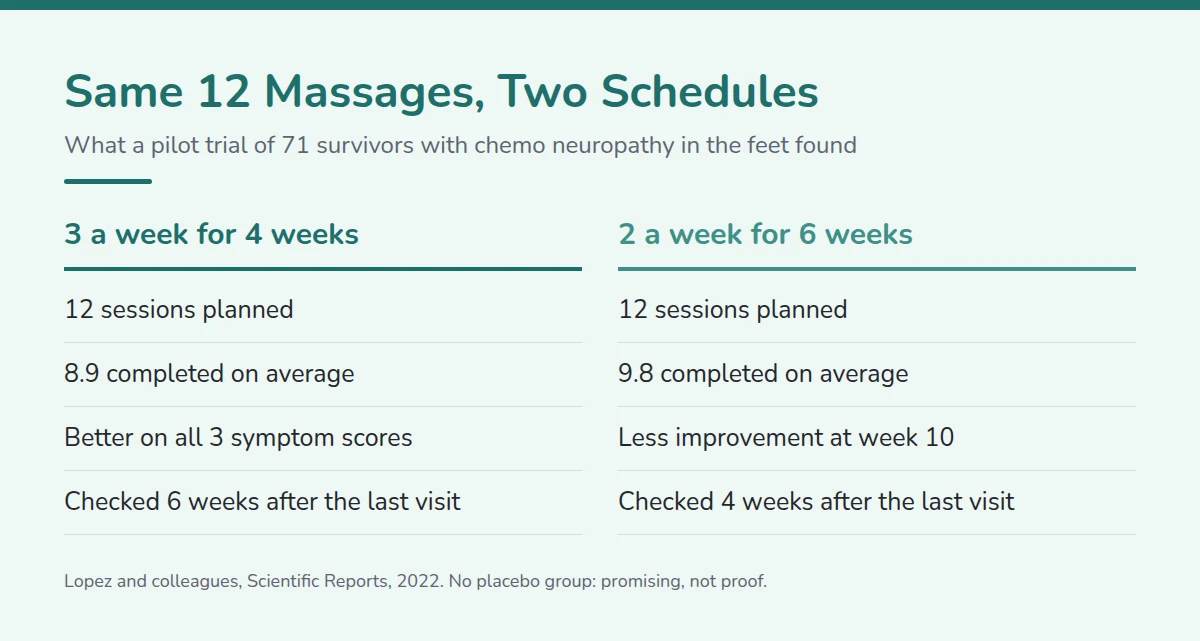
The trial asked two questions at once. The first was where to massage. Two groups received a standardized Swedish massage protocol on the lower legs and feet, while two comparison groups received massage to the scalp, neck, shoulders and upper back instead, a design meant to control for the passage of time and for the effect of a therapist’s attention. The second question was how often. Within each pairing, one group had three sessions a week for four weeks and the other had two a week for six weeks. Both schedules planned for twelve sessions, so only the spacing differed.
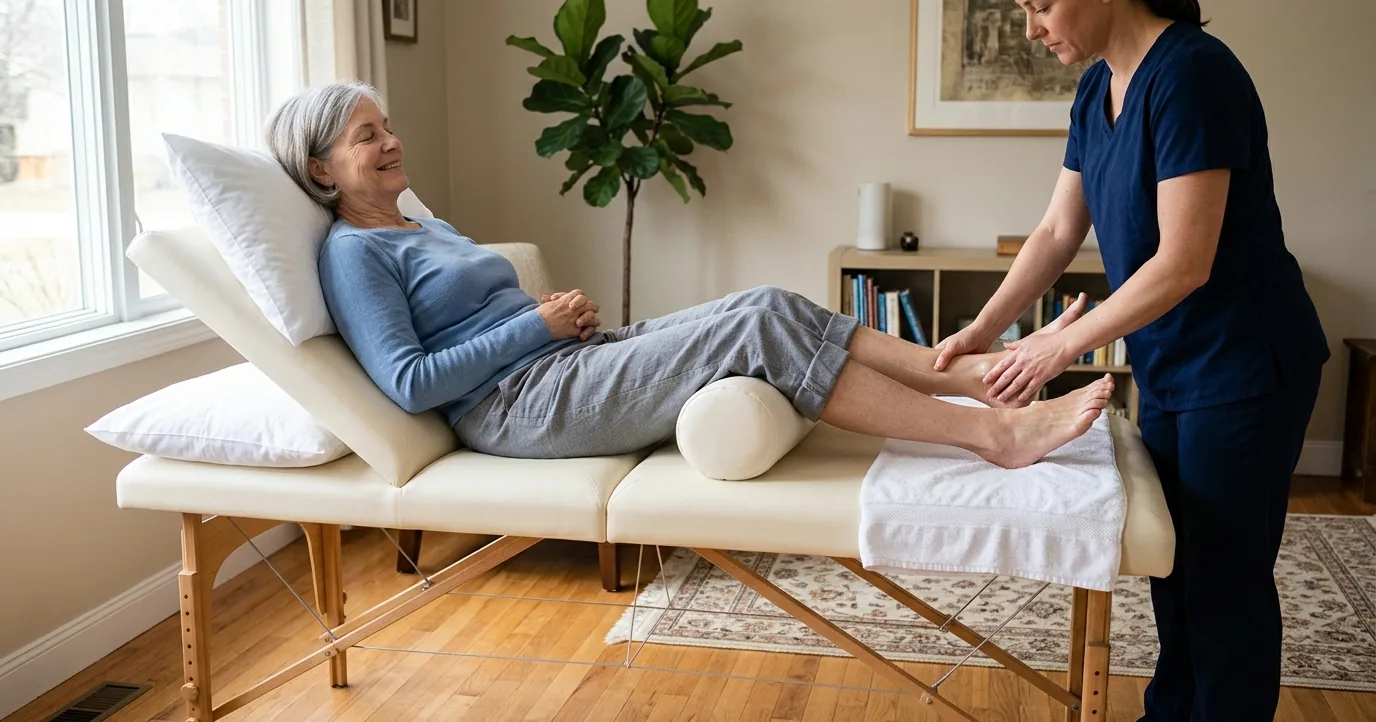
The protocol is worth knowing, because it is shorter and gentler than most people imagine. Three licensed oncology massage therapists, each with more than 15 years of experience, gave every session. A whole visit took 30 minutes or less, setup and positioning included, with 10 to 12.5 minutes of massage on each leg. The client lay semi-reclined with the knees supported on a bolster. The therapist applied a hypoallergenic, unscented lotion below the knees, began at the toes, finished at the knee and raised pressure only gradually, as far as the client could tolerate, following oncology massage guidelines. The room was kept at a controlled temperature, with no music playing.
Schedule Mattered More Than Site
Feasibility came first, since it was the trial’s main question. On the three-a-week schedule, participants completed an average of 8.9 of their 12 sessions; on the twice-weekly schedule, 9.8. That difference was not statistically significant. Packing the sessions closer together did not make people drop out.
Symptoms were scored with the Pain Quality Assessment Scale, a 20-item questionnaire that rates three kinds of sensation separately: deep aching and cramping, surface sensations such as numbness, tingling, itch and cold, and sudden shooting or electric pain. Everyone was assessed 10 weeks after starting. On all three scores, the groups that had three sessions a week came out significantly better than the groups that had two. Whether the massage went to the legs or to the neck and shoulders made no significant difference to those scores at 10 weeks.
Two refinements matter. First, direct work showed a signal of its own. In one analysis, lower-leg massage eased the shooting, electric kind of pain more than the comparison massage did. And the lower-leg group on three sessions a week improved by more than 2 points on 16 of the 20 individual symptoms, and by more than 3 points on six of them, while the lower-leg group on two a week had no symptom improve by more than 2. Most of those item-by-item comparisons did not reach statistical significance, so read them as a hint.
Second, the benefit seemed to hold. Because everyone was assessed at week 10, the three-a-week groups had gone six weeks without massage by then, two weeks longer than the twice-weekly groups, and they still scored better. At their exit interviews, 88 percent of participants agreed their neuropathy had improved, and 84 percent called their schedule acceptable.
How Much a Pilot Trial Can Carry
This is a pilot, and its authors say so plainly. There was no usual-care or placebo group, since everyone received some form of massage, so the trial cannot separate massage from the slow natural recovery some neuropathy makes. Most participants were more than three years out from chemotherapy, when a big spontaneous change within ten weeks is less likely, but that is an argument rather than a control group. The trial ran at a single academic cancer center, included only breast and gastrointestinal cancers treated with three drugs, and made no correction for testing many outcomes at once, so the authors call its results hypothesis-generating. Its questionnaire measures how symptoms feel, not how well someone walks or balances, and the two-week difference between the schedules is itself a confounder.
The wider literature leans the same way and carries the same caution. A 2026 meta-analysis by Chen and colleagues, pooling 11 randomized trials with 646 patients, found that hands-on approaches such as massage, reflexology and acupressure may ease sensory and motor symptoms and improve quality of life in CIPN, but it judged the certainty of that evidence low to very low. A 2023 network meta-analysis by Zhang and colleagues found massage outperformed the other non-drug treatments it compared on pain and neuropathy symptoms, while cautioning that the limitations of the included studies call for care in reading it. And when Yang and colleagues looked back at 23 patients who had a single massage for CIPN at a comprehensive cancer center, ratings of pain and neuropathy had dropped immediately afterward. That tells you how a client may feel as you pack up, not what lasts.
Prevention during treatment is a separate question. Izgu and colleagues randomized 40 women with breast cancer to classical massage before each paclitaxel infusion or to usual care, and at week 12 the massage group had less neuropathic pain and better results on nerve conduction tests. It is a small trial in an infusion setting, and not the work most mobile therapists will be asked to do.
So here is the defensible sentence to say to a client. In a small pilot trial of survivors with lasting neuropathy in the feet, twelve gentle massages packed into four weeks eased symptoms more than the same twelve spread over six, and the gains were still there six weeks later. It is promising, it is not proof, and it does not repair nerves. Our guide to what the research actually says about massage explains why trials like this are hard to run and how to read one before you quote it.
Clearance First: The Exclusion List Is Your Intake
Neuropathy is diagnosed by the medical team, not by you, and anyone with a cancer history starts with written clearance from their oncology team before the first session.
This trial also hands you a screening list, because it shows exactly whom its evidence does not describe. It excluded people with:
- Neuropathy that began before their chemotherapy
- Platelets under 50,000, or a severely low neutrophil count, in the previous six months
- A deep vein thrombosis in the past year, or an untreated leg clot at any time
- Bone metastases
- An active skin infection
- Lymphedema in the area to be massaged
- Pregnancy
- Diabetes
An active infection or an untreated clot in the leg rules out lower-leg work altogether. For the rest, the trial simply says nothing about those clients, so the oncology team needs to clear that specific issue in writing. Diabetes deserves its own question, because it damages the same nerves and a survivor may have both. Our dialysis fatigue guide covers working on diabetic feet, and the same look-first habit applies here.
Add three questions of your own. Ask whether they have fallen, or nearly fallen, in the past month. Ask what they take for nerve pain and whether it makes them drowsy or dizzy; the trial’s authors list drowsiness among the side effects of duloxetine. And ask them to show you where the numbness starts and stops, and whether any area is painfully sensitive rather than numb.
Then know the stop signs. New numbness, numbness that is spreading quickly, new weakness, or symptoms on one side only mean no session today and a call to the care team. A calf that is swollen, warm, red or painful on one side may be a clot: leave it alone and send the client for urgent medical care.
Turning Dose Density Into a Course of Visits
The practical lesson is to book this as a block rather than an open-ended weekly slot: twelve short visits over four weeks, three a week. A 30-minute visit is not a lesser service here. It is the service that was tested, and padding it out to a full hour adds table time that nobody has shown helps.
Three visits a week to one address reshapes your route, so price the four weeks as a package rather than charging a full travel fee three times a week, and set those visits on days you already work in that part of town.
Build slack into it. Even in a motivated trial group, the average participant missed about three of the twelve sessions. Survivors still carry fatigue, follow-up appointments and bad days, so put make-up visits inside the four weeks and do not charge for a reschedule the client could not avoid.
Be careful what you sell afterward. The trial’s authors raise maintenance sessions as an open question, and no one has tested them. Offer a check-in at the end of the block, let the client judge whether the benefit is holding, and do not present an indefinite monthly plan as evidence-based.
On a day when the feet are off limits, whether from an open sore, new swelling, an infection or pain that will not tolerate touch, the neck, shoulders and upper back are still available. In this trial that comparison massage was not clearly worse on the main scores, which makes it a reasonable fallback, not a proven equal.
Working on Feet That Cannot Report Back
Your usual pressure gauge is the client’s feedback, and numb skin breaks it. Everything in this section follows from that.
Look before you touch. Check both feet, tops, soles and between the toes, before any lotion goes on. Someone who cannot feel their feet may not know about a blister, a cut or a sore. If you find one, leave that foot alone and ask the client to show it to their care team.
Then work the way the trial did: slow, broad, gliding strokes from the toes toward the knee, light at first, with pressure building only where the client can feel and report it. Where sensation is gone, stay light the whole way through, because nobody in the room can tell you when it is too much. That is what the cancer guide’s rule means in practice. Leave deep friction and percussion off the lower legs entirely.
Keep heat and cold off numb skin. The American Cancer Society tells people with neuropathy to avoid extreme temperatures in either direction, and the National Cancer Institute notes that damaged sensory nerves can stop someone feeling heat at all. That rules out hot stones, heated towels and wraps, heating pads, warm foot soaks and ice packs on any area the client cannot feel. Our hot stone guide already lists neuropathy among the conditions that need a physician’s input first; on numb feet, leave the stones in the car. Warm the room, warm the lotion between your palms, and keep a blanket over the rest of the body instead.
Use a hypoallergenic, unscented lotion, as the trial did, and only as much as you need to glide. Whatever you use ends up on the soles of feet that are about to stand on your client’s floor.
Clients often buy gadgets to use between visits, and a heated foot massager or a percussion gun has the same feedback problem as a hot stone. Our handheld tools guide says anyone with a condition that dulls sensation needs a doctor’s go-ahead before using one, and CIPN is exactly that condition.
Fall-Proofing the Visit
Neuropathy and falls travel together. Women with CIPN symptoms in the Winters-Stone study had 1.8 times the fall risk of women without them, and the risk climbed with symptom severity. Among 296 breast cancer survivors treated with taxanes, Bao and colleagues found that 23.8 percent of those without neuropathy reported falls, against 31.9 percent with mild symptoms and 41.5 percent with moderate to severe ones.
A home visit adds hazards of its own: a client who cannot feel the floor, lotion on the soles, a portable table at working height, a rug pushed aside to make room, and a body that has been lying still for half an hour. The National Cancer Institute adds that damage to the autonomic nerves can cause dizziness from low blood pressure, one more reason to get up slowly.
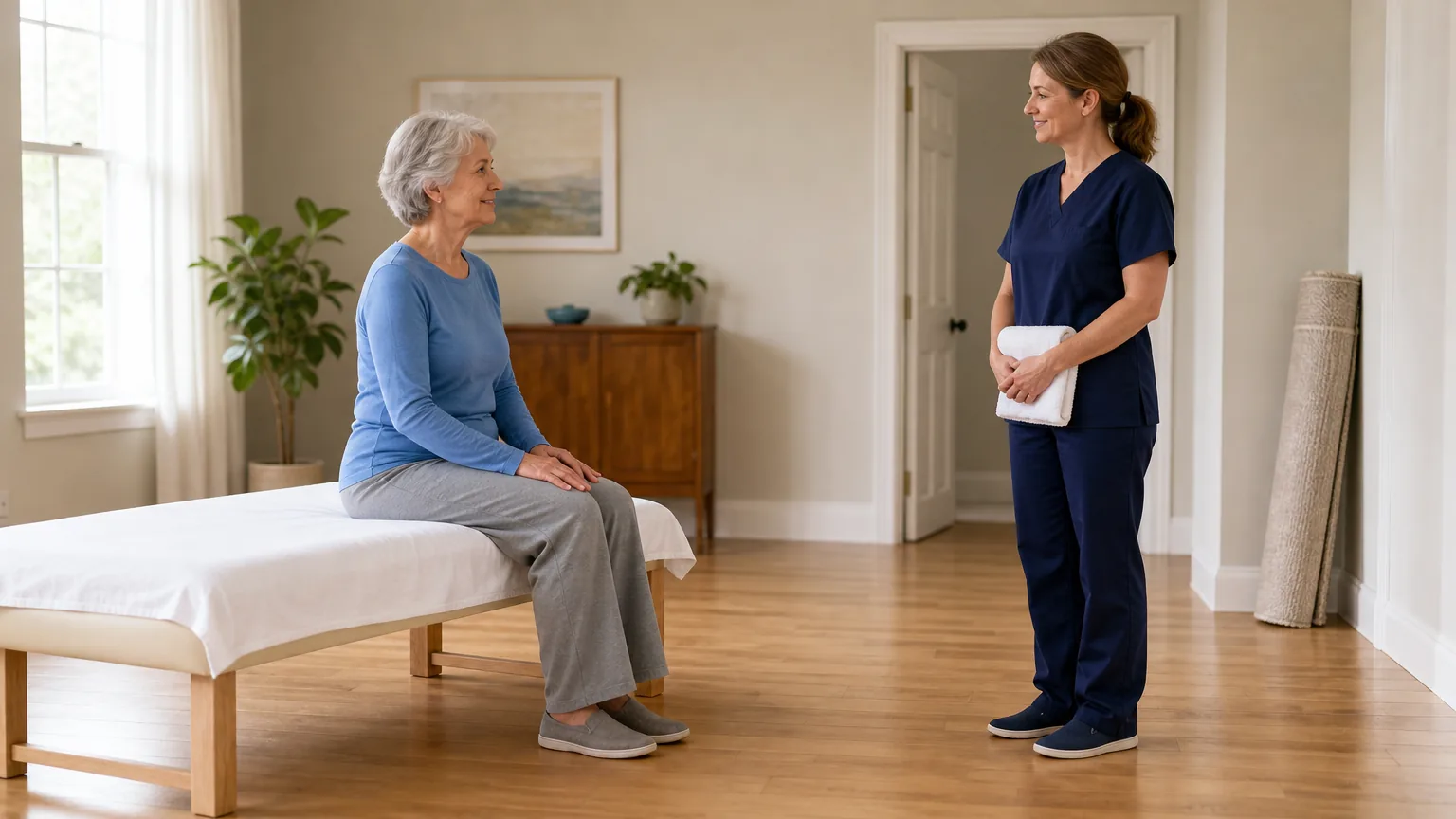
- Consider skipping the table. The trial’s position, semi-reclined with the knees on a bolster, works in the client’s own recliner, on a sofa or on a bed with the head raised, with you on a low stool at the feet. No transfer, and no table height to manage.
- If you use the table, take it to its lowest setting. If the client’s feet still cannot rest flat on the floor from the edge, work in the recliner or bed instead, because sliding down onto a floor they cannot feel is how a fall starts. Never offer a step stool.
- Clear the route. Move rugs, cords and your own bags out of the path between the client’s chair and the table.
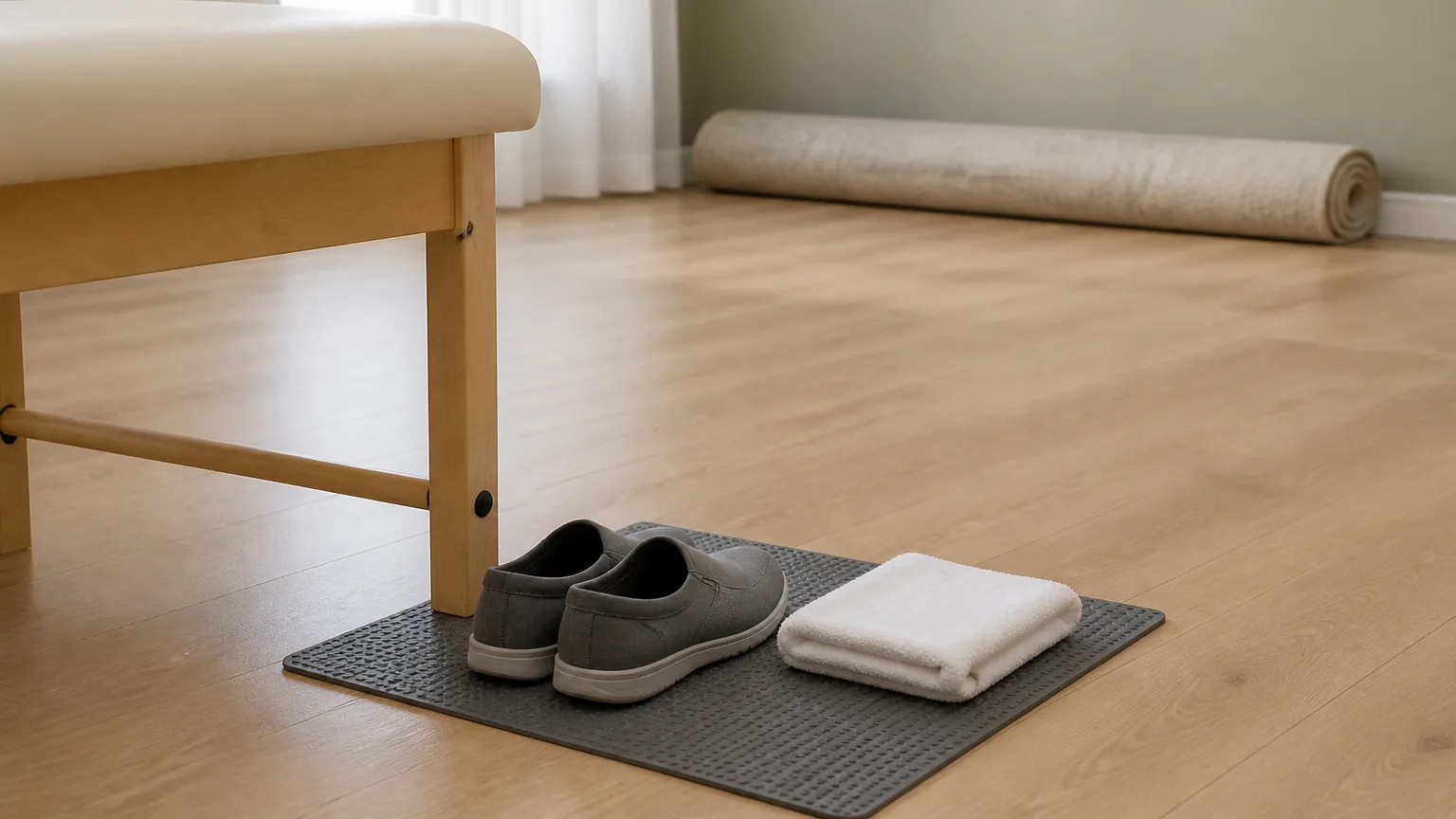
- Wipe the soles before standing. Then the client’s own closed shoes go on. Both the American Cancer Society and the National Cancer Institute advise people with neuropathy to wear shoes indoors as well as out, and NCI specifies sturdy ones with soft soles.
- Sit up in stages. Reclined to sitting, then a full minute sitting with both feet on the floor, then standing, with you within arm’s reach.
- Light the way. After an evening session, leave a lamp on along the route to the bathroom.
Near falls belong on your intake form too. Visovsky and colleagues urge clinicians to ask survivors treated with taxanes about near falls, not only falls, and suggest a prompt referral to physical therapy to strengthen the legs. Massage is not balance training, so a client who reports either should hear from you that their oncology team and a physical therapist need to know.
And check your own cover. A client falling during a home visit is precisely the incident professional and general liability insurance exist for, so confirm that both follow you into clients’ homes before you take on this work.
For Survivors: Questions to Ask Before You Book
If you are living with neuropathy and thinking about massage, a few questions sort out who is ready for you:
- Have you trained in oncology massage? The therapists in the trial each had more than 15 years of experience.
- Will you ask for my oncology team’s clearance before the first session?
- Will you check my feet before you start, and keep heat away from the areas I cannot feel?
- Can you see me three times a week for four weeks, with visits of about half an hour?
- What will you do on a day when my feet are too sore or damaged to work on?
A therapist who answers those easily, and who does not promise to heal your nerves, is a good sign. Licensing and scope of practice vary by state, so also confirm they hold a current license where you live.
The Honest Offer
Done this way, the offer is modest and real: short, gentle, frequent lower-leg massage built on the best trial available, in a home set up so the client never burns, slips or falls on your watch. You cannot promise the nerves will heal. You can ease how the feet feel for a while, and do it without asking someone to drive anywhere on feet they cannot feel.
Sources
- Lopez and colleagues on the pilot trial comparing two massage schedules for chemotherapy neuropathy
- Chen and colleagues with a 2026 meta-analysis of hands-on therapies for CIPN
- Zhang and colleagues comparing non-drug treatments for chemotherapy nerve damage
- Yang and colleagues on symptom ratings before and after a single massage for CIPN
- Izgu and colleagues testing classical massage during paclitaxel treatment
- Seretny and colleagues for how many patients still have neuropathy months after chemotherapy
- Winters-Stone and colleagues on falls, gait and disability in women with lasting CIPN
- Bao and colleagues with fall rates by neuropathy severity in breast cancer survivors
- Visovsky and colleagues on why near falls matter after taxane chemotherapy
- Loprinzi and colleagues for ASCO’s 2020 guideline on preventing and treating CIPN
- National Cancer Institute on nerve problems from cancer treatment and preventing falls at home
- American Cancer Society for foot care, footwear and temperature safety with neuropathy
Further reading
- Mobile Massage for Cancer Patients: An Evidence-Based In-Home Guide
- What the Research Actually Says About Massage: An Evidence Guide for Clients
- Massage for Dialysis Fatigue: Working With Clients Whose Week Is Already Spent
- The Healing Power of Hot Stones in Mobile Massage
- Handheld Massage Tools Worth Recommending Between Sessions: A Therapist’s Picks