How Soon After a Hard Session Should an Athlete Book? The DOMS Recovery Evidence
Published on September 22, 2026
The Text You Get the Next Morning
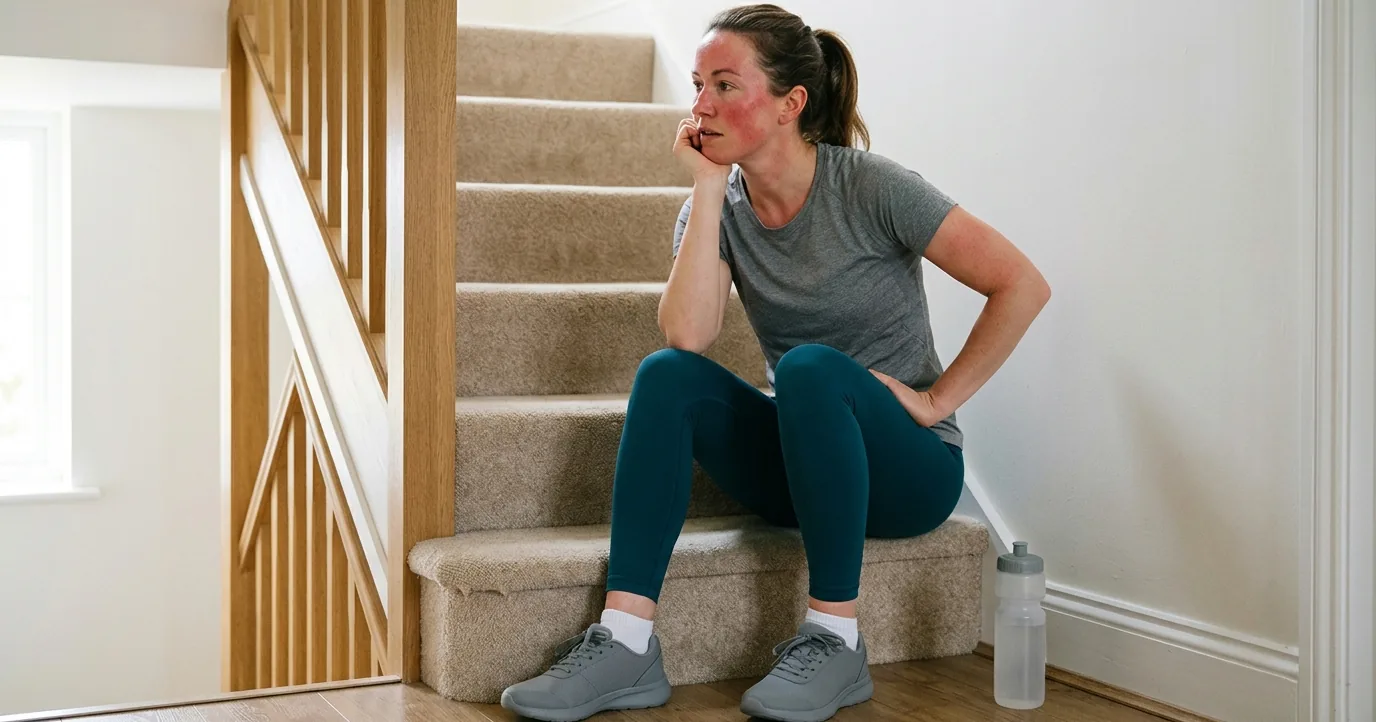
It usually arrives about eighteen hours after the damage. A client ran a downhill half marathon, or went back to heavy squats after six weeks away, or did Murph in a weighted vest, and now they cannot get down their own stairs without the handrail. Can you come today? Will it help?
There are two honest answers, and most therapists give only the flattering one. Massage will almost certainly make that client feel better. It will probably not make them stronger any sooner. Those are two different results, measured with two different instruments, and the research has been able to tell them apart for nearly thirty years. Knowing which one you are selling is what separates a therapist an athlete keeps from one they try once.
Soreness and Performance Are Two Separate Endpoints
The cleanest demonstration is also one of the oldest. Hilbert, Sforzo and Swensen induced delayed onset muscle soreness in eighteen volunteers with six sets of eight maximal eccentric hamstring contractions, then gave half of them twenty minutes of massage two hours later and the other half a sham treatment. At 48 hours the massage group rated the intensity of their soreness significantly lower than the controls. Peak torque, range of motion, neutrophil count and mood showed no treatment difference at all. The muscle was not working any better. It simply hurt less.
That split keeps reappearing. Farr and colleagues found the same thing after downhill walking: massage attenuated soreness and tenderness, while the strength and functional declines went untouched. Weber, Servedio and Woodall tested massage, upper body ergometry and microcurrent stimulation against plain rest after eccentric elbow work and found no statistically significant difference between any of the four groups. Tiidus, reviewing the field for the Journal of Orthopaedic and Sports Physical Therapy, concluded there was little evidence that manual massage meaningfully changed the recovery of muscle function, and noted that light exercise probably did more.
Ernst’s systematic review in the British Journal of Sports Medicine gathered seven controlled trials and reached the careful version of the same verdict: most were burdened with serious methodological flaws, the results were far from uniform, and most of them still suggested that post-exercise massage may relieve the symptoms. Moraska’s later review of the sports massage literature put it in one line worth memorizing. Soreness associated with DOMS is reduced by massage. Whether force recovers faster is still unclear.
None of that makes the work pointless. Soreness is the reason athletes skip Tuesday, and a client who feels loose enough to run the session they planned has gained something real, even if a dynamometer cannot see it. The physiology behind why that relief is genuine rather than imaginary sits in our explainer on how touch affects the nervous system. Just do not let it get described as repair.
So When Should They Actually Book?
The trials point at a window rather than a moment, and it is later than most athletes assume.
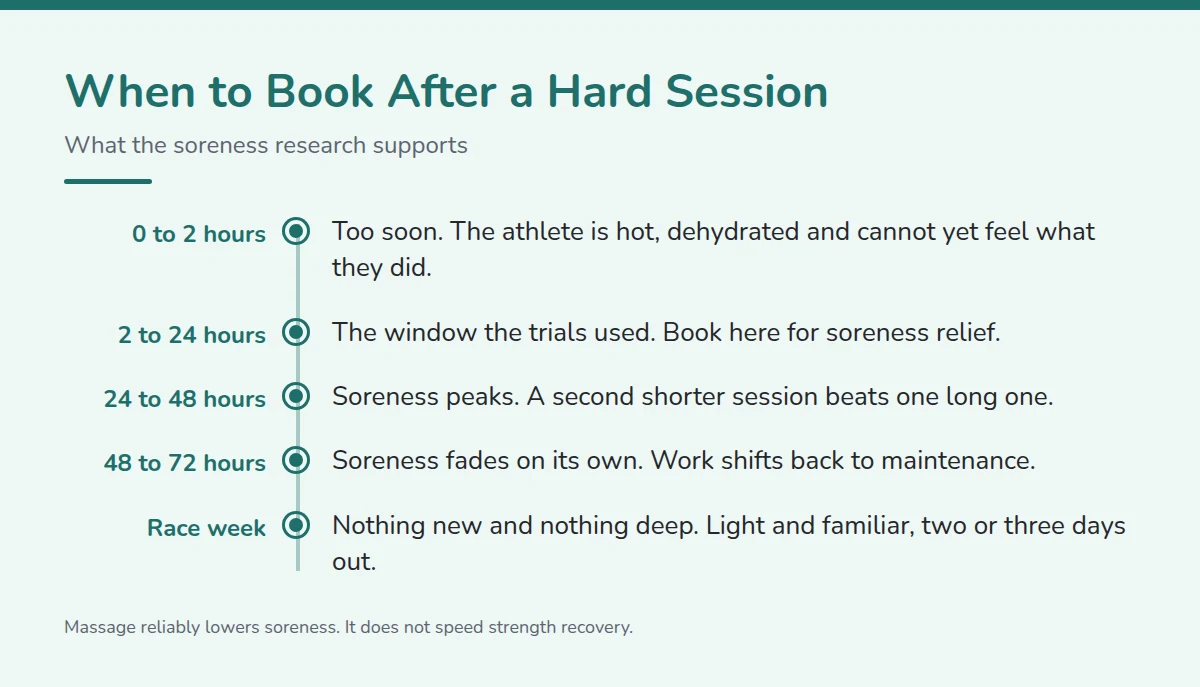
Immediately after a hard effort is the weakest slot. The client is dehydrated, still hot, and their sense of what hurts has not caught up with what they did. Hilbert’s protocol deliberately waited two hours. Coverage in Runner’s World gives working athletes the same steer from the practical side: take the session later in the day rather than straight off a long run, and treat the day after the hardest effort as the other good slot.
That second slot matters because of how DOMS behaves. Soreness climbs through the first 24 hours, peaks somewhere between 24 and 48, and fades on its own by about 72. Booking at 24 hours puts your hands on the muscle as the symptoms arrive rather than after they have gone, which is exactly where the 48 hour measurements in the literature were taken.
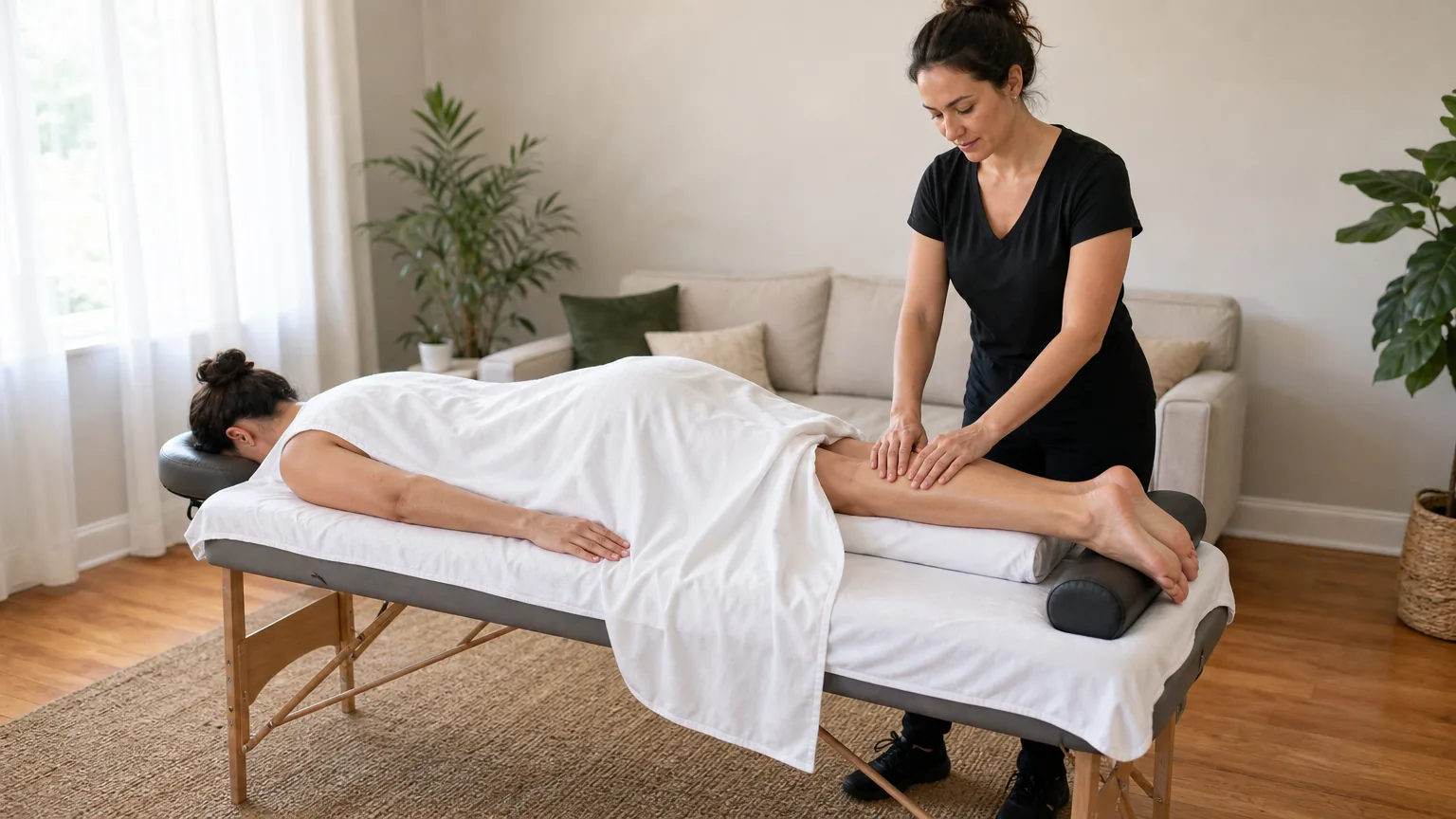
Two shorter appointments also beat one heroic one. The recent trials that found the largest effects delivered treatment twice, once after the damaging bout and once at 24 hours, rather than staging a single long session. For a mobile practice that is a scheduling question more than a clinical one, and it is worth pricing as a pair rather than hoping the client rebooks.
The Cold Water Question Every Athlete Will Raise
Pereira and colleagues, publishing in PLoS One, randomized thirty experienced CrossFit athletes after a Murph workout to either massage or cold water immersion. The cold group came out ahead on pain, at rest and during exercise, to the point that nobody in that group reported pain at the 48 hour mark. The authors flag the limits themselves: thirty people, no blinding, so read it as a signal rather than a settled result.
So why not tell every sore athlete to sit in a bin of ice? Because cold has a cost that hands do not. In a USA Track and Field piece on trendy recovery strategies, the US Anti-Doping Agency’s science director Dr. Laura Lewis sets out the caveat directly: ice baths do help most athletes feel less sore, but research shows they can blunt some of the muscle growth adaptations a hard session was meant to produce. Her advice is to skip the plunge after a heavy lifting day unless you specifically need to feel better for a competition or another session later. When it is worth using, 8 to 15 degrees Celsius for 5 to 10 minutes is enough, and colder or longer is just less comfortable.
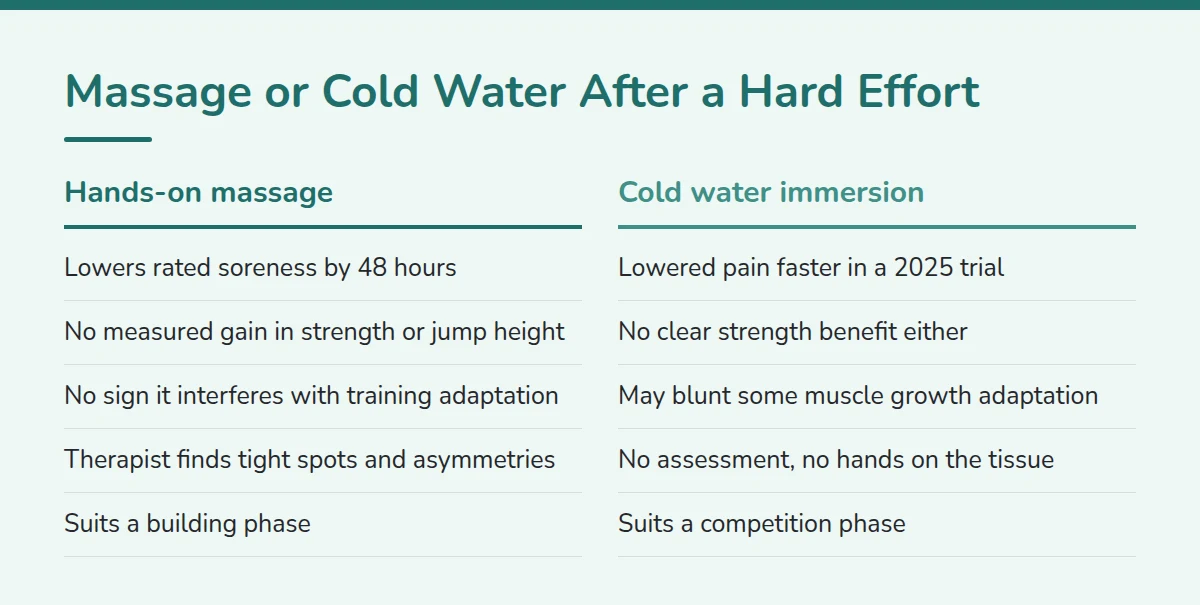
That gives you a genuinely useful thing to tell a client. In a building phase, when the point of the training is adaptation, hands-on work is the safer choice because it does not appear to interfere with the stimulus. In a competition phase, when the point is to be ready again by Saturday, cold water has the stronger short-term soreness data behind it. They are not competitors so much as tools for different weeks.
Percussion, Vibration, and the Work Between Visits
Every athletic client owns a percussion device or is about to buy one, so have a position ready.
Li and colleagues, in Frontiers in Public Health, randomized thirty physically active men into static stretching, 25 minutes of percussion therapy, or 40 minutes of it, after a squat protocol designed to produce DOMS. At 48 hours the 40 minute group showed greater countermovement jump height, greater peak ground reaction force, greater knee range of motion and lower pain scores than the stretching group, and beat the 25 minute group on the jump measures too. Dose was the variable that moved the outcome, which is awkward news for the client giving each quad ninety seconds in front of the television.
Yin and colleagues’ meta-analysis in Medicine reached a compatible conclusion for vibration training, and added a timing detail worth having: subjective pain fell most at the 48 hour mark, pain tolerance improved most at 72 hours, and serum creatine kinase and lactate dehydrogenase came down. The effect on joint range of motion stayed unclear. Beardsley and Škarabot’s systematic review of self-myofascial release found that rolling acutely increases flexibility and reduces soreness without impairing performance, which makes it a reasonable thing to send a client home with.
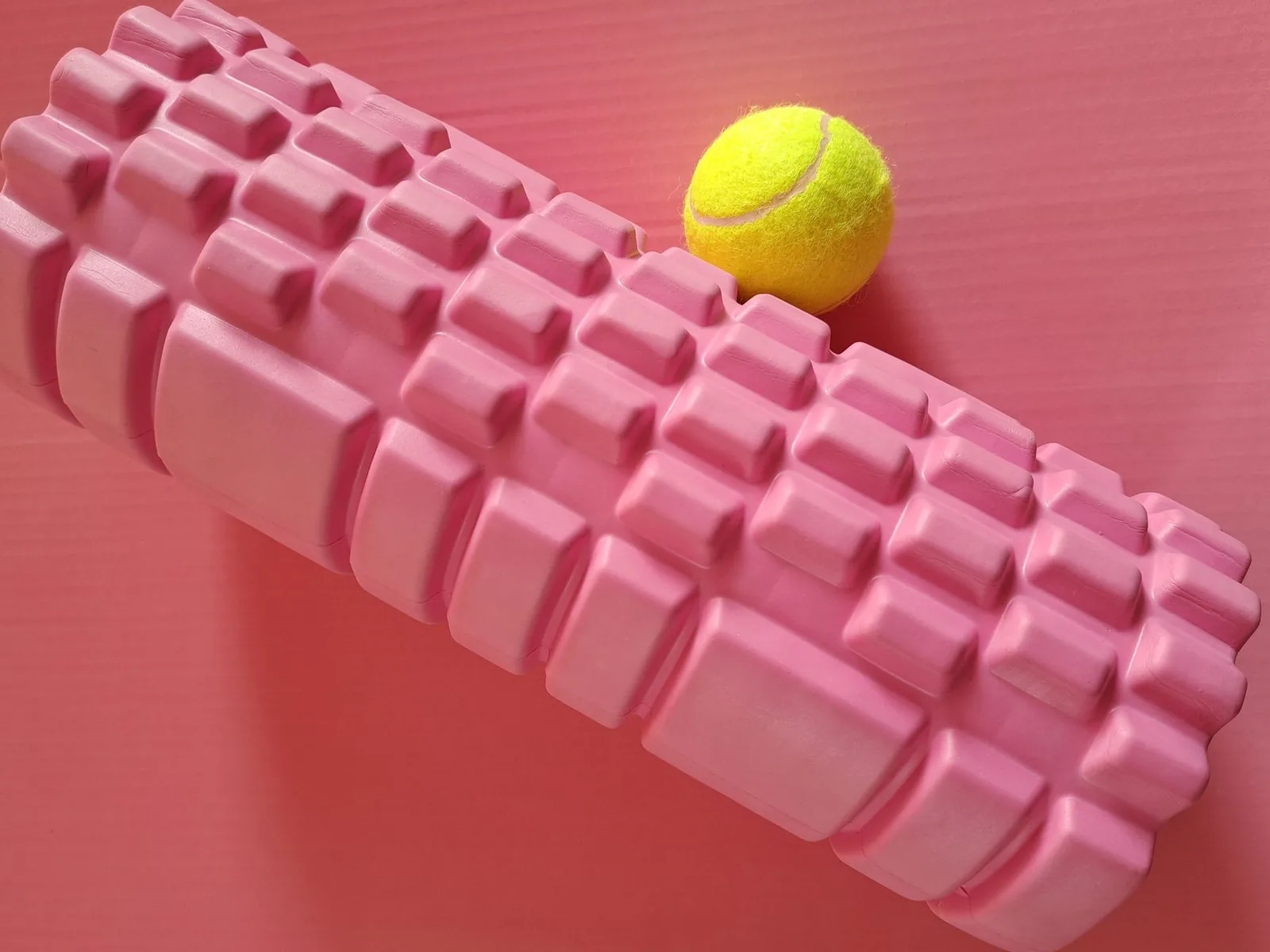
Coach the tool rather than dismissing it. Our guide to handheld tools between sessions covers where these devices help, where they cause trouble, and the regions clients should keep them away from entirely.
Sequencing a Week Around Competition
Before building anyone a plan, absorb Barnett’s warning from his review of recovery modalities in elite athletes. Most DOMS research recruits untrained people and gives them large amounts of unfamiliar eccentric work, which is nothing like a trained athlete’s ordinary Tuesday. He also points out that after high-intensity exercise, rest alone returns blood lactate to baseline well inside the normal gap between training sessions. Nobody needs a massage to clear lactate, and a therapist who sells it that way is making a claim the physiology does not support.
What survives is a defensible shape for the week. Put the deepest work 48 to 72 hours away from the next hard effort, so any treatment soreness has cleared before it matters. During race week, do nothing new and nothing deep: a lighter, shorter version of what the client already knows, two or three days out. After the event, wait for the day after rather than working a body that has just finished. Event-day work on the sideline is a different job with different rules, priced and staffed differently, and our guide to on-site and event contracts covers that side.
Pressure is the other thing to hold steady. An athlete under race stress will ask for more, and harder is not a higher dose of the same medicine. The same logic applies at the opposite end of the sensitivity range, which our fibromyalgia pressure and pacing guide works through in detail.
What You Can Honestly Promise
Tell an athlete that a session in the day or two after a hard effort will reliably reduce how sore they feel, that it will not speed up how fast their strength returns, and that you will find the tight spots and asymmetries a training log cannot. That is a smaller claim than the recovery industry makes and a considerably more durable one. Reading the studies for yourself is easier than it looks, and our evidence guide for clients explains how to spot the difference between a soreness endpoint and a performance one.
Then point at the unglamorous thing. Lewis’s verdict after running through ice baths, saunas, compression boots and percussion guns is that no recovery tool comes close to sleep, which she calls the body’s real repair window. A therapist who says that out loud, while their hands are already doing something useful, is the one the athlete believes about everything else.
The last advantage is structural, and it belongs to mobile work specifically. Sitting upright in a car is a poor way to spend the half hour after a recovery session. When you come to them, the client stands up, walks ten feet, and lies down.
Sources
- Hilbert, Sforzo and Swensen on what changed and what did not when massage followed eccentric hamstring work
- Ernst reviewing seven controlled trials of post-exercise massage for soreness
- Moraska with a comprehensive review of the sports massage research
- Tiidus for the evidence on massage and the recovery of muscle function
- Farr, Nottle, Nosaka and Sacco measuring soreness against function after downhill walking
- Weber, Servedio and Woodall comparing three recovery modalities against plain rest
- Barnett asking whether recovery modalities help elite athletes between sessions
- Pereira and colleagues testing cold water immersion against massage after a Murph workout
- Li, Luo, Zhang and Cheng on how the length of a percussion session changed the outcome
- Yin, Wang, Duan and Cai pooling the vibration training trials by time point
- Beardsley and Škarabot reviewing the acute and chronic effects of self-myofascial release
- USA Track and Field with an anti-doping science director’s read on trendy recovery strategies
- Runner’s World for where sports massage fits into a runner’s training week
Further reading
- Handheld Massage Tools Worth Recommending Between Sessions: A Therapist’s Picks
- What the Research Actually Says About Massage: An Evidence Guide for Clients
- The Science of Touch: How Mobile Massage Affects the Nervous System
- On-Site and Corporate Mobile Massage: The Complete Guide to Workplace and Event Contracts
- Building Your Mobile Massage Service Menu: A Modality-by-Modality Guide
- Fibromyalgia and Mobile Massage: Pressure, Pacing, and Why Home Visits Suit This Client