The Fake-Credential Crackdown: What Massage License Fraud Cases Mean for Honest Mobile Therapists
Published on November 3, 2026
Six Schools Closed, and Every Graduate Asked for Proof
Between October 2025 and May 2026, the Texas Department of Licensing and Regulation (TDLR) shut six massage schools by emergency order. The agency sums up its reasons in one line: findings that included fraud, falsified records, or conduct that compromised the integrity of the licensure and examination processes. Its order against the last two, a pair of Plano schools under one owner, said they were operating “in a manner consistent with diploma mills.” Most of their students lived outside Texas, with large groups from New York and California, and investigators concluded that many could not have traveled to Texas to complete the in-person training their records showed. Only a small share of students applied for or obtained a Texas license after graduating.
For an honest therapist, the important part came after the closures. TDLR says it cannot automatically accept the education hours those schools reported, for any student, past or present. The hours count only if the student produces independent, verifiable evidence of having done the training personally, and graduates who already hold a Texas license will be asked for that evidence at their next renewal.
That is how a fraud case reaches people who did nothing wrong. A few operators sell credentials, the regulator stops trusting the paper, and everyone holding the same paper has to prove it. Texas is the sharpest recent example, not the only one. Below are the cases behind the crackdown, what boards have changed, and what it means for you as an applicant, at renewal, and as a mobile therapist whose license is the only storefront a client ever sees. Licensing rules vary by state, so read every state example here as a prompt to check your own board.
Why a Massage License Is Worth Faking
A massage license is worth counterfeiting for the same reason it is worth earning: the public trusts it. In the Massachusetts case covered below, federal prosecutors said fake school documents had let workers obtain state massage licenses that “could be displayed at massage parlors offering prostitution services,” lending those businesses an appearance of legitimacy. TDLR’s May order tied students and graduates of the two Plano schools to illicit massage establishments that had already faced enforcement, some of them showing signs of human trafficking, such as people living inside the business.
So the license gets used as a prop, and every fake one cheapens the real ones. That cost falls hardest on the therapist who works alone. A spa client can at least trust the building. A client who has read about fake credentials has nothing to go on but the stranger at the door with a table bag.
Three Ways the Fraud Worked
Paper From a School That Had Already Closed
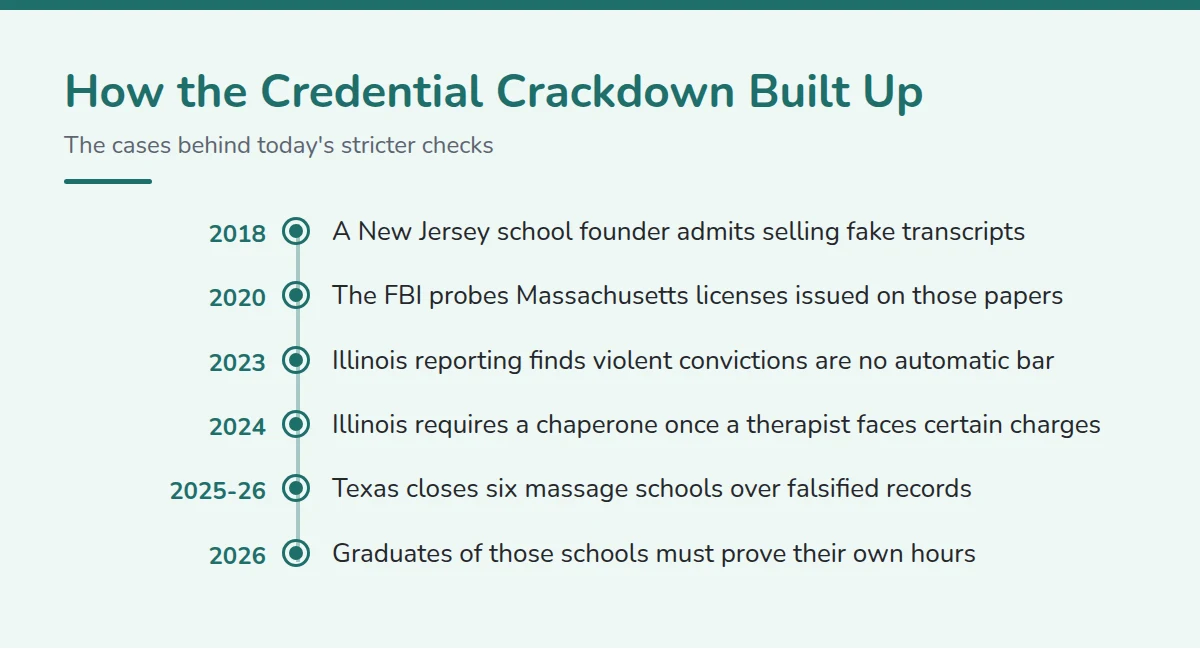
In February 2020, the Boston Globe reported that the FBI was investigating how applicants with phony or questionable credentials had obtained Massachusetts massage licenses. The applicants under scrutiny listed training at a New Jersey school, most of them claiming to have attended in 2015 or later, although the school had closed in 2014. Its founder had pleaded guilty in 2018 in a case built on selling fake transcripts and graduation certificates, at $1,000 to $2,600 apiece.
The fallout was wide. A board staff member was suspended for approving applications from the school’s “graduates,” the board’s executive director stepped down, and the state began reviewing all 9,000 of its massage licensees. It also changed the front door. From January 2020, every out-of-state application was reviewed twice, and none was approved until the board had proof that the school was in good standing with its own state’s licensing authority.
Hours That Never Happened
The Texas schools were licensed, which is what made them useful. The fraud sat in what they reported. TDLR’s May order describes attendance and internship records showing training at times when inspectors saw too little activity at the schools to support it, distance learning arranged so that nobody could tell whether students were taking part, and students giving massages without the licensed supervision their internships required. Texas training includes in-person classroom and supervised internship hours, which is exactly what students living in New York or California could not plausibly have been completing.
A Record That Never Reached the Board
The third gap sits between the courts and the licensing office. In 2023, CBS Chicago reported that Illinois automatically barred applicants convicted of sex offenses or prostitution, but only weighed, case by case, convictions such as first-degree murder, armed robbery and kidnapping. The station also found lapses in communication between the agencies taking criminal complaints and the agency holding the licenses. A state representative filed two bills in response, one to put massage therapists through the same background checks as other health care workers and one to make sure the licensing office received records of felony convictions.
In 2024, Illinois amended its massage law to close part of that communication gap, as the section on faster action below explains.
What Boards Have Changed
Training Verified at the Source
Two of the three cases turned on training paperwork that did not match the training. Boards now want those records only from the school itself, and only from schools in good standing with their own state’s regulator. The Federation of State Massage Therapy Boards (FSMTB), which runs the MBLEx licensing exam, requires your school to submit education verification directly to it. It counts a program only if the massage board in the school’s own state approves it, or, where that board approves no programs, the state’s education department.
Florida’s rule asks for more. An official transcript must name the campus address where classroom hours were completed, give the dates of enrollment and graduation, carry the signature of an approved signer, and travel directly from the school, or from the custodian of records if the school has closed, in a sealed envelope. In California, the state’s certifying council (CAMTC) accepts transcripts only when the school sends them directly, and only from schools it has approved.
The upshot is that your transcript is now a message between your school and the board. You cannot carry it in yourself, and if your school’s standing collapses, the paper goes with it.
Fingerprints That Stay on File
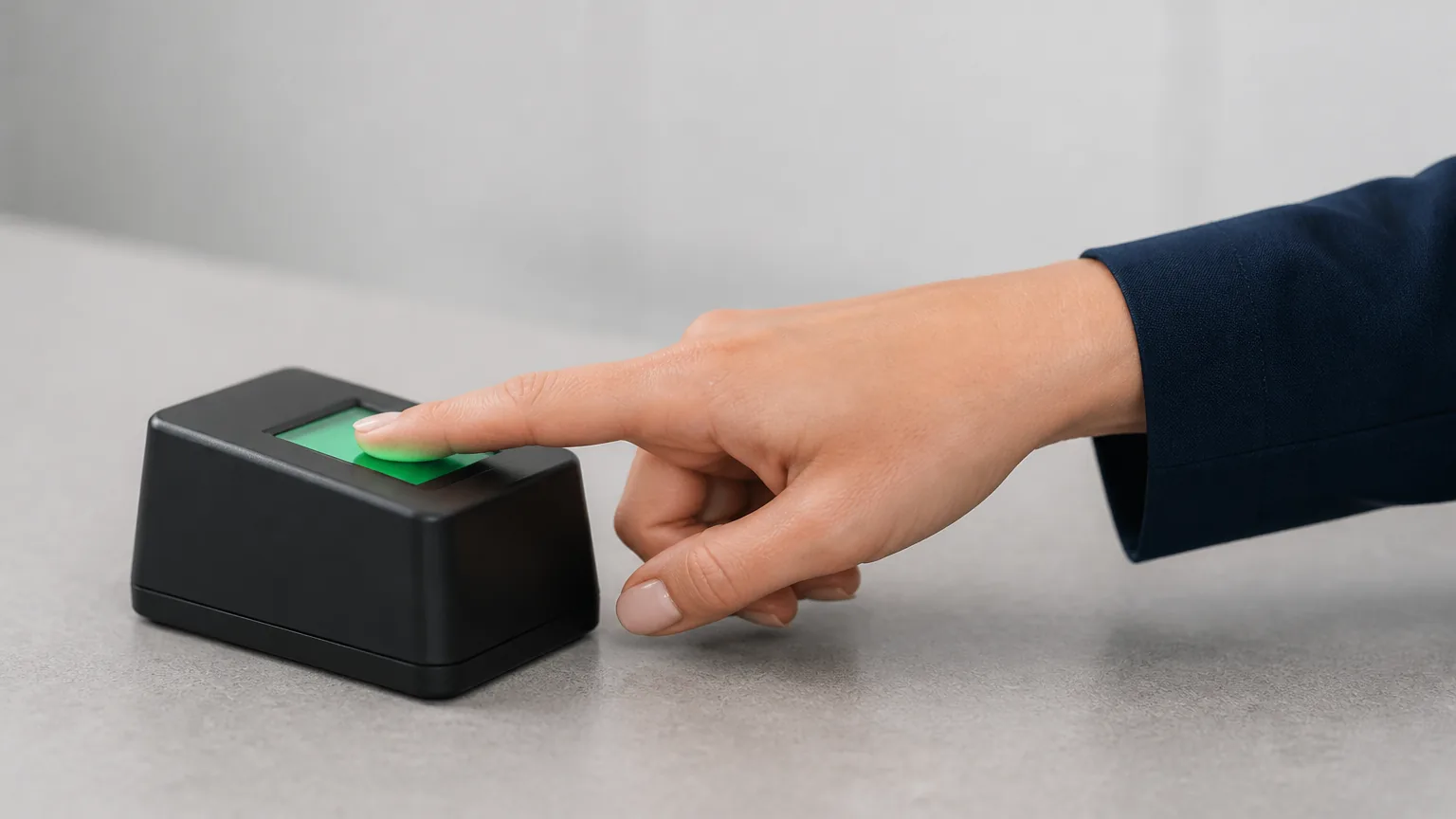
Fingerprinting ties a criminal record to a person rather than to a name. Florida has required fingerprints with every initial massage license application since 2013, checked against state records and by the FBI. The prints are not discarded afterward. The statute directs the state to retain them, enter them in its care provider screening clearinghouse and enroll them in the FBI’s national arrest notification program, and the retained prints are reused at any renewal that calls for a national check. California’s CAMTC requires a Live Scan fingerprint submission and a passed criminal background check before it certifies anyone.
In a state that keeps prints, a background check is no longer a single event at the start of a career.
Exam Rules With Teeth
The MBLEx candidate handbook, effective July 2025, is blunt about identity. Candidates bring two forms of ID whose names match the application exactly, and temporary paper licenses and digital IDs are refused. Getting through the door settles nothing for good: the handbook says admission does not mean an ID was authentic, and a result can be invalidated later if FSMTB finds impersonation, forgery or fraud.
Falsifying or leaving out information on the application can bring denial, an invalidated result, suspended access to future exams and notice to state boards, and FSMTB notifies every state licensing board of each invalidation. The handbook also forbids passing on exam content “by any means whatsoever, including memorization,” which rules out sharing or buying remembered exam questions. Illinois lists cheating on, or attempting to subvert, the licensing exam among its grounds for discipline.
Faster Action on Charges, Not Only Convictions
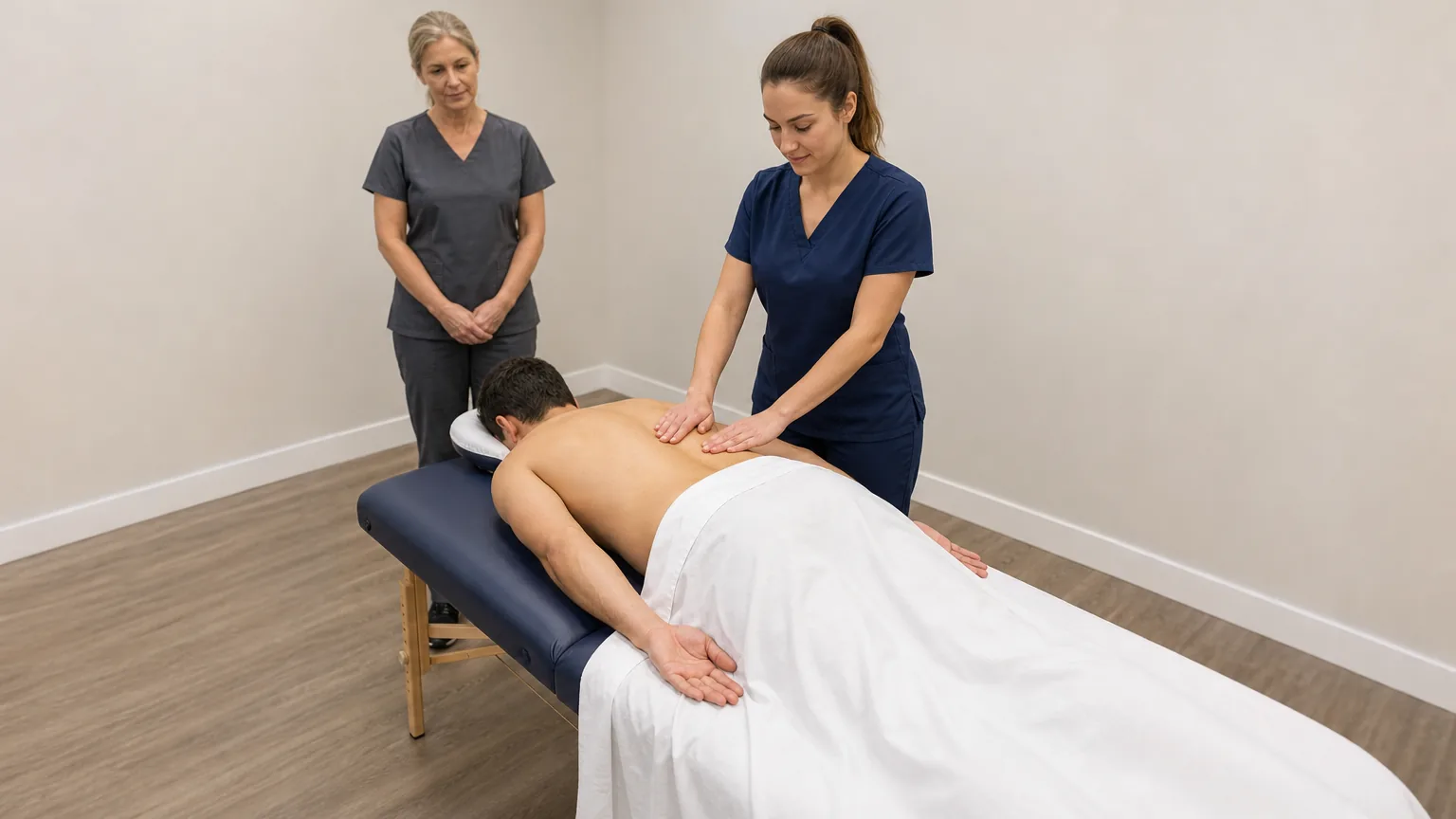
The 2024 Illinois amendment changed what happens before any verdict. When a licensed massage therapist is charged with certain offenses, among them any offense carrying sex offender registration, battery against a patient in the course of care, or a forcible felony, the prosecutor must notify the state licensing department immediately. Within five business days the department must order the therapist to practice only with a chaperone, who must be a licensed massage therapist or another licensed health care worker, at every patient encounter until the case ends. Each patient receives written notice, which must state that “the massage therapist is presumed innocent until proven guilty of the charges.” If there is no conviction, the order is vacated and removed from the therapist’s record.
For a solo mobile practice, a chaperone order works much like a stop-work order, since few home visits can carry the cost of a second licensed professional.
Michigan strikes a different balance. Its public health code lets regulators summarily suspend a license when public health, safety or welfare requires emergency action, a finding the law makes automatic after a felony conviction. Short of that finding, the license stays active while the ordinary disciplinary process runs.
Under either model, a mobile therapist works without witnesses, so careful records are the best protection if a complaint ever lands: signed intake and consent forms, notes on draping and any change of plan, and arrival and departure times logged with someone you trust. Our guide to ethics, consent and draping in the client’s home covers what to document, and our personal safety protocol sets up the check-in system.
If You Are Applying Now
Most of the new scrutiny lands at the start of a career, which is also when it is cheapest to prepare for.
Check the school’s standing before you pay. Look the school up with the massage board in its own state, not only on its website. A school that offers to skip in-person hours, credits time you did not spend in class, or runs internship clinics without a licensed supervisor in the room is offering exactly what got the Texas schools closed. Use your own address, phone number and email on every form, never ones a school supplies. Our guide from massage school to licensed mobile therapist covers choosing a program in full.
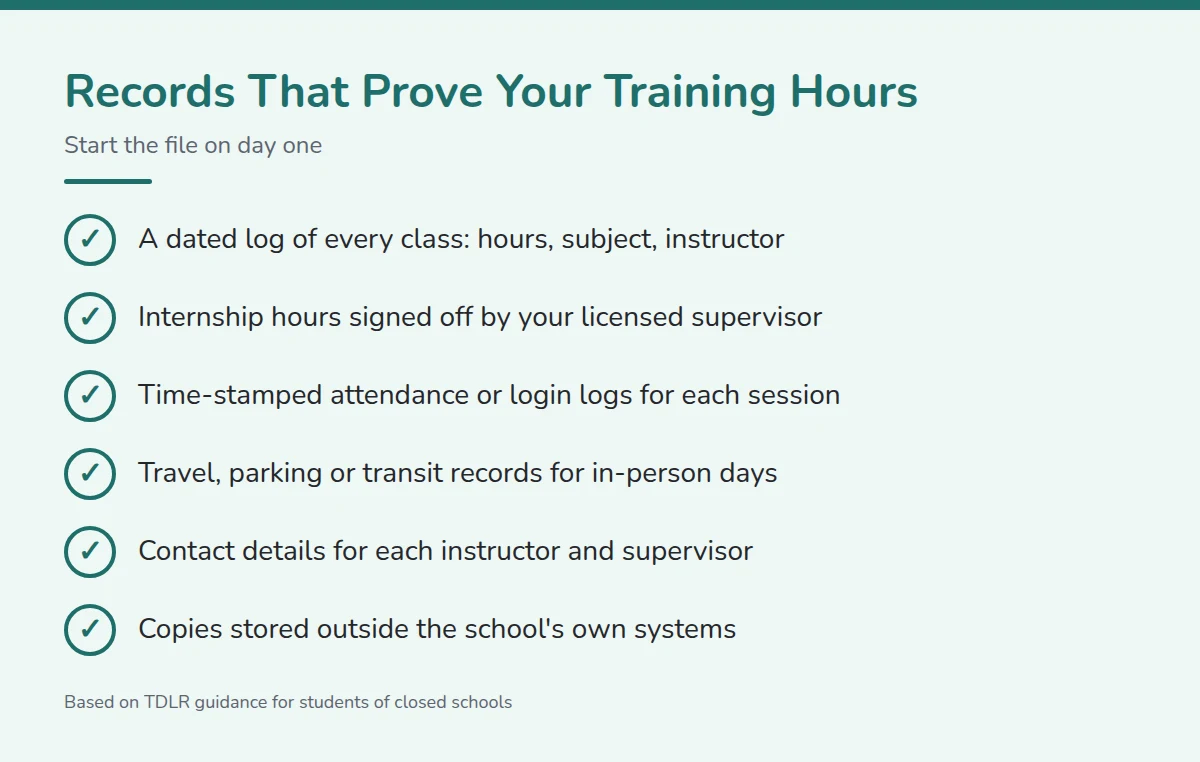
Keep your own record of the training as it happens. TDLR’s guidance for students of the closed schools spells out what proves hours once a school’s word no longer counts. Official school records cannot support a claim on their own. What works is statements from instructors or supervisors who saw you train, records of travel to and from the school for in-person classes, time-stamped attendance or system logs, and other reliable records made at the time and clearly tied to your education. A habit started on day one covers all of it.
Get your transcript sent while the school exists. If your school closes before you apply, FSMTB advises contacting your state’s department of higher education, where closed schools’ student records are often stored, and Florida accepts a transcript from the custodian of records.
Answer every application question completely. FSMTB treats falsification, misrepresentation or omission as grounds for denial and for notifying state boards. Illinois can discipline a licensee for fraud or misrepresentation in applying for a license or a renewal. Florida goes further: a license obtained by fraudulent misrepresentation, or “through an error of the department or the board,” can be disciplined. A license is not safe just because a clerk approved it, which is the Massachusetts lesson in one line.
Use one version of your name everywhere. Put your full legal name, spelled the same way, on your school enrollment, your exam application and your license application. The MBLEx requires the names on both of your IDs to match the application exactly.
At Renewal
Renewal used to mean a fee and a folder of continuing education certificates. For some therapists it now means a second look at how they got licensed in the first place.
In Texas, licensed graduates of the six closed schools will be notified at their next renewal that, to keep the license, they must submit a Verification of Education Hours questionnaire with supporting documents. TDLR says this is separate from continuing education and concerns only the initial training hours. The alternative is to surrender the license, which cancels it and withdraws any pending renewal. Anyone who reapplies later must meet every requirement in force at that time, including training through a licensed school.
Elsewhere, two habits keep renewal routine. Report criminal matters on time: Florida requires a licensee to tell the board in writing within 30 days of a conviction, a finding of guilt or a no contest plea to a crime in any jurisdiction, whether or not the court formally adjudicated guilt. And look up your own public record once a year to check that your name, address and status are right, as our state licensing and scope of practice guide recommends.
Make Your Verified License the Storefront
A clinic borrows trust from its building: a reception desk, a framed license on the wall, a manager down the hall. A mobile therapist has none of that. The client’s only evidence is whatever you hand them, and after a few headlines about fake credentials, more of them will ask. Make the answer easy.
Put your license number in every ad. Illinois counts “failing to use the massage therapist’s own license number in an advertisement” as false or misleading advertising, which is a ground for discipline. In California, CAMTC says a sole provider must include the certificate number in any and all advertising, business cards and websites included, and must carry the certification ID card while working. Even where the law is silent, a number in the ad gives a careful client something to check.
Make the check one tap. Add your full name exactly as licensed, your license number, the issuing state and a link to the board’s public lookup to every booking confirmation. A client who verifies you in thirty seconds before the visit opens the door already reassured.

Offer proof before you are asked. Carry your license or ID card along with a photo ID, and show them at the door. A lookup proves that a license exists; your photo ID is what connects it to the person on the doorstep.
Treat the question as a good sign. A client who checks you probably checks everyone, and that habit is bad news for anyone working on a fake credential. Our client guide to verifying a mobile massage therapist walks through what a careful household looks for, and it is worth reading from the other side of the door.
If Your School Turns Up in the News
Finding your own school on a closure list is alarming, and the instinct is to wait and see. Act early instead.
- Gather evidence now, while memories and records are fresh. Contact former instructors and internship supervisors, pull bank and travel records for the months you trained, and download anything stored in the school’s systems before they go dark.
- Know your options. In Texas, a student can submit the questionnaire and evidence to have the hours credited, or voluntarily surrender the reported hours and enroll at another approved school. A student who does neither cannot finish training at another school, take the Texas exam or transfer the hours to another state.
- Ask about refunds. TDLR says the school is responsible for refunds to eligible students under its contract and the state’s rules, and suggests contacting the owners directly or consulting an attorney.
- Never sign for hours you did not attend. If a school asks you to, report it to the board. You are protecting the value of the credential you are paying for.
A Shared Credential, Worth Protecting
The fraud cases involve a small number of schools and operators, but the cost lands on every honest licensee as extra checks, more paperwork and more doubtful clients. You cannot stop a diploma mill. You can make your own record easy to trust: training you can prove, a license you keep current, and a number you put in front of every client before they think to ask.
Sources
- Texas Department of Licensing and Regulation on what students and licensees from the six closed massage schools must now prove and its May 2026 order against two Plano schools run like diploma mills
- The Boston Globe reporting the FBI inquiry into Massachusetts licenses issued on fake school papers
- CBS Chicago on criminal records that did not bar an Illinois massage license
- Illinois General Assembly with the Massage Licensing Act’s grounds for discipline, as amended in 2024 to add chaperone orders
- Federation of State Massage Therapy Boards for the MBLEx handbook’s education verification, ID and fraud rules
- Florida Administrative Code on what an official massage school transcript must show and how it must arrive
- Florida Statutes for fingerprints kept on file for health license applicants and discipline over licenses obtained by fraud or error and unreported convictions
- California Massage Therapy Council with its Live Scan and direct transcript requirements and why the certificate number belongs in every ad
- Michigan Legislature on when a health license can be summarily suspended
Further reading
- Before You Let Them In: How to Verify a Mobile Massage Therapist’s License and Training
- State Licensing and Scope of Practice: A Mobile Therapist’s Compliance Guide
- From Massage School to Licensed Mobile Therapist: The Complete Career-Entry Guide
- When Anti-Trafficking Massage Ordinances Hit Legitimate Outcall Therapists
- Personal Safety for Mobile Massage Therapists: A Comprehensive Protocol