Before You Let Them In: How to Verify a Mobile Massage Therapist's License and Training
Published on October 14, 2026
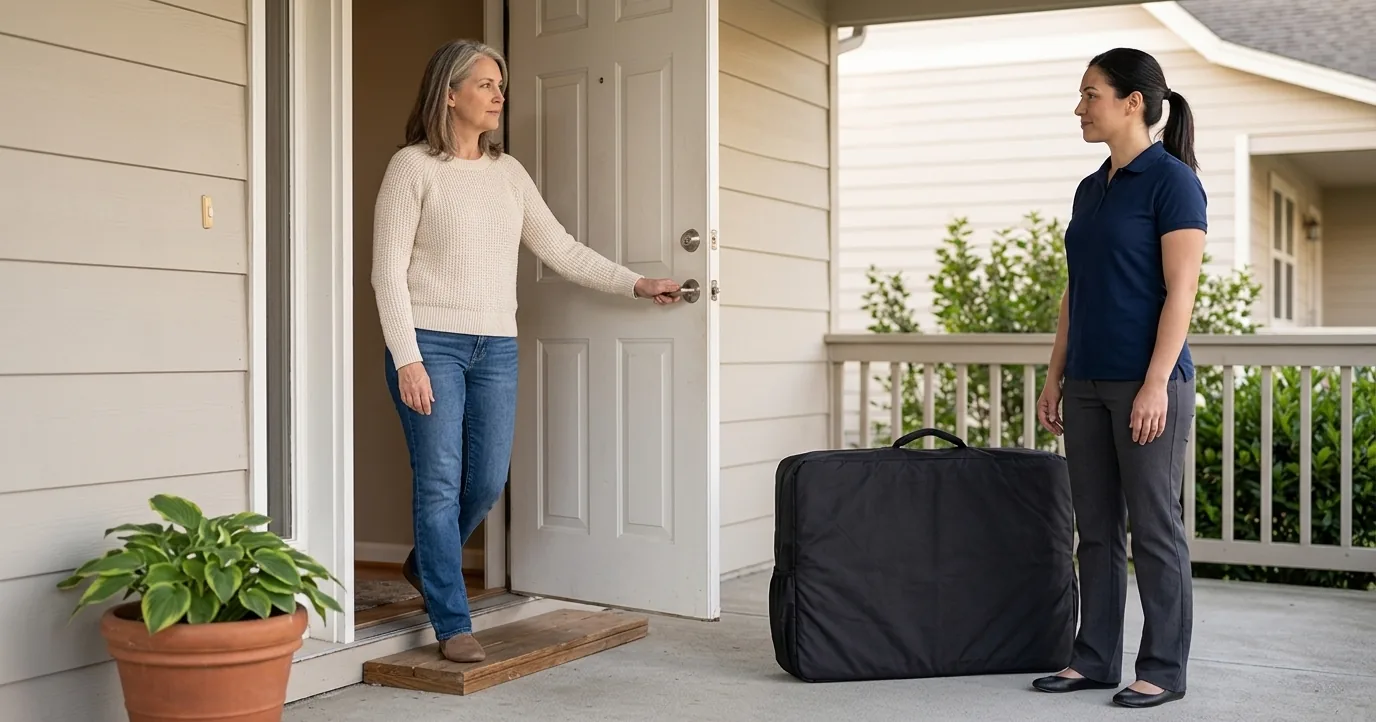
A Stranger With a Table, in Your Living Room
You have found someone who will come to the house. Maybe the booking is for your mother, who has not managed the drive to a spa since her hip surgery. Maybe it is a birthday gift for your partner. Either way, a person you have never met is about to spend ninety minutes in a private room of your home, with someone you care about lying under a sheet.
A spa at least claims to vet its staff before they reach you. When the therapist comes to you, there is no front desk in between, and the checking falls to whoever made the booking. The good news is that the check that matters most is free, public and takes about five minutes. The rest takes a few questions, a little reading, and the confidence to walk away from anyone who will not answer them.
This guide is about checking the person. If you are still deciding whether a home visit, a spa, a clinic or a membership chain suits you at all, our comparison of where to book a massage covers the setting. Everything below applies once you have chosen.
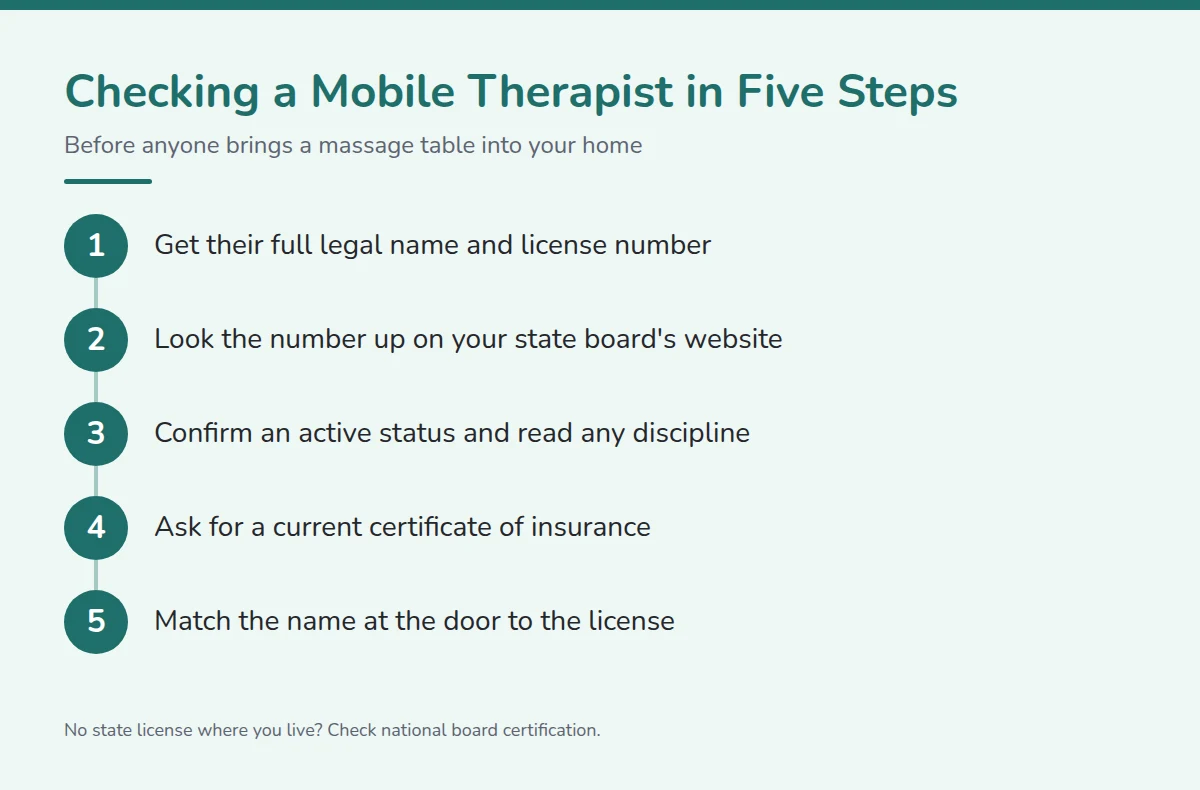
Start With a Full Name and a License Number
Before anything else, ask for the therapist’s full legal name, the state that licensed them, and the license number. A first name and a mobile number are not enough to check anything. A legitimate therapist hands these over without hesitation, because in many places they already appear in every ad.
Some states make that a legal duty. Florida requires every licensed massage therapist to include the license number in any advertisement, online listings included. California, which certifies rather than licenses (more on that below), requires certificate holders to put their certified name and certificate number in all advertising, to give their full name and number to any member of the public who asks at the place they are working, and to carry their certification ID card while they work. Montgomery County, Maryland, which publishes consumer guidance on massage safety, puts “unable to provide therapist license numbers upon request” first on its list of licensing red flags.
If someone will not give you a number before the appointment, you have your answer. There is no innocent reason to keep a license number secret: it exists so that the public can check it.
Look It Up With the State, Not on Their Website
Take the number to the state licensing board, not to the therapist’s own site, a booking profile or a photo of a framed certificate. State boards that license massage run free public lookups, and the Federation of State Massage Therapy Boards (FSMTB), whose members are the boards themselves, keeps a map that links to each state’s search.
When the record comes up, check four things:
- The name matches the person you are booking, spelled the same way. A license that belongs to someone else is worth nothing to you.
- The license is for massage therapy. Some boards license several professions, or license massage businesses separately from therapists, so read the line that says what the license covers.
- The status is active and the expiry date is in the future. Expired, inactive, suspended or revoked all mean the person may not practice. Probation usually means they can, under conditions, and the board’s order will say why.
- The discipline section is empty, or you have read it. Many lookups list public board actions or link to the orders themselves. One old action is not automatically disqualifying, but you should know what it was before you open the door.
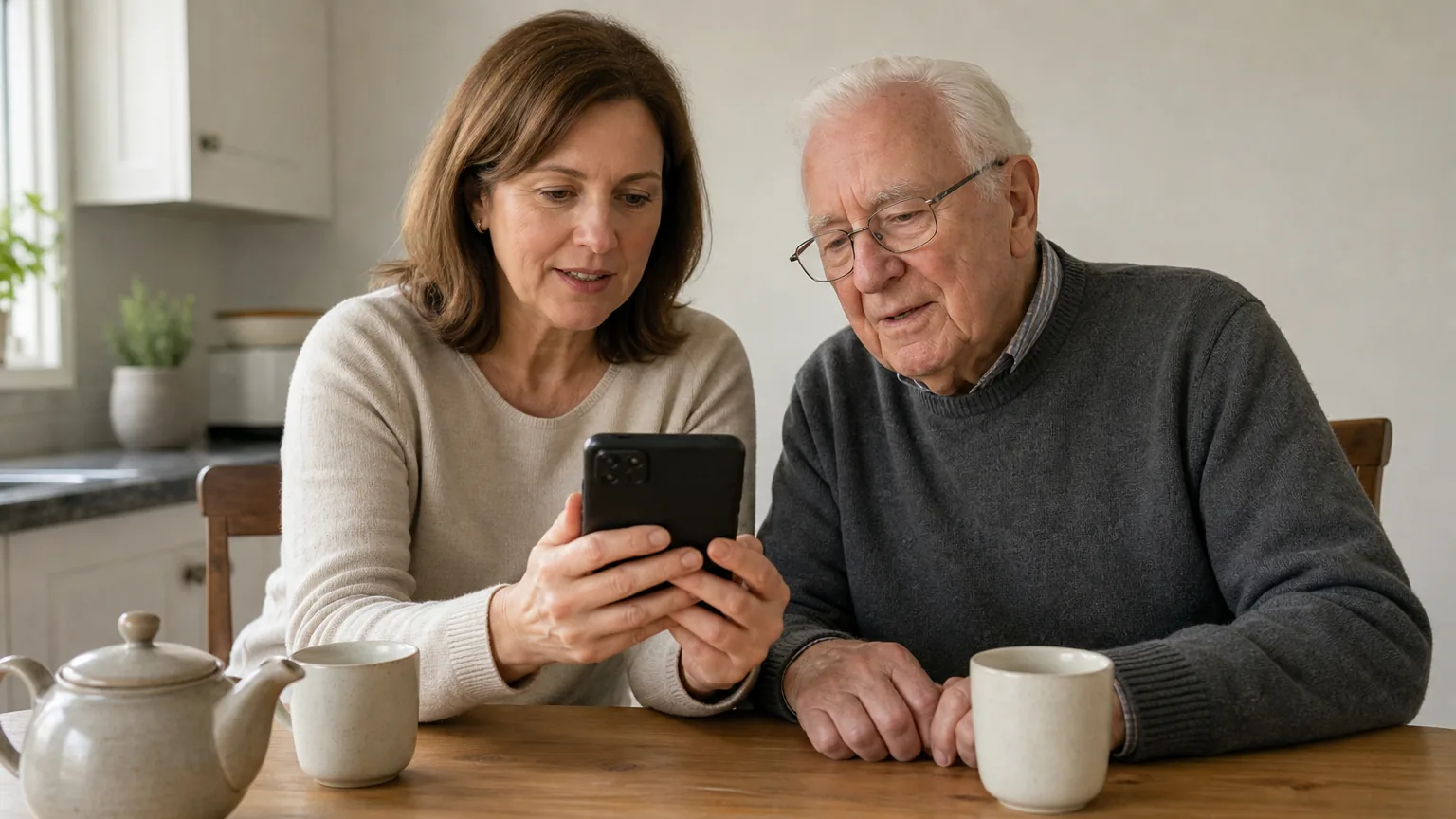
The license must also come from your state. Massage licenses do not travel, so a therapist licensed next door is not licensed in your living room, which matters if you live near a state line. Our guide to state licensing and scope of practice explains how therapists handle work across state lines and what the law allows them to do.
If the search finds nothing, try the legal name rather than a nickname, and check the number for typos. If it still finds nothing, treat the person as unlicensed until they show you otherwise.
What an Active License Proves
An active license is the strongest single piece of evidence you can get, because a government body checked the person before issuing it and checks again at every renewal. In practice it tells you four things.
They finished the state’s minimum training. The American Massage Therapy Association (AMTA) explains that state education requirements cover anatomy and physiology plus the theory and practice of massage, and run from 500 to 1,000 hours. FSMTB’s state table shows the spread: 500 hours in states such as Florida, Georgia and Texas, 650 in Alabama and Tennessee, and 1,000 in Nebraska and New York. Five hundred hours is the floor wherever a floor exists, not the norm everywhere.
They passed an entry-level exam. Most states accept the Massage and Bodywork Licensing Examination (MBLEx), which FSMTB runs. New York and Hawaii use their own state exams.
In many states, they passed a criminal background check. Florida, for example, requires fingerprints with every initial license application, checked by the state’s Department of Law Enforcement and the FBI.
They have kept it current. Licenses renew every one to four years depending on the state, usually with continuing education attached, so an active status means the board has heard from this person recently.
What a License Does Not Prove
It does not prove that the person at your door is the person you looked up. State lookups rarely include a photo, and identity is the one gap the database cannot close for you. When the therapist arrives, ask to see the license or a photo ID and compare the name. California builds this into law with its required ID card. Anywhere else, a professional will understand why you asked.
It does not prove specialty training. Prenatal massage, oncology massage, lymphatic drainage and work with frail older adults are largely taught as continuing education after licensing, and being “certified in” a technique usually means a course certificate rather than a state credential. If the session calls for one of those skills, ask where the training came from and how long it lasted.
It does not prove insurance, which is a separate question covered below. And it cannot tell you whether the person is good at the work, or right for the person on the table. The lookup clears the floor. Everything after that is still your judgment.
States Where There Is No License to Check
According to FSMTB’s table, 45 states and the District of Columbia license massage therapists. The rest do something else, and if you live in one of them, the lookup works differently.
California does not license massage at all. Its credential is a voluntary certification from the California Massage Therapy Council (CAMTC), the only massage credential state law recognizes. State law makes it an unfair business practice for anyone without CAMTC certification to use titles such as licensed, certified, Certified Massage Therapist or CMT. CAMTC runs its own public verification search. Many California cities and counties now require CAMTC certification in place of a local permit, but state law does not, so ask.
Vermont registers massage therapists, and FSMTB’s table lists no minimum training hours and no exam for that registration. A Vermont registration tells you the person is on the state’s list, not how they were trained.
Kansas, Minnesota and Wyoming have no statewide massage credential, although cities and counties may license therapists locally. Minnesota is adding a voluntary state registry, which our guide to Minnesota’s new registration law walks through.
In these states, look for three things instead: a city or county license if your area requires one, a diploma or transcript showing completed hours, and national board certification, which has its own public directory.
Memberships and Certificates: What They Actually Certify
Therapists often show association logos and certificates in the place where a license number should be. Here is what each one means.
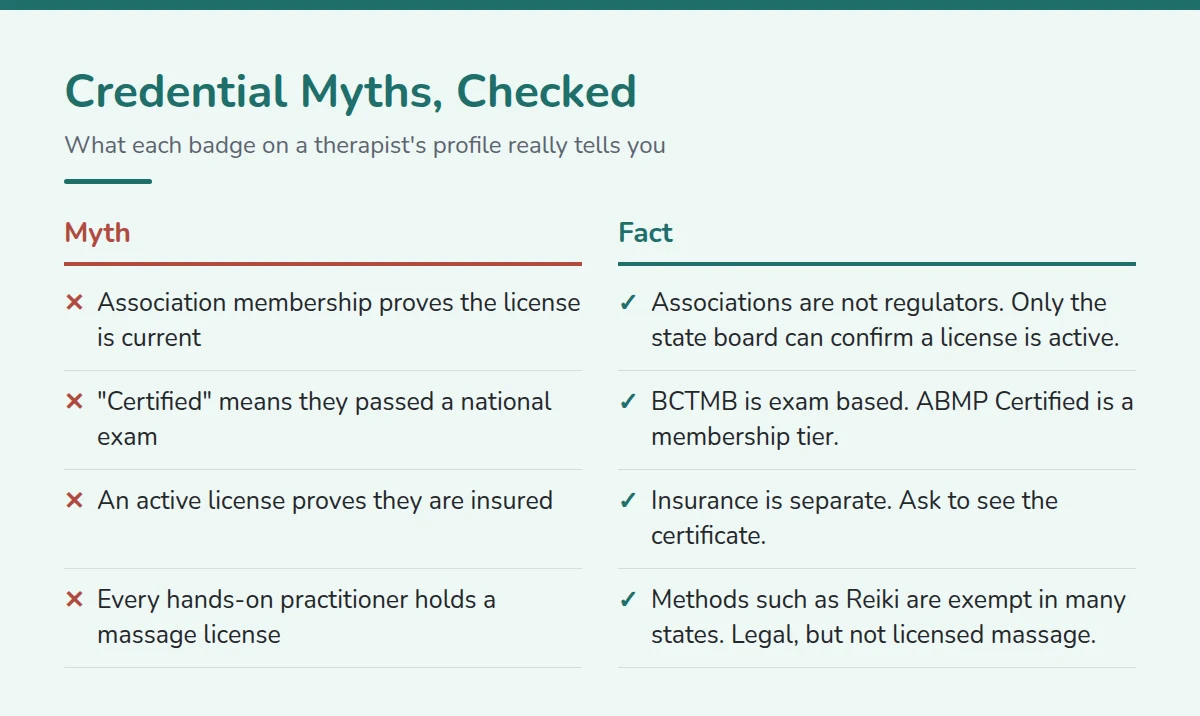
Board Certification (BCTMB). The National Certification Board for Therapeutic Massage and Bodywork (NCBTMB) offers a voluntary national credential, accredited by the National Commission for Certifying Agencies. In a licensed state it requires a current license, a passing score on the board certification exam and a criminal background check. In a state without licensing, a 500-hour program takes the place of the license, alongside the same exam and background check. NCBTMB’s directory of board certified therapists is public. Board certification sits on top of a license; it does not replace one.
AMTA membership. AMTA’s professional members must hold a state license where one applies, plus one of three things: a supervised program of at least 500 hours, a current license, or NCBTMB certification. They also agree to a code of ethics. AMTA’s Find a Massage Therapist locator is a reasonable place to start a search, but it does not replace the board lookup.
ABMP membership. Associated Bodywork and Massage Professionals (ABMP) requires members at its insured levels to comply with their state’s rules. One of its tiers, Practitioner, exists for people who practice a technique exempt from state regulation, or who work in unregulated states with less than 500 hours of training. ABMP’s most fully featured tier is called Certified, and its own FAQ describes that tier by its benefits (more free continuing education, bigger discounts, priority directory listing), not by an exam. “ABMP Certified” names a membership level, not a board credential.
Neither association is a regulator. A membership tells you the person joined, met the association’s entry rules, agreed to its ethics code and, at most levels, bought insurance through it. It cannot tell you whether a license is active today. Only the state can.
Licensed Massage Therapist or Something Else? Read the Title
In a licensed state, the title carries legal weight. AMTA describes licensing as the most rigorous form of regulation, the kind that makes it illegal to work as a massage therapist without a license. LMT (licensed massage therapist), or your state’s equivalent, matched to a record in the lookup, is what you are looking for.
Some hands-on work sits legitimately outside massage laws. Energy work such as Reiki, and some movement and somatic education methods, are exempt in many states, and their practitioners can work without a massage license. ABMP’s Practitioner tier exists for exactly this group. If one of those methods is what you want, that is fine. It is not massage therapy, though, and an exempt practitioner should not be selling you a deep tissue or Swedish session.
Be wary when something that is plainly a massage is offered under a title that sidesteps the regulated one, such as “body rub” or “relaxation therapist”, in a state that licenses massage. The same goes for any version of “I don’t need a license because…”, unless the reason survives a call to the board.
Ask for Proof of Insurance
Professional liability insurance is non-negotiable for a practicing therapist, and asking to see it is normal. Policies sold to massage therapists usually bundle three kinds of cover, which ABMP describes plainly: professional liability for a client who alleges malpractice, general liability for something like a slip and fall, and products liability for a reaction to a lotion. In a home visit, the second is not abstract. Oil on a hardwood floor and a table bag left in a hallway are how people fall.
Both large associations include liability insurance with professional membership, and ABMP sends members a digital insurance certificate when coverage starts, so a therapist insured through either one can produce proof in a minute. Ask for the certificate of insurance, then check that the named insured matches the license and that the policy dates cover your appointment. Montgomery County lists a refusal to provide proof of liability insurance among its red flags.
Red Flags That Should End the Conversation
Most bad bookings announce themselves early, in the ad or the first few messages. Any of these is reason enough to stop:
- No full name or license number, or an excuse where one should be.
- A record that does not match: a different name, an expired license or a suspension.
- Suggestive or vague wording in the ad, photos that sell the therapist rather than the work, or a listing on a site you would not show your mother. Florida bars licensed therapists from advertising sexual services, or advertising on websites known for them, and legitimate practitioners everywhere avoid both.
- Late-night availability as a selling point. Montgomery County flags appointment times at unusual hours.
- Cash only, with no receipt.
- No health questions. A real therapist asks about medications, conditions and recent injuries before the first session, usually with a written intake form.
- Personal questions with no clinical purpose, about your appearance, your relationship status or what you will be wearing.
- Pressure: a discount that expires tonight, a deposit demanded before you have checked anything, or irritation when you ask.
Montgomery County’s guidance sums it up: “Professional businesses welcome these questions.”
Some questions run the other way, and they are a good sign. A careful mobile therapist will ask for your full name and address, may phone to confirm the booking, and may ask who else will be in the house. That is their own safety screening, not nosiness, and therapists who vet their clients tend to be the ones worth booking.
Booking for a Parent or a Partner
Booking for someone else adds two jobs: you do the checking, and you make sure the therapist hears directly from the person on the table.
For a parent, run the lookup yourself rather than handing the job to them, and plan to be in the house for the first visit. Serious injuries from massage are rare, but the National Center for Complementary and Integrative Health (NCCIH) notes that some reported cases, among them blood clots, nerve injuries and fractures, involved vigorous techniques such as deep tissue work, or people at higher risk of injury, such as older adults. Share the medication list, and expect the therapist to ask about blood thinners, any history of blood clots, recent surgery or falls, osteoporosis, heart conditions and cancer treatment. Several of these can require clearance from your parent’s doctor before massage, and a good therapist will ask for it rather than work around it. Walk away from anyone who proposes deep pressure for a frail 85-year-old without asking a single question. Our guide to mobile massage in aged care covers the contraindications, and how consent works when memory is failing.
For a partner, remember that consent belongs to the person receiving the massage, not the person who paid for it. Expect the therapist to talk with them directly about health history, pressure and draping, and make sure they know they can change anything or stop the session at any point. Our guide to ethics, consent and draping in the home sets out what every client is entitled to expect.
If the Check Fails
If the lookup comes back empty, expired or suspended, or the person admits they are not licensed in a state that requires it, do not book, however good the reviews look. State boards take complaints, and most also handle reports of unlicensed practice, so a short report protects the next household as well as yours.
Five minutes with a state database will not tell you everything about a stranger. It will tell you whether the state has checked them, which is a great deal more than any ad can.
Sources
- Federation of State Massage Therapy Boards on regulatory status, training hours and exams by state and its map of state license lookups
- American Massage Therapy Association for how licensing, certification and membership differ and who qualifies for professional membership
- Associated Bodywork and Massage Professionals with its membership tiers and what member insurance covers, plus when members receive an insurance certificate
- National Certification Board for Therapeutic Massage and Bodywork on board certification requirements and its public directory of certified therapists
- Florida Legislature for the rule that massage ads carry a license number and fingerprint screening of license applicants
- California Massage Therapy Council with California’s certification, protected titles and ID card rules
- Montgomery County Commission for Women on red flags to check before booking a massage
- National Center for Complementary and Integrative Health for massage safety and choosing a practitioner
Further reading
- State Licensing and Scope of Practice: A Mobile Therapist’s Compliance Guide
- Mobile Massage vs Spa, Clinic, and Franchise: How to Choose Where to Book
- Mobile Massage in Aged Care: Bringing Wellbeing Home to Seniors
- Ethics, Consent, and Draping in the Client’s Home: A Professional Boundaries Guide
- Minnesota’s New Massage Therapist Registration: What Mobile Therapists Need to Know Before 2028