From Massage School to Licensed Mobile Therapist: The Complete Career-Entry Guide
Published on August 31, 2026
Deciding on Mobile Changes Every Step That Follows
Massage therapy is a large profession and still growing. The American Massage Therapy Association counted an estimated 355,075 massage therapists working in the United States in 2025, spread across spas, medical offices, chiropractic clinics, sports programs and private practices. A steadily growing share of them never work from a fixed address at all.
If you already know you want to be one of those, make that decision before you enrol somewhere rather than after you graduate. Standard career advice assumes you will finish school, take a job at a spa or a franchise, and learn the business on someone else’s floor. Mobile therapists skip that apprenticeship. You become the practitioner, the receptionist, the compliance officer and the person carrying a table up three flights of stairs, often inside your first six months. Choosing a school, a state and a first set of credentials with that ending in mind saves years of correction later.
Step One: Pick a Program That Will Actually License You
There are more than 196 massage institutions accredited by large national accrediting agencies, many with several campuses, plus others accredited at state or regional level. Most training programs require only a high school diploma to enter, though earlier study in anatomy and physiology, business or the humanities makes the first term considerably easier.
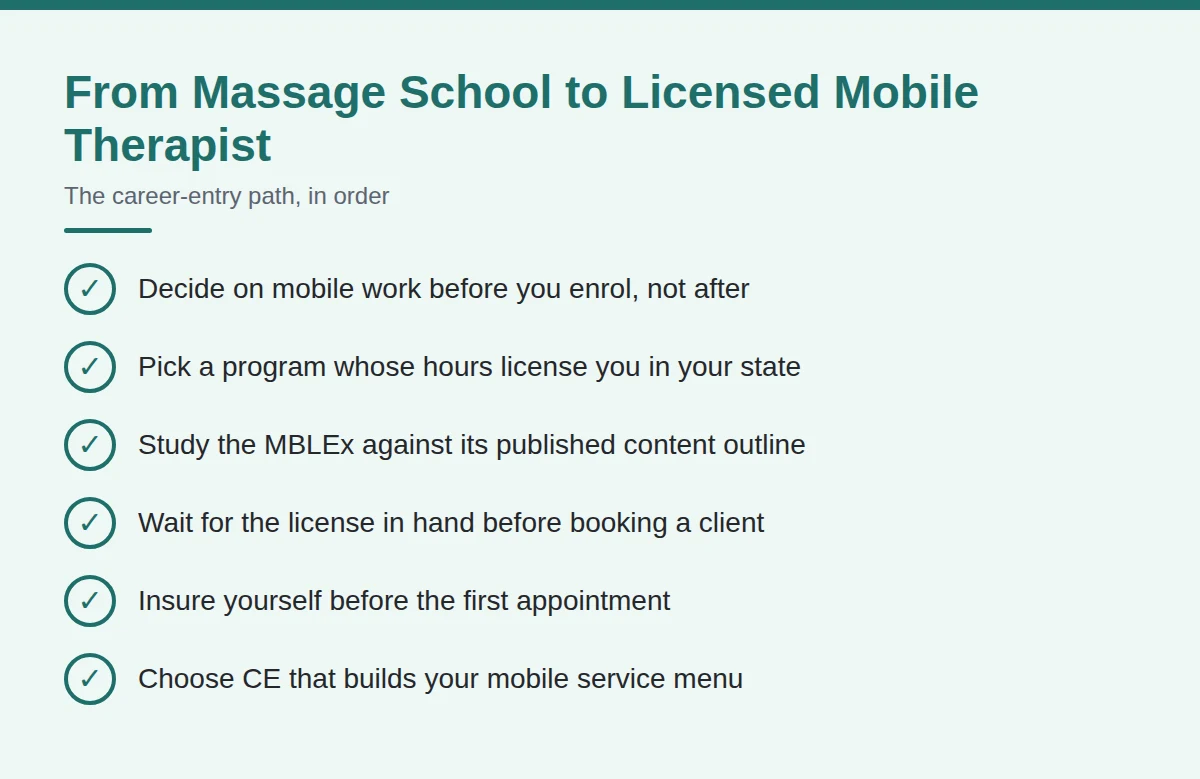
Accreditation matters less on its own than one blunt question: will this program’s hours and curriculum qualify you to practice in the place you intend to work? A program can be reputable and still leave you short of a neighbouring state’s requirement. Confirm the match in writing before you pay a deposit.
Then ask the mobile-specific questions that admissions staff rarely hear:
- Does the student clinic ever leave the building? Programs that run outreach events, chair massage at community fairs or on-site days give you supervised practice at packing, travelling and setting up somewhere unfamiliar. That is the actual skill of mobile work.
- How much practice management is in the curriculum? Marketing, bookkeeping, insurance and client communication are electives at some schools and core units at others. If you will never have an employer’s back office, you need the core version.
- How seriously is body mechanics taught? A therapist who carries their own table and works on floor level in living rooms loads their body harder than a clinic colleague.
- Do they teach chair massage and table setup as their own skills? Both are central to mobile and corporate work and are treated as afterthoughts in spa-oriented programs.
- What are recent MBLEx pass rates, and what do graduates actually do? A school that measures success purely by spa placement is not built around your plan.
Step Two: Read Your State’s Rules Before You Pay Tuition
Massage is regulated state by state, and required education hours, examinations and application steps genuinely differ between them. Some cities and counties layer their own permits on top. AMTA maintains a state regulations hub with current requirements and board contacts, and it is the right place to start, but treat any summary as a pointer and verify the detail on your own board’s site.
Two questions deserve answers now rather than in your final term. First, where do you intend to practice, and does your school’s hour count clear that bar with room to spare? Second, if you might move, how portable is the credential you are about to earn? AMTA has campaigned for fair licensing and portability across all fifty states precisely because the answer is still uneven. Once you are licensed, our state licensing and scope of practice compliance guide covers the day-to-day rules that follow you across county and state lines.
Step Three: Prepare for the MBLEx Like a Content Exam
Most states use the Massage and Bodywork Licensing Examination, administered by the Federation of State Massage Therapy Boards, as their licensing exam. It is a multiple-choice test drawn from a published content outline covering anatomy and physiology, kinesiology, pathology and contraindications, the effects of soft tissue techniques, client assessment and treatment planning, ethics and boundaries, and the laws that govern practice.
That published outline is the whole strategy. Scoring well comes from knowing what the exam actually covers, building a focused study plan against it, and practising test-taking technique rather than rereading class notes. Work backwards from the outline, score yourself honestly on each domain, and give your weakest two the most hours instead of revisiting the material you already enjoy.

Free help exists and new graduates routinely fail to use it. AMTA publishes an MBLEx study guide with practice exams that syncs between browser and mobile app, so study history carries over between sessions, plus a video series of short modules on study strategy and self-care during exam prep. Members also get a musculoskeletal anatomy app produced with Books of Discovery, and AMTA’s ten test-taking tips are worth reading the week before you sit. Book the exam date first and plan the study around it. An open-ended timeline is how a three-month preparation becomes a nine-month one.
Step Four: Turn a Passing Score Into a License
Passing is not licensure. You still submit an application to your state board with transcripts, exam results, fees and usually a criminal background check, and several states add a jurisprudence exam on their own statutes. Processing takes weeks, sometimes longer around renewal season.
Do not schedule paying clients against a license you have not received. Practising a day early is the kind of avoidable violation that follows a new therapist for years. Use the waiting period productively: secure professional liability insurance, which is non-negotiable for every practising therapist and doubly so once no employer’s policy sits behind you, and add general liability for the ordinary mishaps of working inside other people’s homes. Professional association membership often bundles coverage and is usually the cheapest route for a new practitioner.
The Continuing Education That Pays Off Fastest on the Road
Every state sets continuing education hours for renewal, so you will be taking classes regardless. Choose them deliberately and they become your service menu instead of a compliance chore.
Prenatal training earns its cost quickly, because late-pregnancy clients are exactly the people who would rather not drive anywhere and who need bolstering a spa table does not provide. Chair massage and on-site technique open corporate and event contracts, the highest-margin work available to a mobile practitioner. Oncology and palliative training unlock referral relationships with care teams that stay loyal for years. Ethics and boundaries hours are mandatory in many states, and for a solo therapist working unsupervised they are genuinely useful rather than a box to tick. Body mechanics and self-care courses protect the only equipment you cannot replace. Our modality-by-modality service menu guide walks through what each specialisation demands in training and gear before you commit tuition to it.
What School Does Not Teach About Working in Living Rooms
A massage program teaches you to treat a body. It rarely teaches you to work alone in a stranger’s home, and that gap is where new mobile therapists get into difficulty.
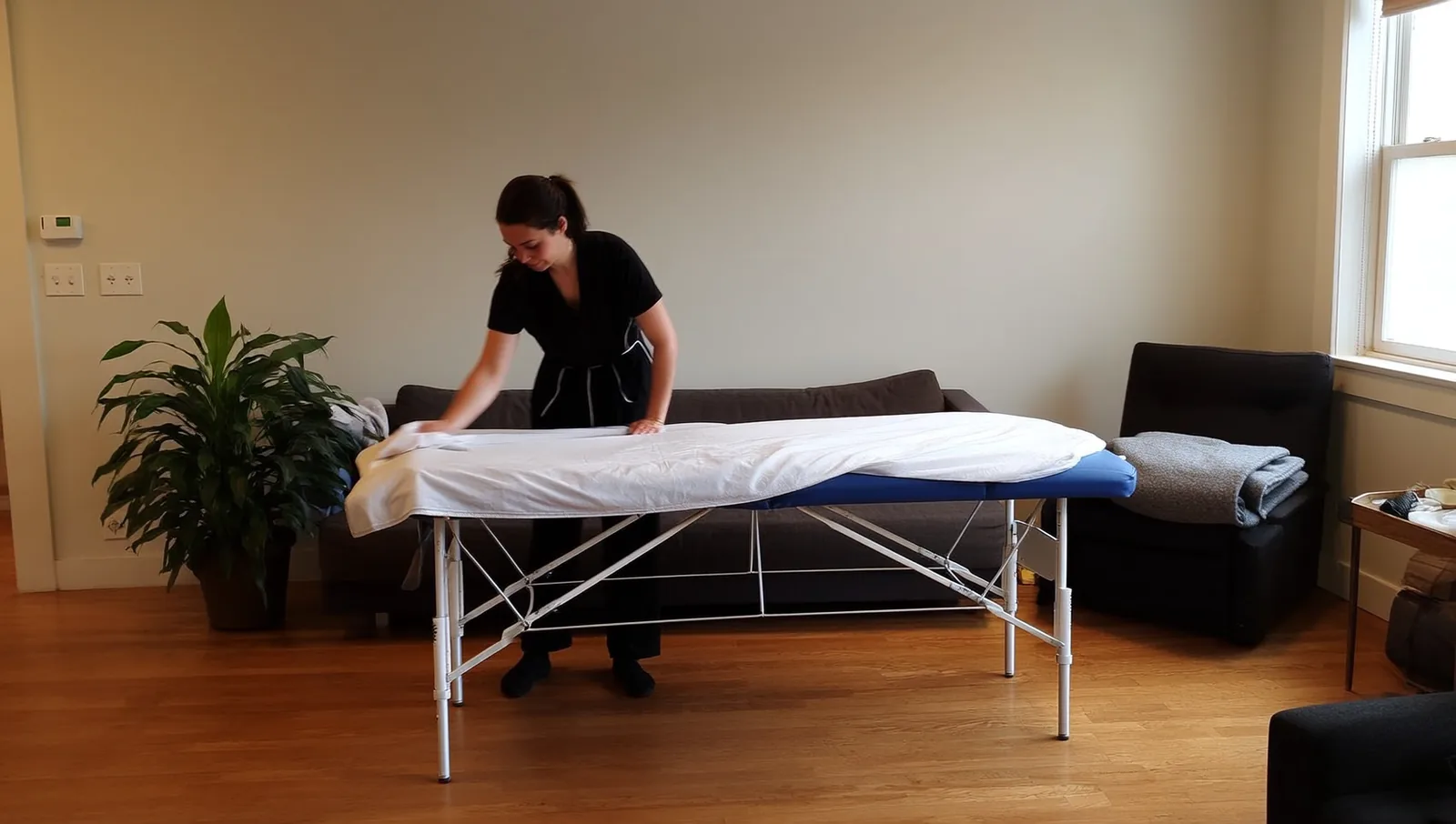
Three habits belong in place before your first appointment. Build a client vetting and check-in routine from day one using our personal safety protocol for mobile therapists, because there is no receptionist and no colleague next door. Write down your own consent and draping standards rather than improvising them in the moment, which our guide to ethics, consent and draping in the client’s home sets out position by position. And buy your first kit for the road, not the classroom, since a table you can carry comfortably matters far more than one that feels luxurious in a showroom. The mobile massage equipment buyer’s guide covers the weight and durability tradeoffs that only show up after fifty appointments.
Your First Year: Employed, Independent, or Both
Plenty of excellent mobile therapists spent a first year on a spa floor, and there is no shame in it. Volume builds hands fast, and a fixed schedule while you learn to read bodies is a reasonable trade. The mistake is drifting into a fifth year there because leaving got harder every month.
A hybrid start suits most people: part-time employment for baseline income while you build a mobile book around it. Find a mentor early, whether through AMTA’s mentoring program or a local therapist a few years ahead of you, because the questions that actually stall a new practice are small and specific and rarely covered in class. When the mobile side can carry you, our first-year roadmap for launching a mobile practice picks up exactly where this guide ends.
The path is not complicated. It is a program that matches your state, an exam you prepare for against its own outline, a license you wait for properly, and a set of first credentials chosen for the career you actually want. Decide on mobile early, and every one of those steps gets easier to choose.
Sources
- American Massage Therapy Association on the three steps from training program to licensed practice
- Massage Magazine for studying smart and passing the MBLEx first time
- AMTA with free MBLEx practice exams, the study app and the prep video series
Further reading
- State Licensing and Scope of Practice: A Mobile Therapist’s Compliance Guide
- Launching a Mobile Massage Business From Scratch: Your First Year Roadmap
- Personal Safety for Mobile Massage Therapists: A Comprehensive Protocol
- Ethics, Consent, and Draping in the Client’s Home: A Professional Boundaries Guide
- Building Your Mobile Massage Service Menu: A Modality-by-Modality Guide
- NCCIH on what the research says about massage therapy