When Anti-Trafficking Massage Ordinances Hit Legitimate Outcall Therapists
Published on September 25, 2026
The Ordinance Was Written for a Storefront
In June, Everett’s city council voted unanimously to put new teeth into its massage rules. Massage businesses in the Washington city may no longer operate between 10 p.m. and 6 a.m., the city can inspect them unannounced, and working without a license is now a misdemeanor. The city attorney was plain about the target: operators “putting people in compromising positions for their own economic gain.” The council also wrote in two exemptions, sparing solo practitioners who work out of their homes from both the hours limit and the inspections.
Those exemptions show a council thinking about one kind of therapist without a storefront. The mobile therapist is the other kind, and whether a rule like Everett’s reaches a late appointment in a client’s living room depends on a definition few therapists ever read.
Everett is one of many. St. Joseph County, Indiana, passed stricter rules in November 2025. Palo Alto put a rewrite of its therapist permitting on the council’s December consent calendar. Utah now requires massage establishments to register with the state. Santa Barbara and Morro Bay spent the winter debating new ordinances, and Ross Township, north of Pittsburgh, adopted one in April. Each was aimed at illicit massage businesses and the exploitation that can hide inside them. The tools they reach for are built around premises: closing times, inspections of a building, permits tied to an address. The mobile therapist is the one practitioner with no premises at all.
In a metro area, one service radius can cross several of these jurisdictions. Here is how outcall is treated in law, how to read a draft before it passes, what to carry under a strict ordinance, and what has persuaded councils to change course. Our state licensing and scope of practice guide covers the state layer above all of this.
Why Premises Rules Land on the Therapist With No Premises
Anti-trafficking ordinances borrow from a short, familiar toolkit, and every tool in it assumes a building.
Closing hours. Everett shuts massage businesses from 10 p.m. to 6 a.m., and Ross Township lets them open only between 7 a.m. and 10 p.m. Florida wrote a version into state law, barring massage establishments from operating between midnight and 5 a.m., with exceptions for those inside hotels, health care facilities and a few other settings. Against a storefront trading after midnight, a closing time is a sensible tool. Attached to a person, it takes the evening slot a mobile book depends on: clients who work days, parents after bedtime, and athletes told to book later in the day after a hard effort.
Unannounced inspections. St. Joseph County’s health department now makes unscheduled visits to confirm that everyone giving massages is licensed and that nobody is living on site. Utah’s regulators can inspect registered establishments, and Santa Barbara’s first draft allowed unannounced inspections. Every one of those clauses names a premises, and a mobile therapist’s only premises are a car and someone else’s home.
Living-quarters bans and posted notices. Ross Township bars massage premises from doubling as dwellings, and Palo Alto’s rewrite points its establishments to state rules on posting human trafficking notices. Both target real signs of exploitation, such as workers who live where they work.
Location clauses. The bluntest tool is a clause that allows massage only on licensed premises. Where local codes regulate outcall at all, they tend to fence it in: a separate outcall permit, outcall only when booked through a permitted business, a list of places it may happen, or a cap on how much of a business’s revenue it can make up. An ordinance that adds a premises-only clause with no outcall exception makes an entire mobile practice unlawful on the day it takes effect.
The pattern repeats. A clause that makes sense against a storefront gets attached to “any person” instead of to a business, and a licensed therapist working at a client’s address lands on the wrong side of it. A Morro Bay studio owner who supports regulation put the stakes plainly: people underestimate “how many good therapists could disappear overnight if the rules change too fast.”
The Definition That Decides Whether You Are Covered
Most of the damage, and most of the protection, sits in the definitions section, the page readers tend to skip.
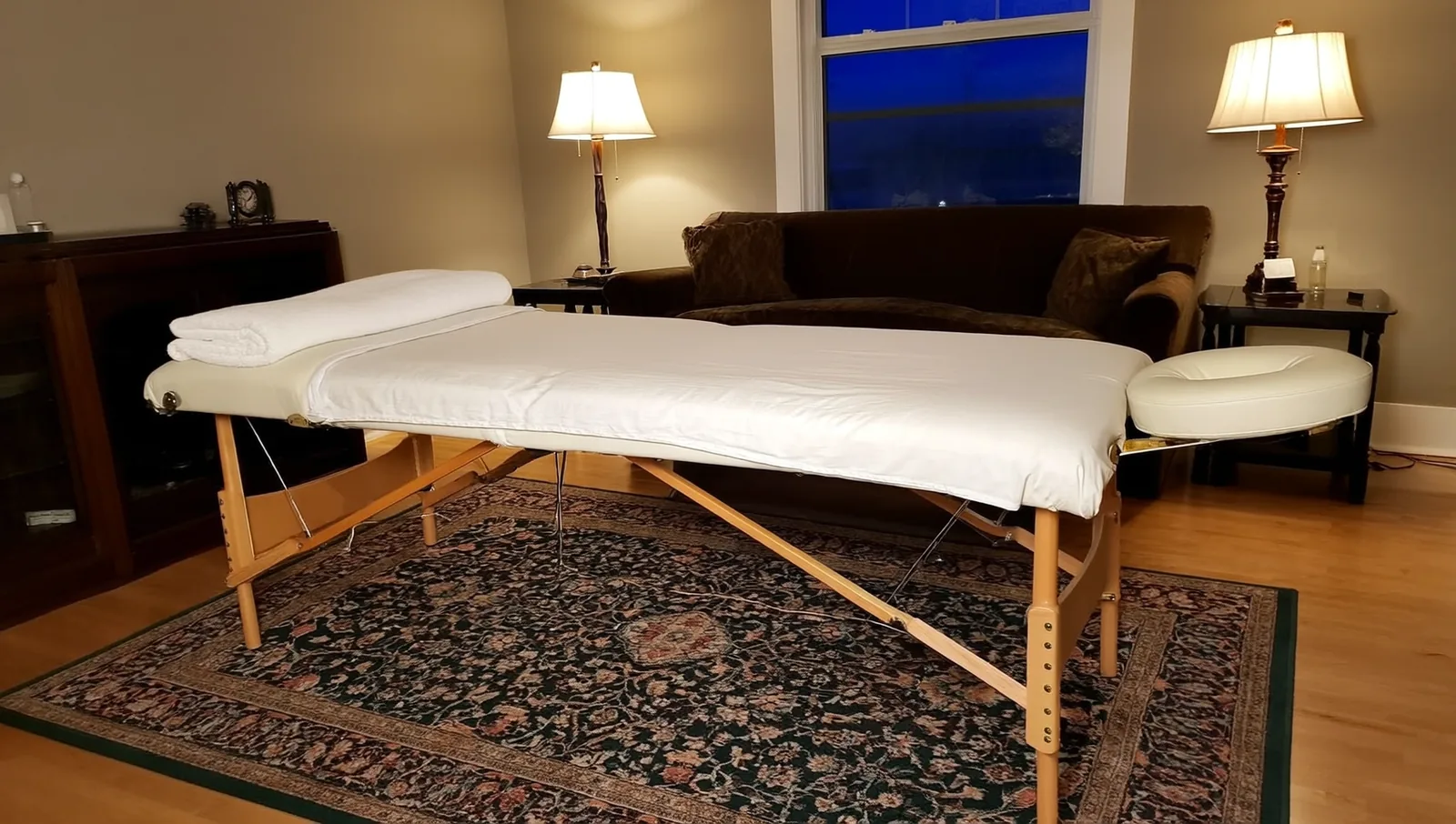
Utah shows what careful drafting looks like. Its statute defines a massage establishment as a place where massage services are performed, then carves three things out of it: a location owned, rented or leased by a single sole practitioner, a massage school used only for teaching, and an out-call location, meaning a place where massage is provided that the practitioner does not own, lease or rent. A client’s living room is an out-call location by definition. You still need your state license there, but the registration, signage and inspection duties that come with being an establishment do not follow you through the door. The bill’s sponsor said the impact on compliant businesses should be minimal, and a licensed therapist interviewed by KUTV welcomed the law, saying illicit businesses had given ethical therapists an unfair reputation. For mobile work, the definitions are what make the sponsor’s promise true.
Local ordinances can inherit that protection. The ordinance put to Ogden’s city council in November 2025 adopts the state’s definition of a massage establishment by reference, so its 10 p.m. to 8 a.m. closing rule applies to establishments, and an out-call location sits outside the definition.
California takes a different route to a similar place. Its Massage Therapy Act defines an establishment as a fixed location where massage is performed for compensation, excluding locations where massage is only provided on an out-call basis. A city cannot require a therapist certified by the California Massage Therapy Council to hold any other license or permit to provide massage, although it can still license massage businesses and enforce zoning. The certifying council also says cities there cannot ban outcall services outright, and the act tells local governments to impose only reasonable and necessary regulations, mindful of legitimate massage professionals, “particularly sole providers.” Those protections belong to certificate holders: cities may still license, regulate or prohibit someone who provides massage without a certificate.
Where state law is silent, each council decides for itself, and the draft on the table is the whole story.
How to Read a Draft Before the Vote
By the time an ordinance reaches a final vote, it is usually finished. Palo Alto’s rewrite went from a unanimous committee recommendation onto the council’s consent calendar, where items pass together with minimal or no discussion. Wording changes at committee, at first reading and during public comment, so the job is to find drafts early.
Start with a map. List every city, town and county inside your service area, the same map you drew when you priced your travel zones, and find where each posts its council and committee agendas. Many offer email alerts, and an alert for the word “massage” costs nothing. When a draft appears, read it in this order:
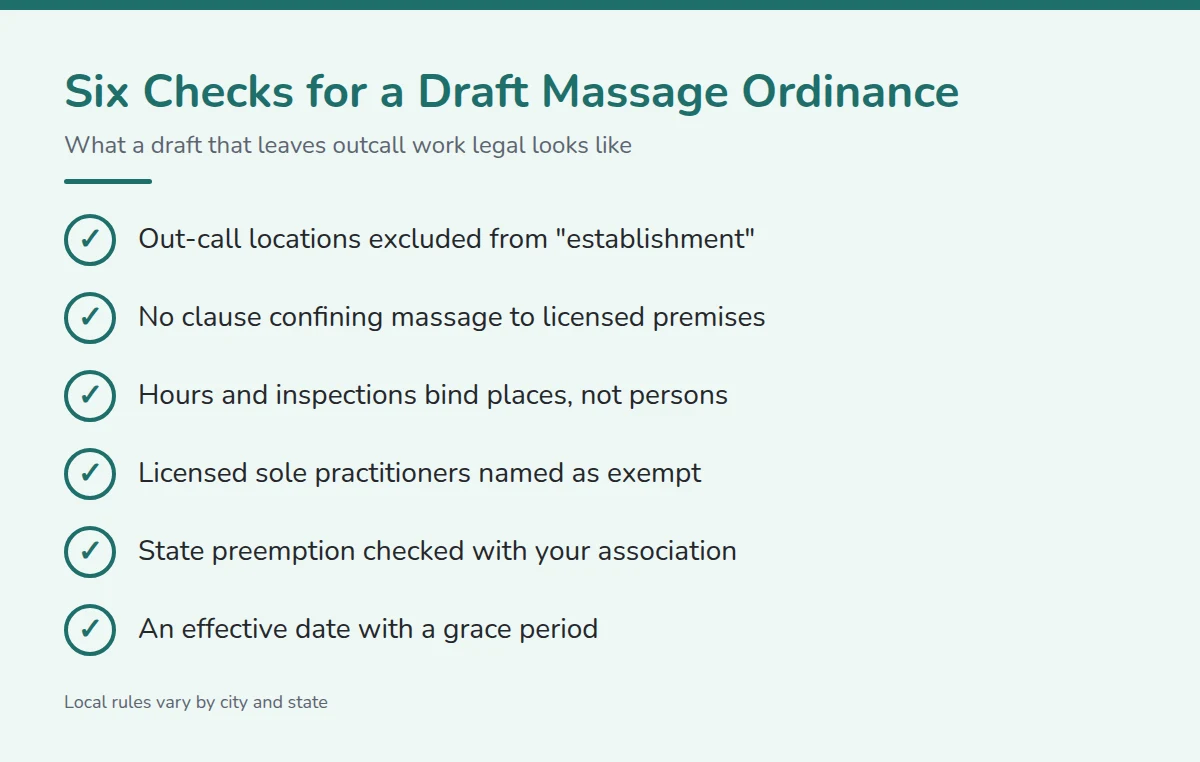
- Definitions. Find “massage establishment,” “massage business,” “operator,” “premises” and “outcall.” Is an establishment a fixed location? Are places the therapist does not own, lease or rent excluded?
- The location clause. Search for “only,” “except,” “any location” and “off-premises.” A sentence confining massage to licensed premises, with no outcall exception, is the one that ends mobile work.
- Who each duty binds. Hours, inspections, signage and living-quarters rules written as “no massage establishment shall” bind a place. Written as “no person shall,” they follow you into every client’s home.
- The exemptions. Is a state-licensed therapist named? A sole practitioner? Does a home-based exemption reach outcall, or only a studio in the therapist’s own home?
- State preemption. Ask your AMTA state chapter, or check your professional association’s legislative updates, to learn what your state already controls.
- Dates. Find the effective date and any grace period, and ask for one if there is none.
Then read the staff report. It explains why the council believes it needs the ordinance, and it is the document to answer. If it describes complaints about storefronts open past midnight, an outcall exemption costs the council nothing it asked for.
Working an Address Under a Strict Ordinance
Once an ordinance is in force, the practical question is what you can show when an inspector, an officer or a building manager asks what you are doing at an address. Carry the things that make a therapy visit recognizable as one:
- Your state license or certificate, on your person. California requires certified therapists to carry their identification card while working and to give their full name and certificate number when a member of the public, the police or a local regulator asks.
- Any local permit or outcall endorsement for the jurisdiction you are standing in, which may not be the one you live in.
- The booking record: the client’s name and address, the booked time and service, and the message trail showing how they found you. A pre-booked, documented appointment is what separates your visit from what the ordinance targets.
- The signed intake form, which shows a health history was taken before any touch.
- Proof of professional liability insurance. Some permits require it, and no mobile therapist should work without it.
- The section number of the exemption that covers you, saved on your phone. Pointing to a clause ends a doorstep conversation faster than explaining outcall.
Keep sessions inside local closing hours even where you are fairly sure the cap does not reach you, because a debate about definitions at 11 p.m. is not worth winning. The arrival and departure times your safety check-in system already logs double as a compliance record.

Watch the edges, too. Outcall rules generally assume the location belongs to the client, so treating someone at a space you rent or control, even for an hour, can turn that space into an establishment needing its own permit. Check the local rules before accepting a hotel booking, because some codes limit outcall to a client’s home or workplace. And keep your advertising unmistakably clinical. California already requires certified therapists to print their name and certificate number in every advertisement, a habit worth copying anywhere, because words like “discreet” and “late night” read badly to anyone enforcing an anti-trafficking ordinance.
What Has Actually Moved Councils
Ordinances do change between first draft and final vote, and the changes that stick tend to share a shape: they keep the council’s goal and move the burden off the licensed individual.
Santa Barbara is the clearest recent case. Its first draft raised fees, allowed unannounced inspections and doubled required training from 250 to 500 hours, which long-practicing therapists said would send them back to school. After they pushed back, the city limited inspections to those prompted by complaints, lowered fees for sole proprietors and moved the training deadline from 2028 to 2029. A councilmember said that after hearing from the people it would affect, “it does seem unfair.” A therapist who has practiced in the city since 2002 told the Independent she was pleased the city had listened, and that there was “still a ways to go.”
Everett’s council, though unanimous, amended its ordinance before passing it, adding a financial penalty for landlords who knowingly lease space to businesses that break the rules. Palo Alto went further in the same direction. A police department analyst described its rewrite as “flipping” the onus from the individual practitioner to the owner-operator of the business, who may hire only certified therapists.
Immigrant massage workers in Everett made a related point from the other side. Their advocates argued that misdemeanor penalties for unlicensed work would land on low-income workers facing real barriers to licensing, including cost and limited language access, and the city committed to multilingual outreach before enforcing. An ordinance aimed at operators and landlords protects exploited workers and licensed therapists at once. That is the argument to make.
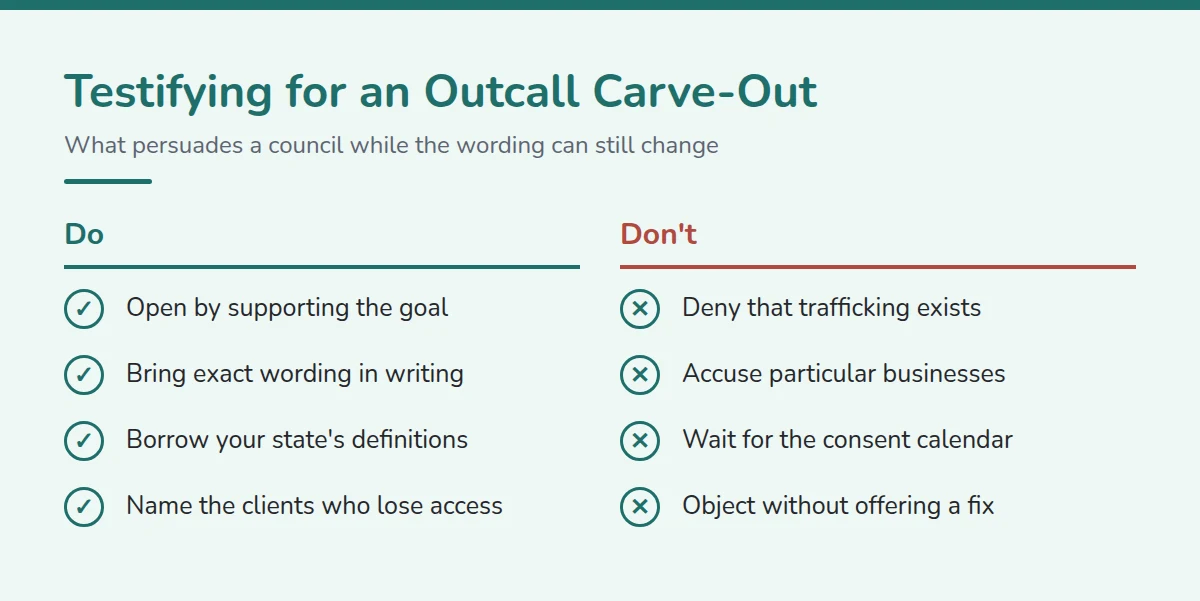
When you testify, open by supporting the goal. Then ask for one specific change, in writing, with wording the city attorney can drop into the draft. The strongest ask borrows your own state’s definitions, because the legislature has already vetted that language. Tell the council who loses access if outcall ends: homebound seniors, hospice patients, new parents and people with disabilities. Leave accusations about particular businesses to the police. Offer a better model, too: the same Morro Bay owner urged oversight run like health department inspections of tattoo studios, focused on sanitation, documentation and safety rather than suspicion. And come in numbers, with other local therapists or your association’s chapter behind you.
Here is a starting point for the wording, modeled on Utah’s statute. Have your association or an attorney check it against your state’s law before you submit it:
“Massage establishment” does not include an out-call location. “Out-call location” means a location where massage is provided that the licensed massage therapist providing it does not own, lease, or rent. The hours of operation and inspection provisions of this chapter apply only to massage establishments.
The Council and the Licensed Therapist Want the Same Thing
Illicit massage businesses exploit the people working in them, and every one that makes the news costs licensed therapists some reputation. Nobody has a stronger interest in shutting them down than the profession they imitate. A mobile therapist who reads the draft early, arrives at committee with a definition instead of a complaint, and works every address with license, booking record and insurance in hand is the easiest ally a council will find. Licensing and scope of practice vary by state and ordinances vary by city, so confirm the details with your own board and the local code before relying on any of them.
Sources
- HeraldNet on Everett’s closing hours, inspections and solo practitioner exemptions
- Palo Alto Online for moving permit responsibility from therapists to owner-operators
- The Santa Barbara Independent with what therapists won after pushing back on the first draft
- TribLIVE on the Ross Township massage rules as first introduced
- TribLIVE reporting the commissioners’ April vote to adopt them
- WNDU for St. Joseph County’s licensing and unscheduled inspection rules
- KUTV on Utah’s registration law and how licensed therapists received it
- Utah Legislature with the statutory definitions of a massage establishment and an out-call location
- Ogden City Council staff review of a city ordinance built on the state definitions
- New Times San Luis Obispo on a practitioner’s case for health department oversight in Morro Bay
- California Massage Therapy Act for the establishment definition, sole provider protections and what certified therapists must carry
- California Government Code on what cities may not require of a certified massage therapist
- California Massage Therapy Council answering whether cities can require local permits or ban outcall
- The Florida Senate with the statewide midnight to 5 a.m. closing rule for massage establishments
Further reading
- State Licensing and Scope of Practice: A Mobile Therapist’s Compliance Guide
- Personal Safety for Mobile Massage Therapists: A Comprehensive Protocol
- Your Car Is the Clinic: Vehicle Setup, Route Planning, and Travel Zones for Mobile Massage
- Soothe, Zeel, or Your Own Book? A Mobile Therapist’s Guide to Platform vs Independent Work
- The Complete Marketing Playbook for Mobile Massage Therapists