Massage for Anxiety and Depression in Cancer: What the 288-Patient Trial Found, and What Fades by Week Ten
Published on November 7, 2026
The Client Who Books an Hour to Switch Off
Very few people in cancer treatment book a massage “for anxiety.” They ask for something relaxing, or an hour to switch off, and the real reason surfaces once they are lying down: a scan next week, a result they are still waiting on, a treatment that has taken their sleep, their appetite and, on some days, their sense of themselves. Whether or not your intake form asks about mood, you will hear about it.
It is also very common. In a 2026 meta-analysis, Jia and colleagues pooled 52 reports covering 16,850 women with breast cancer and estimated that 44.3 percent had symptoms of depression and 47.9 percent had symptoms of anxiety. Where studies broke out a severe category, 16.7 percent fell into it for depression and 18.2 percent for anxiety. Hold those numbers loosely, as the authors do. They come from symptom questionnaires rather than diagnoses, the estimates varied enormously from study to study and from tool to tool, and the authors present their pooled figures as descriptive summaries rather than precise rates. Looking across all cancers, a 2026 review by Carlson, Deleemans and colleagues puts elevated anxiety and depression symptoms at roughly one patient in three. On either estimate, a large share of the cancer clients on your schedule are carrying more than tight shoulders.
Mood gets a single paragraph in our guide to mobile massage for cancer patients. This piece fills in the rest: the trial that put massage to the test on exactly this problem, why its benefit had faded by week ten, what that should change about how you book, and how to notice distress without pretending to diagnose it.
What the Trial Tested
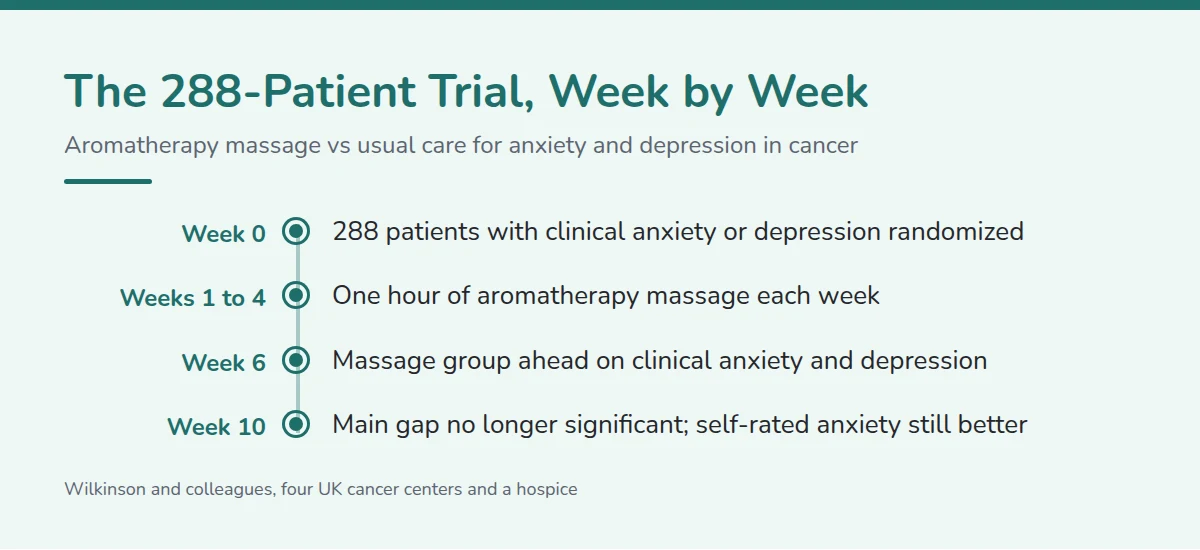
The study was run by Wilkinson and colleagues and published in the Journal of Clinical Oncology in 2007. It enrolled 288 people with cancer across four UK cancer centers and a hospice, and it remains one of the largest trials to test massage against anxiety and depression in this population. Every participant had been referred to a complementary therapy service and had clinical anxiety, clinical depression or both. That detail matters: these were not healthy volunteers scoring their stress for a study, but patients whose distress had reached a clinical level.
Participants were randomly allocated to one of two arms. One group received a course of aromatherapy massage on top of their usual supportive care; the other received usual supportive care alone. A later review by Li and colleagues tabulates the course as one hour a week for four weeks, with each patient able to choose from 20 essential oils.
The design was pragmatic, meaning it tested aromatherapy massage the way services actually deliver it rather than under tightly controlled laboratory conditions. That makes the results easier to carry into everyday practice. It also means the comparison was massage against no massage, so the trial cannot say whether the oil, the touch or an hour of undivided attention did the work.
The main outcome was whether each patient’s clinical anxiety or depression had improved, assessed six and ten weeks after randomization. Patients also scored their own anxiety on the State Anxiety Inventory and their own depression on a questionnaire called the CES-D.
Six Weeks Yes, Ten Weeks No
At six weeks, about two weeks after the last session, the massage group was ahead on the main outcome: the odds of improvement were about 1.4 times those in the usual care group, a difference unlikely to be due to chance. At ten weeks, roughly six weeks after the course had ended, the gap had narrowed (an odds ratio of 1.3) and was no longer statistically significant.
The patients’ own ratings split along the line between anxiety and depression. Self-rated anxiety improved more in the massage group at both six and ten weeks. Self-rated depression did not: on the CES-D there was no significant difference at ten weeks.
The authors’ conclusion is worth reading exactly as they wrote it. Aromatherapy massage “does not appear to confer benefit on cancer patients’ anxiety and/or depression in the long-term, but is associated with clinically important benefit up to 2 weeks after the intervention.”
Two practical readings follow. Anxiety responded more readily, and for longer, than depression did. And whatever the massage achieved stayed close to the sessions themselves: present while the course was running and for a couple of weeks afterward, no longer detectable on the main outcome six weeks after it stopped.
The Same Shape in a Hospice Trial
A large American trial shows the same pattern from a different angle. Kutner and colleagues randomized 380 adults with advanced cancer and moderate to severe pain, 90 percent of them enrolled in hospice, to six 30-minute sessions across two weeks of either massage or “simple touch”: hands resting still on the body for three minutes per location, given by people with no bodywork experience. The setting will look familiar to any mobile therapist. Around four in five participants were receiving their care at home. Half of the massage sessions were given with the client lying face up and a quarter with the client seated, and fewer than a quarter of participants undressed for treatment.
Both groups felt better straight after a session. Massage beat simple touch on immediate mood, by 0.61 points on a 0 to 10 scale, and on immediate pain, by 0.90 points. Over the following weeks, though, the two groups did not differ in pain, quality of life, symptom distress or use of pain medication. One caution applies to the immediate results: the before and after ratings were collected by the study therapists, who knew which treatment they had given, and the authors acknowledge this may have inflated the benefit. Their conclusion was that massage may help pain and mood in the moment, and that, given the short-lived effects and the gains in both groups, “the potential benefits of attention and simple touch should also be considered.”
Set the two trials side by side and the lesson for a mobile therapist is consistent. Massage can lift mood and ease anxiety in the hours and weeks around a visit. It does not build a lasting change that carries on once the visits stop, and part of what it offers is calm, unhurried human attention, which a good session provides whatever the technique.
What the Guidelines Say
The guidelines do not speak with one voice. A 2017 guideline from the Society for Integrative Oncology by Greenlee and colleagues, covering integrative therapies during and after breast cancer treatment, listed massage among the therapies recommended for depression and mood disorders. The newer 2023 guideline on anxiety and depression, written by Carlson and colleagues for the Society and ASCO, covers adults with any cancer and drew on research published from 1990 through 2023. For anxiety during active treatment, it recommends mindfulness-based programs, yoga, relaxation, music therapy, reflexology and aromatherapy by inhalation; for depression during treatment, mindfulness-based programs, yoga, music therapy, relaxation and reflexology. Massage does not appear on any of its lists, during treatment or after it.
That inhaled aromatherapy recommendation is narrower than it sounds. The 2026 review by Carlson, Deleemans and colleagues describes it as a weak recommendation, resting on low-quality evidence, for breathing in lavender oil around diagnostic tests and treatment procedures. Massage did earn a recommendation in the two groups’ 2022 guideline on cancer pain, by Mao and colleagues, but specifically for pain during palliative or hospice care.
The Cochrane review by Shin and colleagues helps explain the caution. Pooling 19 small trials and 1,274 participants, its authors could not find a single outcome where the evidence rose above very low quality. Plain massage made no difference to depression compared with no massage. Aromatherapy massage did reduce anxiety a little, but the reviewers did not think the reduction was big enough to matter clinically.
Treatment for anxiety and depression in cancer comes from elsewhere. ASCO’s 2023 guideline update, by Andersen and colleagues, sets out stepped care matched to severity: education about anxiety and depression for every patient, then talking therapies such as cognitive behavioral therapy, behavioral activation or mindfulness-based stress reduction, or structured physical activity, for moderate symptoms, with medication available in particular circumstances. A small pilot trial set the two approaches side by side. Serfaty and colleagues randomized 39 distressed outpatients to up to eight weekly sessions of either aromatherapy massage or cognitive behavioral therapy. Mood improved in both groups. Patients preferred the massage and attended more of those sessions, while depression showed a trend, not statistically significant, toward greater improvement with therapy, and that gain appeared to last. A 39-person pilot proves little on its own, but the signal fits everything above: clients want the massage, and the therapy carries depression further.
For a therapist, that settles the scope question. With a distressed cancer client, massage is comfort care that runs alongside their treatment for anxiety or depression, never a substitute for it. If a client asks whether massage will help, a fair answer goes like this. In one of the biggest trials of its kind, a month of weekly aromatherapy massage helped anxiety and low mood for a couple of weeks after it ended, and by ten weeks the main difference had gone. It can help you feel calmer while you are having it. It is not a treatment for depression.
What “Fades by Week Ten” Means for Booking
Do not sell a fixed four-week “anxiety package” that hints at a lasting fix. That is precisely the shape the trial tested, and its benefit had faded six weeks after the last session.
Book around the hard stretches instead. If the benefit lives close to the visits, the visits belong where the client needs them most. Carlson, Deleemans and colleagues note that anxiety tends to be most prominent early on, around diagnosis and uncertainty about treatment, and that it also gathers around follow-up scans (sometimes called scanxiety), while depressive symptoms can build as the physical and emotional load accumulates. A weekly slot through a treatment cycle, a visit in the days before a scan or results, and a run of sessions after a recurrence are all sensible to offer, scheduled around infusion days as our cancer guide describes.
Plan the ending before you reach it. The weeks after a block ends are exactly when the trial saw the benefit slip away, so do not let a series simply stop. A visit or two before the last booked session, ask the client how they want to continue: carry on weekly, drop to every other week, or pause. None of those options has been tested, so present them as choices rather than prescriptions. Ask, too, whether the rest of their support is in place.
If a client wants ongoing visits, describe them honestly. No trial has tested whether continuing weekly massage holds the gain, so a standing slot is comfort that helps while it continues, reviewed with the client every month or so. Our guide to massage for chemotherapy neuropathy describes a trial that supports packing visits close together for that symptom; for mood, the evidence tells you only that the effect stays near the visits.
Let fatigue set the session length. The UK trial used an hour, the hospice trial 30 minutes, and both found benefits close to the sessions. A half hour in a recliner is a legitimate session for someone with nothing left in the tank.
On scent, remember that the 288-patient trial tested aromatherapy massage, yet no trial has shown the oil adds anything to the massage itself. If a client enjoys a scent, use a properly diluted blend and ask at every visit rather than assuming. Our guide to essential oils on mobile visits covers dilution, and why marketing a blend as a fix for anxiety is a claim to keep off your menu.
Noticing Without Diagnosing
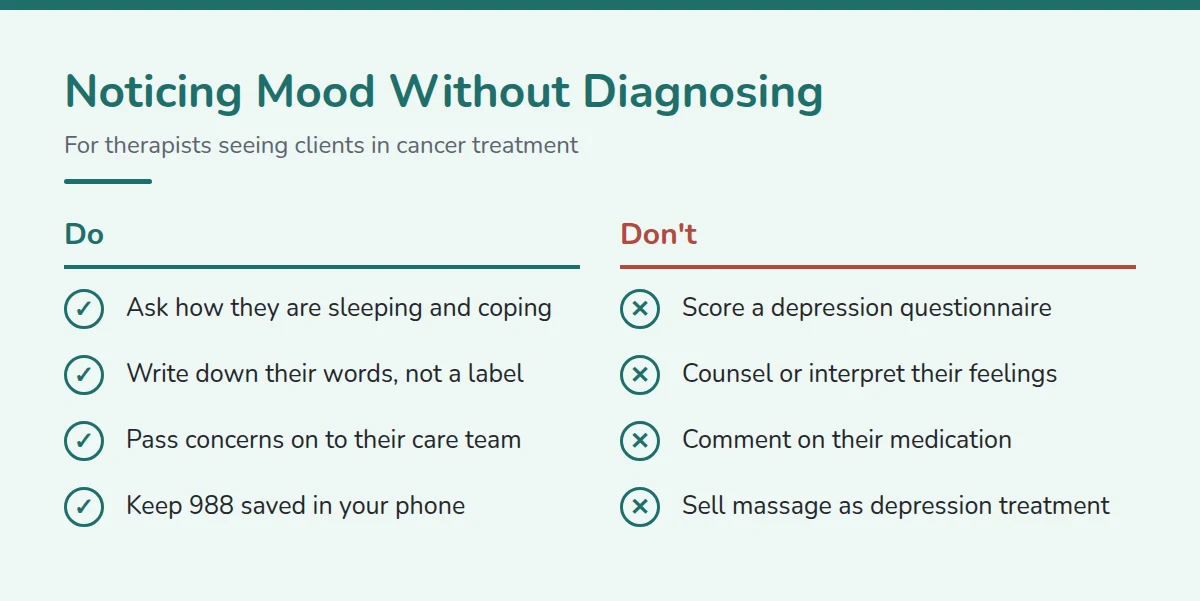
A massage therapist does not diagnose anxiety or depression, and should not score a depression questionnaire on a client, however easy one is to download. Screening is already somebody else’s job: as the Carlson review notes, both ASCO and the National Comprehensive Cancer Network recommend that cancer teams screen routinely with validated tools such as the PHQ-9 for depression and the GAD-7 for anxiety. Your part is to notice, ask and pass on, normally with the client’s permission.
Even specialists find this hard. Fatigue, poor sleep, changes in appetite and weight, and trouble concentrating all count as symptoms of depression, and they are also everyday effects of cancer and its treatment. That is why clinicians assessing people with cancer give more weight to hopelessness, loss of pleasure, feelings of worthlessness, excessive guilt and thoughts of death. You cannot untangle that on a massage table, and you should not try.
What you can do is ask plain questions at the start of a visit:
- How have you been sleeping, and how are you feeling in yourself this week?
- Is anything coming up, like a scan or results, that is on your mind?
- Is there someone on your care team you talk to about how you are coping?
Record the answers in the client’s own words. “Says she has stopped enjoying the garden” belongs in your notes; “depressed” does not, because it is a diagnosis you are not qualified to make. Listen especially for the things clinicians weigh most heavily: no pleasure in what used to matter, hopelessness, guilt, a sense of being worthless, or any talk of death. Those are not yours to interpret. They are yours to pass on.
And keep to your side of the line. Do not counsel, do not interpret what the client is feeling, do not offer views on antidepressants or any other medication, and do not suggest that more massage will lift it.
When to Pass It On
Think in three tiers.
Expected worry and sadness. Fear at diagnosis, dread before a scan and worry about recurrence usually fall short of an anxiety disorder, and sadness and grief can be, in the Carlson review’s words, “entirely expected responses” to cancer. Both still weigh on quality of life. Listen, carry on with the session if the client wants to, and let them know that if their cancer center has a counseling or social work service, it exists for exactly this.
Symptoms that persist. If low mood or loss of interest has lasted two weeks or more, for most of the day on most days, or worry has started to run the client’s life, encourage them to tell their oncology team, which should be screening for this anyway. Offer to mention it yourself in your next update to the team, and only do so with their consent, noted in your records.
Any talk of suicide or self-harm. Take it seriously every time. A 2022 meta-analysis by Heinrich and colleagues, covering more than 22 million patients, found that suicide deaths among people with cancer ran at 1.85 times the rate in the general population, with risk strongly related to prognosis, stage, time since diagnosis and region. The 988 Suicide and Crisis Lifeline advises being direct, talking about suicide openly and matter-of-factly, listening without judgment, and never keeping it secret when someone tells you about a plan to hurt themselves. Stop the massage, sit with the client, and ask plainly whether they are thinking about ending their life. If they are, call or text 988 together. If they are in immediate danger, call 911 and stay with them. Tell the oncology team. This is the one situation where you do not wait for permission.

Set up the routes before you need them: the oncology team’s number from your clearance paperwork, the cancer center’s support service if it has one, and 988 saved in your phone. Then look after yourself afterward. The 988 Lifeline notes that supporting someone through a difficult time can stir up difficult feelings in the helper too, and encourages helpers to reach out for support themselves. Our hospice and palliative massage guide covers the emotional load of this work in more depth.
Why the Home Visit Suits This Client
The hospice trial was largely a trial of home visits: around four in five participants were receiving their care at home, and the therapists adapted to each setting, with most clients clothed and many sessions given seated or face up. That is the mobile toolkit for this client: a recliner, a bed propped up with pillows, a kitchen chair, half an hour, clothes on.
The home also protects whatever benefit the session brings. To reach a clinic, a client who is anxious and exhausted has to drive there, park, sit in a waiting room and then drive home drowsy. At home, the calm from the session is not spent in traffic, which matters more when the evidence says the effect sits close to the visit.
It gives emotion somewhere private to land, too. Clients cry on the table, and it is usually not a crisis. In their own room, with nobody waiting on the other side of a thin door, they can let it happen. Pause, keep tissues and water within reach, ask whether they would like to stop or carry on, and do not probe.
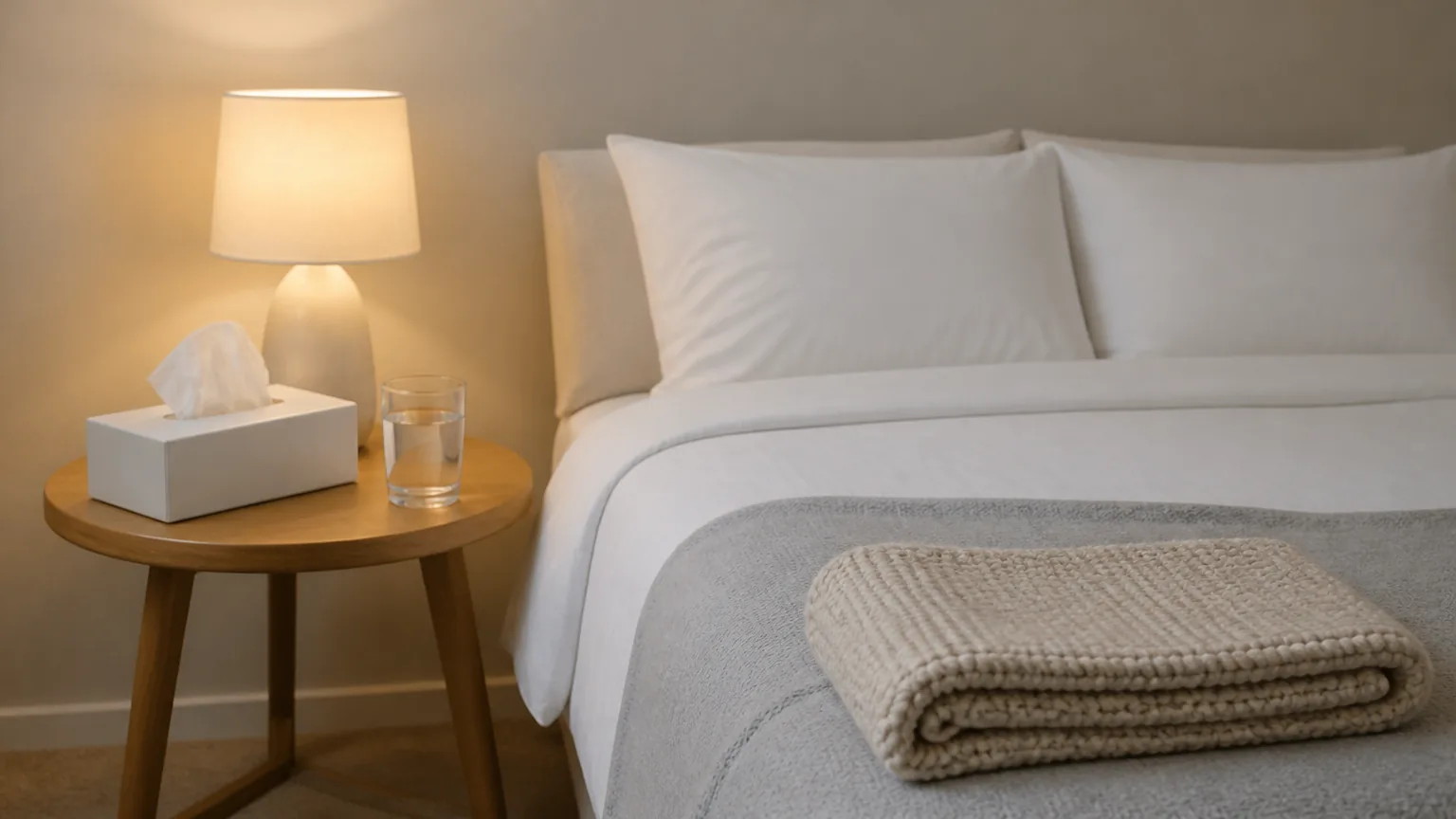
The flip side is that you are alone in a home with a person in distress. Keep the referral routes ready, hold your boundaries, and resist becoming the client’s counselor by text between visits.
For Clients and Families: What to Ask Before Booking
Both trials above enrolled adults. If the person in treatment is a child, consent and clearance work differently, and our guide to massage for children with cancer covers both. For an adult, a few questions will show you whether a therapist is ready for this work:
- Do you have oncology massage training? In the hospice trial, every therapist was licensed, had at least six months of experience with advanced cancer or hospice patients, and had completed at least 500 hours of massage training.
- Will you get clearance from my oncology team before the first visit?
- Can we work with me clothed, in my own chair or bed, for half an hour if that is all I can manage?
- What do you do if I get upset during a session?
- Will you ask before using any scented oil?
Ask one question of yourself as well: is the rest of your support in place? Massage can make a hard week feel lighter, but your oncology team can offer treatment for anxiety and low mood that massage cannot. Rules on licensing and scope differ from one state to the next, so check that your therapist is currently licensed in yours.
The Honest Offer
What you can offer is modest, and it is real. Regular, gentle visits through the hardest weeks, in a home where the client does not have to drive anywhere or undress unless they choose to, will probably leave them calmer for a while after each one. Those visits will not cure depression, and one of the largest trials built around this question found the effect faded within weeks once they stopped. Deliver the comfort, notice what you hear, and make sure it reaches the people who can treat it.
Sources
- Wilkinson and colleagues on the 288-patient trial of aromatherapy massage for anxiety and depression in cancer
- Li and colleagues with a meta-analysis that tabulates the trial’s weekly one-hour sessions
- Jia and colleagues for a 2026 meta-analysis of anxiety and depression in breast cancer
- Kutner and colleagues comparing massage with simple touch in advanced cancer, mostly at home
- Carlson, Deleemans and colleagues on telling expected cancer distress apart from anxiety and depressive disorders
- Carlson and colleagues for the SIO and ASCO guideline on integrative care for anxiety and depression
- Greenlee and colleagues with the 2017 guideline on integrative therapies in breast cancer
- Mao and colleagues on the SIO and ASCO guideline on integrative care for cancer pain
- Shin and colleagues for the Cochrane review of massage with and without aromatherapy in cancer
- Andersen and colleagues on ASCO’s stepped-care guideline for anxiety and depression in survivors
- Serfaty and colleagues comparing aromatherapy massage with cognitive behavioral therapy for distress
- Heinrich and colleagues with a meta-analysis of suicide risk among patients with cancer
- 988 Suicide and Crisis Lifeline on how to help someone who may be thinking about suicide
Further reading
- Mobile Massage for Cancer Patients: An Evidence-Based In-Home Guide
- Massage for Chemotherapy-Induced Peripheral Neuropathy: What the Dosing Trial Found and How to Work Numb Feet Safely at Home
- Essential Oils on the Road: Aromatherapy Scope, Evidence, and Scent in Someone Else’s Home
- Hospice and Palliative Massage at Home: A Mobile Therapist’s Guide
- Massage for Children With Cancer: Evidence, Consent, and Safe Sessions at Home