Essential Oils on the Road: Aromatherapy Scope, Evidence, and Scent in Someone Else's Home
Published on September 27, 2026
The Bottle You Open in Someone Else’s House
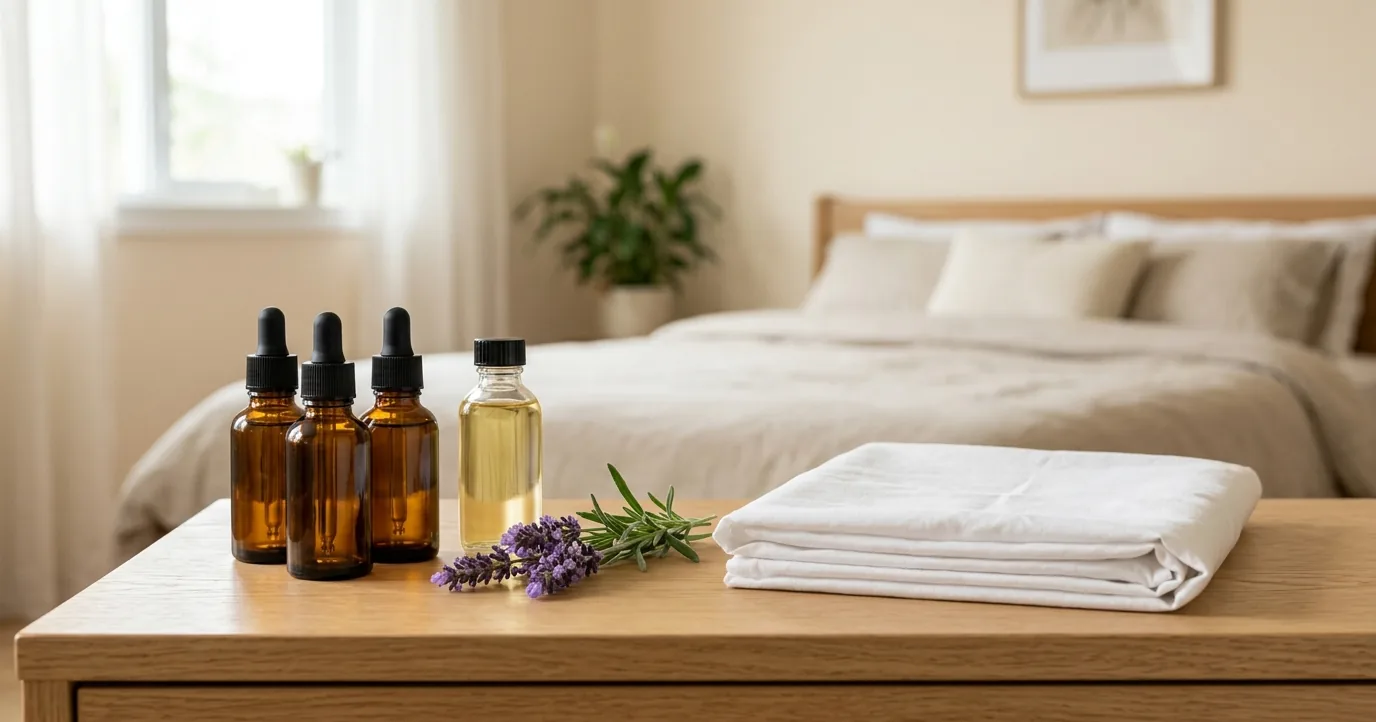
In a treatment room, the scent belongs to you. You choose it, you air the room between clients, and everyone who walks through the door has chosen to walk into a massage studio. None of that survives the drive to a client’s house. The lavender you open at two in the afternoon can still be hanging in the bedroom at bedtime, and the people breathing it include a child with asthma who was at school during the session, a partner who is fourteen weeks pregnant, and a cat that will spend the evening in your client’s lap.
None of them booked the appointment. That is the part of aromatherapy the wellness copy never covers, and for a mobile practice it is most of what matters. The rest is a short list of questions few therapists ask out loud: what the oil adds on top of the massage, where using a scented oil ends and practicing aromatherapy begins, and what a safe blend actually looks like.
What the Oil Adds on Top of the Massage
Start with the most optimistic reading. Sattayakhom, Wichit and Koomhin searched a decade of research, 2012 to 2022, and included roughly seventy original studies on essential oils and the nervous system. They found reports of antistress, antianxiety, analgesic, cognitive and autonomic effects, and concluded that the oils “showed promising effects on the nervous system.”
Keep that in proportion. A scoping review maps what has been studied without grading or pooling it, so “promising” describes a direction, not a verdict. Its outcomes ran from pain and depression to consumer acceptance and willingness to buy, and the authors see applications in functional foods and drinks as well as therapy. It is a map of a broad commercial field, not a treatment review.
The question a massage therapist needs answered is narrower. Hold the massage constant: does the oil add anything? The Cochrane review by Shin and colleagues comes closest, and mostly it answers how little is known. Across 19 studies and 1,274 people with cancer, the reviewers rated the evidence for every outcome as very low quality. Only two studies, with 117 participants between them, compared massage using essential oils against the same massage with carrier oil alone, and from those the reviewers could not assess whether adding aromatherapy changed pain, anxiety, depression or quality of life. Seventeen of the nineteen studies did not report adverse events at all, so the safety record here is silence rather than reassurance.
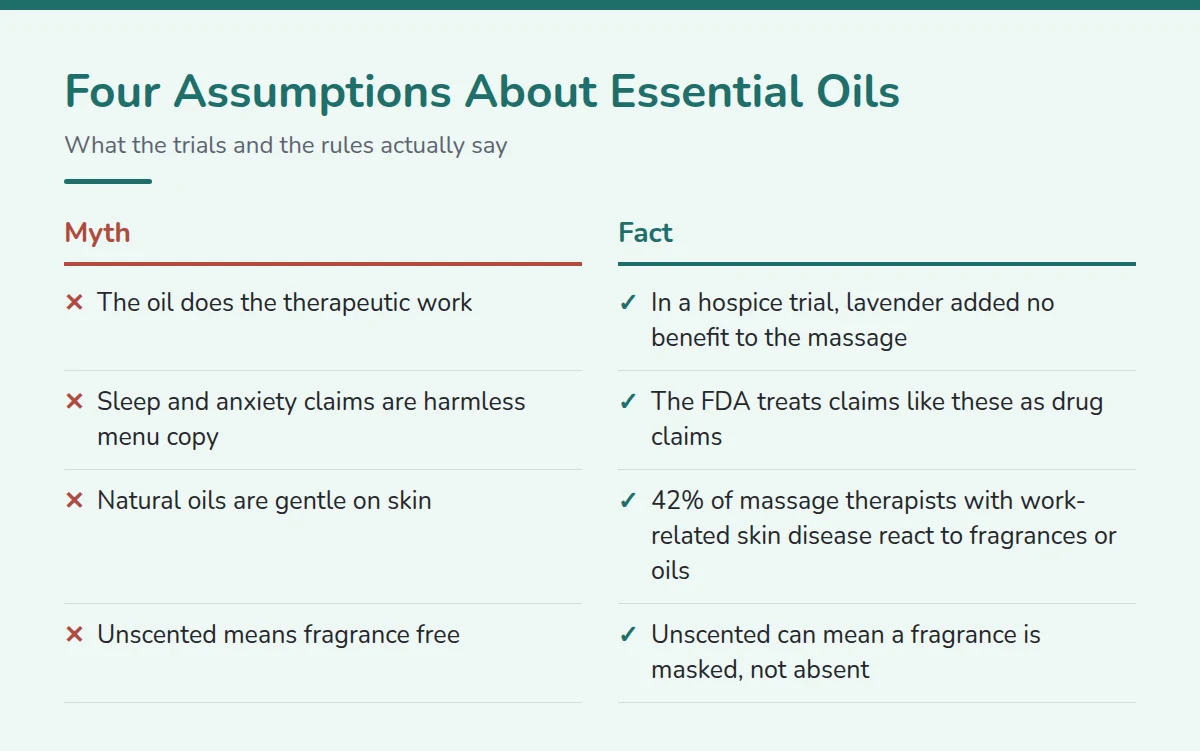
One of those two head-to-head trials is worth knowing by name. Soden and colleagues gave 42 hospice patients a weekly massage for four weeks, either with lavender in a carrier oil, with the carrier oil alone, or not at all. Sleep improved in both massage groups. The authors’ conclusion is the most useful sentence in this literature for a working therapist: “the addition of lavender essential oil did not appear to increase the beneficial effects of massage.”
Bigger trials usually compare aromatherapy massage with no massage, which cannot separate the oil from the hands. Wilkinson and colleagues randomized 288 people with cancer and clinical anxiety or depression to aromatherapy massage or usual care, and the benefit seen at six weeks had faded by ten. Harahap and colleagues did include a plain lotion arm, in 30 young boxers, and reported that lime oil massage beat ordinary lotion on pain and lactate. That is one small study, and lime carries a catch of its own, covered below.
Put together, the hands carry what the research can detect. The oil is a sensory preference layered on top, which is a perfectly good thing to offer as long as you describe and price it as one. Our guide to reading massage research explains why studies in this field so rarely manage to isolate a single ingredient.
Using a Scented Oil Is Not Practicing Aromatherapy
Most practice acts already cover what goes on the skin. Florida’s definition of massage therapy explicitly includes “the application to the human body of a chemical or herbal preparation,” so a licensed therapist there who works with a lightly scented blend is doing massage, not something else. Other states word it differently, and our licensing and scope of practice guide covers how to find and read your own act.
The title is a separate question, and it is where therapists get into trouble. Aromatherapy is not a licensed profession in the United States. The National Cancer Institute notes there is no professional standardization and no license required to practice, with the National Association for Holistic Aromatherapy and the Alliance of International Aromatherapists setting national educational standards. The nearest thing to a professional credential is the Aromatherapy Registration Council’s Registered Aromatherapist exam, which requires a professional course of at least 200 hours, including 15 case studies, before a candidate can sit it. A weekend continuing education class is not that, and advertising yourself as an aromatherapist on the strength of one invites exactly the kind of complaint massage boards act on: Florida’s grounds include “false, deceptive, or misleading advertising” and practicing beyond the scope permitted by law.
The third line is the claim. The FDA regards a product intended to treat or prevent disease, or to affect the structure or function of the body, as a drug, and its own examples of drug claims include that a product will “relax muscles, treat depression or anxiety, or help you sleep.” If you retail a blend, those words on the label or your website change what the product legally is. On a service menu they are a therapeutic promise the trials above do not support. “A lavender-scented oil, if you enjoy the smell” is an honest add-on. “A calming blend for anxiety” is not.
Dilution, Carriers, and the Citrus Problem
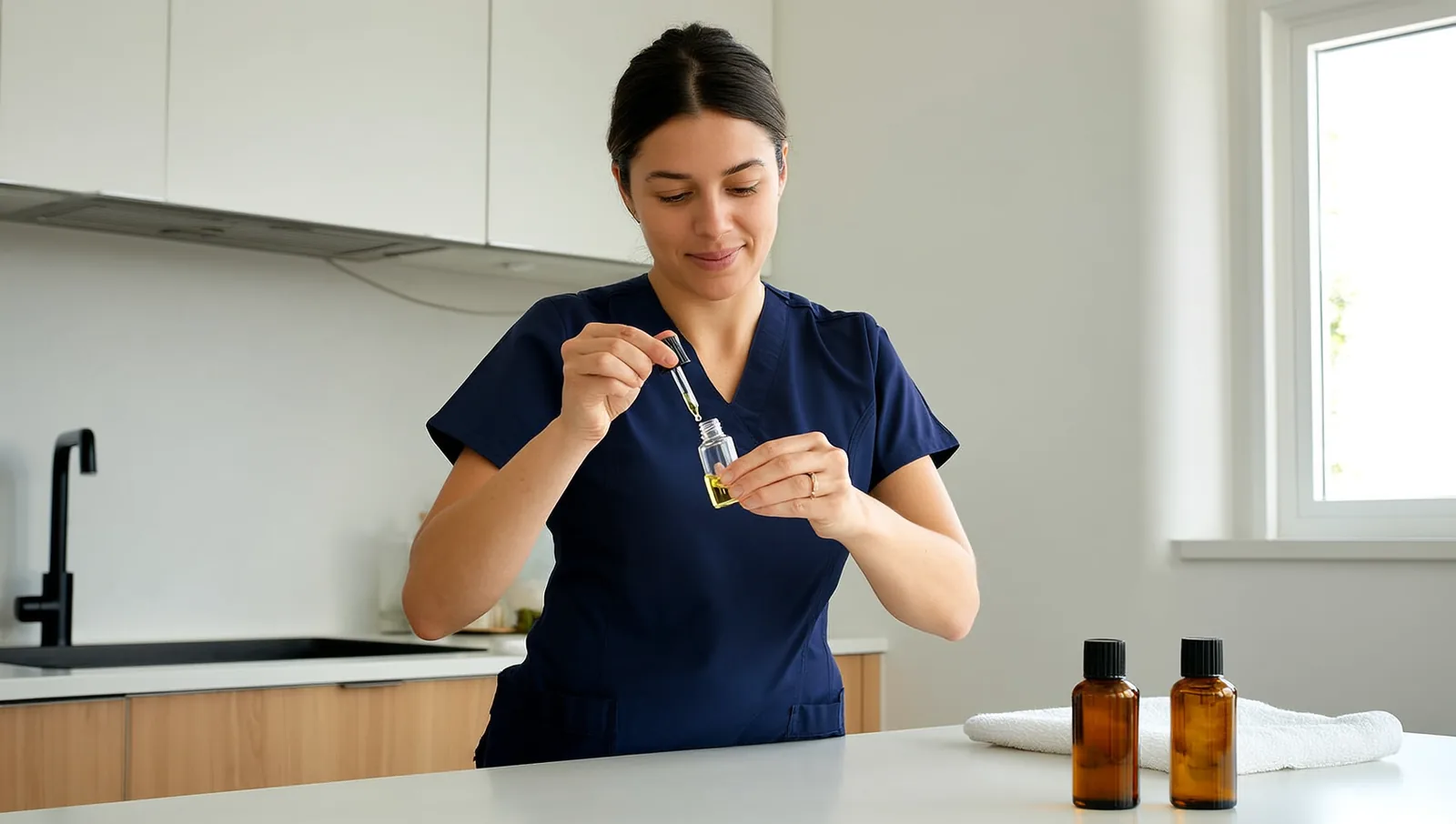
Essential oils go on skin diluted, never neat. The Tisserand Institute puts body oils and lotions in a range of 1 to 3%, and anything for sensitive or impaired skin at 0.2 to 1%. A full-body massage covers a large area of skin for an hour, so the low end of the body range makes a sensible house standard; the standardized blend in one aromatherapy massage study summarized by the National Cancer Institute was 1% lavender and chamomile in sweet almond oil.
In practice, 1% of a one-ounce (30 mL) bottle is 0.3 mL of essential oil. Tisserand works in percentages rather than drops, because no two drops are the same, and a graduated pipette measures 0.3 mL better than any count will. Blend at home, label the bottle with the oil, the percentage and the date, and never mix by eye on a client’s coffee table. That sweet almond carrier is also a reminder to ask about nut allergies before anything derived from a nut touches a client.
Citrus is where the chemistry bites. Bergamot, expressed lime, expressed lemon, bitter orange and grapefruit can all be phototoxic. When skin treated with one of them at sufficient concentration meets UVA light any time within the next 12 hours, possibly longer, it can react like a bad burn. Tisserand’s guidance limits bergamot to 0.4% on skin that will see the sun, while distilled citrus oils and bergapten-free (FCF) bergamot are considered non-phototoxic.
The case reports are vivid. Kaddu, Kerl and Wolf describe two patients who developed blistering reactions 48 to 72 hours after bergamot aromatherapy oil and ultraviolet light, and one of them never touched the oil: the exposure was evaporated bergamot in a sauna, followed by a tanning salon. The everyday version is duller. You finish a two o’clock session, and at four the client walks the dog or heads to the pool. Ask about sun plans, or leave the expressed citrus at home.
Age matters too. Limonene, the main molecule in most citrus peel oils, and linalool, a major one in lavender, oxidize on contact with air into potent skin sensitizers, and Botvid and colleagues found allergy to those oxidized forms throughout a decade of patch testing in Denmark. The half-empty bottle that has been opened daily for a year is not the oil you bought. Buy small, keep it capped, and keep it out of the heat of the car.
The person with the heaviest exposure to your blends is you. Brans and colleagues analyzed patch test records for 128 massage therapists with work-related skin disease in a German dermatology network: 91.4% had hand dermatitis, and 42.2% were sensitized to fragrances or essential oils, more often than workers in other professions with occupational dermatitis.
Some clients should get no scent on their skin at all. Yosipovitch and colleagues list massage and touch among the integrative approaches for atopic dermatitis, with habit reversal replacing scratching with massaging in an emollient. The product in that picture is plain. The American Academy of Dermatology warns that fragrance can make atopic dermatitis flare and advises using only products labeled “fragrance free,” because an “unscented” product can contain a fragrance that has merely been masked. Carry that distinction into your whole kit: your default base should be fragrance free, not just unscented.
Everyone Else in the House
Your client consented to the scent. Nobody else in the house did, and scent does not stay on the table.
Leave the diffuser at home. Schwartz-Narbonne, Du and Siegel ran an ultrasonic diffuser in a test chamber and found that fifteen minutes released 2.6 mg of d-limonene from lemon oil and 3.5 mg of eucalyptol from eucalyptus oil, along with fine particles, and their modeling suggested ordinary use could add substantially to indoor particle levels. A diffuser’s whole job is to put oil into air that other people will breathe after you have gone.
Asthma is the most common reason that matters. In Steinemann’s nationally representative US survey, 64.3% of adults with asthma reported health problems from fragranced products, 27.9% reported asthma attacks, and 46.2% reported problems just from being near someone wearing a fragranced product. More than twice as many said they would prefer health care professionals to be fragrance free rather than fragranced. The survey asked adults, but nothing about an eight-year-old’s airways makes a scented bedroom a better idea.
Pregnancy is subtler than the folklore. Many pregnant people report that familiar smells suddenly turn their stomach, yet a 2022 meta-analysis by Albaugh and colleagues found no measurable change in odor thresholds or in how pleasant odors were rated, only worse odor identification. The aversion is real to the person living with it even when a smell test cannot find it, and the partner in the next room did not choose your blend. A pregnant client gets scent only on request, at the low end of the range, with their prenatal provider in the loop. An infant in the house is simpler still: our infant massage guide keeps essential oils away from babies entirely, and the same logic applies to the air in a nursery.
Pets are the risk most therapists underestimate. Khan, McLean and Slater reviewed ten years of ASPCA Animal Poison Control Center records and found 443 dogs and cats poisoned by undiluted tea tree oil, 106 of them cats. Drooling, lethargy, weakness, unsteadiness and tremors began within 2 to 12 hours and lasted up to three days, and younger, lighter cats were more likely to become seriously ill. The ASPCA warns that animals that walk through oil or get it on their coat can develop health problems, and advises against diffusers altogether in homes with birds, whose respiratory tracts are very sensitive.
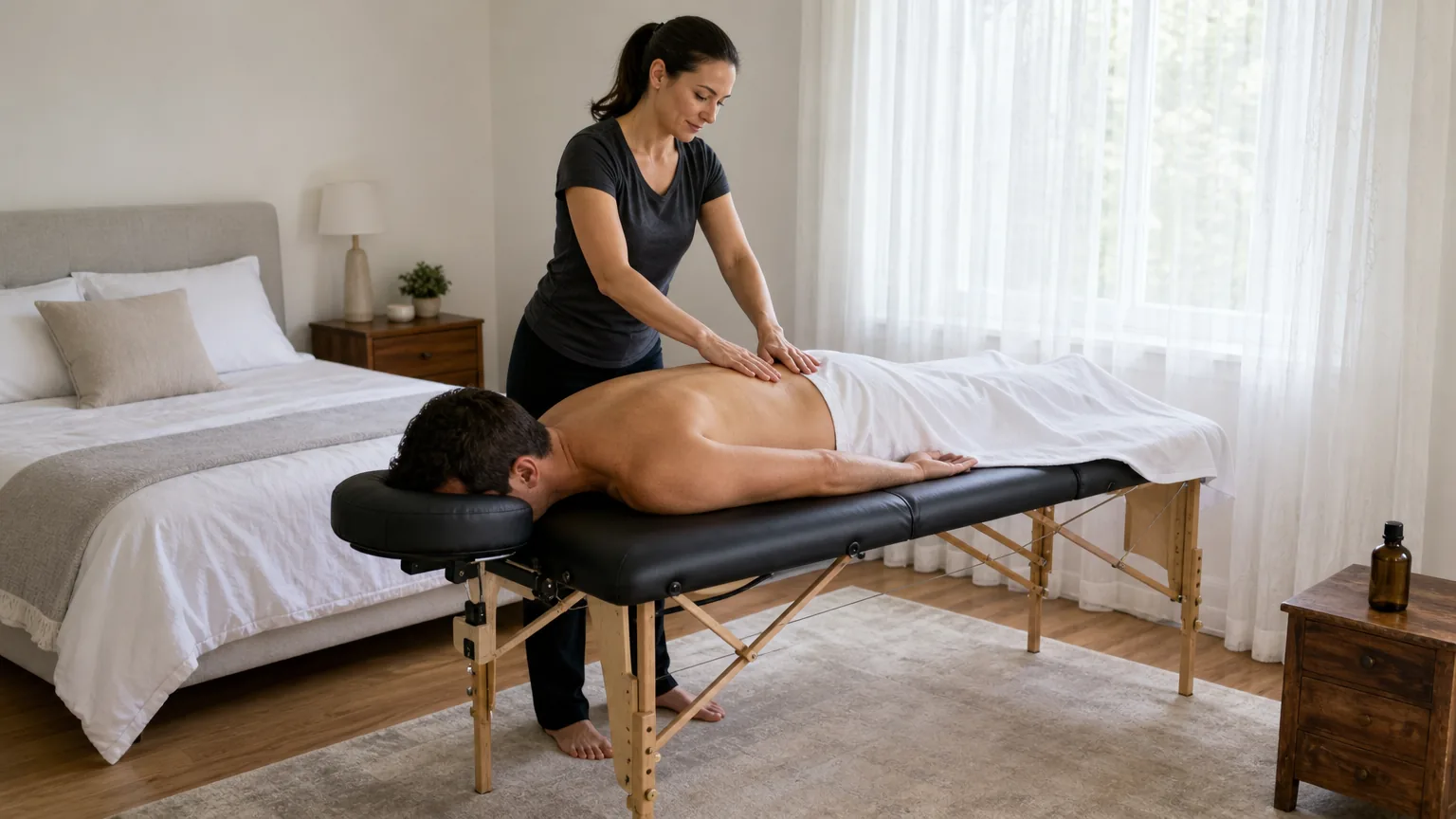
On a home visit that means bottles capped and zipped into the kit, the kit off the floor, and a warm towel over the client’s hands and feet before they get up, because the first thing many clients do after a massage is pick up the cat.

Then there is the client in chemotherapy. The National Cancer Institute notes that once treatment is under way, “the smells, sights, and sounds of the treatment room during a later session may trigger nausea and vomiting before the session begins,” and it suggests eating in a well-ventilated room free of perfume or scented candles. A scent that arrives every week during treatment could become one more trigger. Fragrance free is the default for oncology clients unless they ask otherwise, alongside the intake and clearance steps in our guide to massage for cancer patients at home.
Ask Before You Open the Bottle
Make fragrance free the default and scent something the client opts into. One question on the booking form (“Would you like a scented oil, or fragrance free?”) sorts most of it. The rest belongs in intake, asked about the household rather than just the person on the table.
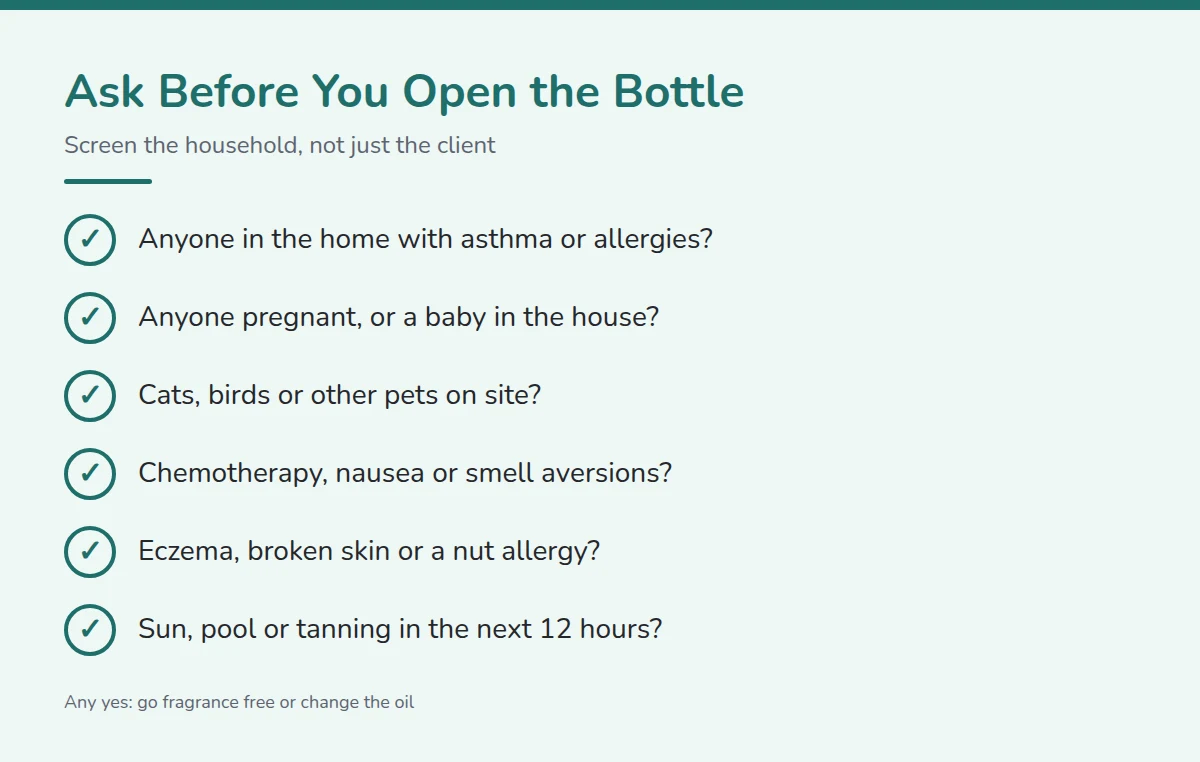
Carry scent sealed and measured: one or two blends at a known percentage, labeled and dated, plus a fragrance-free base for everyone else. Let the client smell the blend on a tissue before it touches skin, every visit, because a scent they liked last month may be wrong today.
You do not control the room’s air. A window can be the answer, but ask first, since some clients keep windows shut for pollen, security, or a cat that would be through the gap in a second. Leave with everything you brought in, used linens sealed in a laundry bag included, and note the oil, the percentage and the client’s consent in your session record. If someone in the house reacts that evening, that note is what you will need.
When an answer raises a flag, fragrance free is the professional choice even if the client would like the lavender. The person with the most at stake may not be the one on your table.
If You Are the Client Choosing the Add-On
Ask which oil is in the blend and at what percentage; a therapist who cannot answer is blending by eye. Mention sun plans, pregnancy, asthma, pets and any treatment you are having, even if it seems unrelated. Take the add-on if you love the smell, and skip it without a second thought if you do not, because the part of the session the research can measure is the massage. Our service menu guide shows how therapists package and price add-ons like this one.
The best-smelling session in someone else’s home is often the one nobody can smell an hour after you leave.
Sources
- Sattayakhom, Wichit and Koomhin mapping a decade of research on essential oils and the nervous system
- Shin and colleagues for the Cochrane review of massage with or without aromatherapy in cancer
- Soden and colleagues on lavender oil versus plain carrier oil in hospice massage
- Wilkinson and colleagues with a multicenter trial of aromatherapy massage for anxiety and depression in cancer
- Harahap and colleagues testing lime oil against ordinary lotion in massage for muscle soreness
- National Cancer Institute on aromatherapy research, training and regulation and how smells can trigger nausea during cancer treatment
- Florida Statutes for the definition of massage therapy and the grounds for disciplining a massage therapist
- Aromatherapy Registration Council on eligibility for the Registered Aromatherapist exam
- U.S. Food and Drug Administration explaining when an aromatherapy product counts as a drug
- Tisserand Institute with dilution ranges by type of use and guidance on phototoxic citrus oils and sun exposure
- Kaddu, Kerl and Wolf describing blistering reactions after bergamot aromatherapy oil and ultraviolet light
- Botvid and colleagues on how limonene and linalool oxidize into skin sensitizers
- Brans and colleagues with patch test data from massage therapists with work-related dermatitis
- Yosipovitch and colleagues reviewing mind-body and touch approaches in atopic dermatitis
- American Academy of Dermatology on why eczema skin care should be fragrance free rather than unscented
- Schwartz-Narbonne, Du and Siegel measuring what an ultrasonic essential oil diffuser releases into room air
- Steinemann surveying how fragranced products affect adults with asthma
- Albaugh and colleagues pooling studies of smell perception during pregnancy
- Khan, McLean and Slater reviewing a decade of tea tree oil poisonings in dogs and cats
- ASPCA on using essential oils and diffusers around pets and birds
Further reading
- Mobile Massage for Cancer Patients: An Evidence-Based In-Home Guide
- State Licensing and Scope of Practice: A Mobile Therapist’s Compliance Guide
- What the Research Actually Says About Massage: An Evidence Guide for Clients
- Fibromyalgia and Mobile Massage: Pressure, Pacing, and Why Home Visits Suit This Client
- Teaching Infant Massage in the Family Home: Scope, Safety, and the Newborn Niche