Postpartum Massage at Home: The Fourth Trimester Guide for New Parents and Mobile Therapists
Published on October 25, 2026
The Fourth Trimester Happens at Home
The American College of Obstetricians and Gynecologists calls the weeks after birth the fourth trimester, and it wants postpartum care to be “an ongoing process, rather than a single encounter.” Its guidance, reaffirmed in 2025, asks for contact with an obstetric provider within the first three weeks and a full postpartum visit no later than 12 weeks after the birth.
Nearly all of those twelve weeks are spent at home, on the baby’s schedule. The American Academy of Pediatrics says breastfed newborns usually nurse about every two hours, ten to twelve times in 24 hours, and the NHS tells cesarean patients they will not be able to drive for a few weeks. A spa appointment asks a new parent for a sitter, a car and an hour and a half out of reach of a baby who will be hungry again soon. A home visit asks for none of it, and the client can be asleep ten minutes after you pack up.
This guide is for new parents and the mobile therapists who visit them: when massage can start after a vaginal or cesarean birth, what needs a doctor’s clearance first, how to position a body that is feeding a baby, what the research says about postpartum depression, and where infant massage fits.
When Massage Can Start After Birth
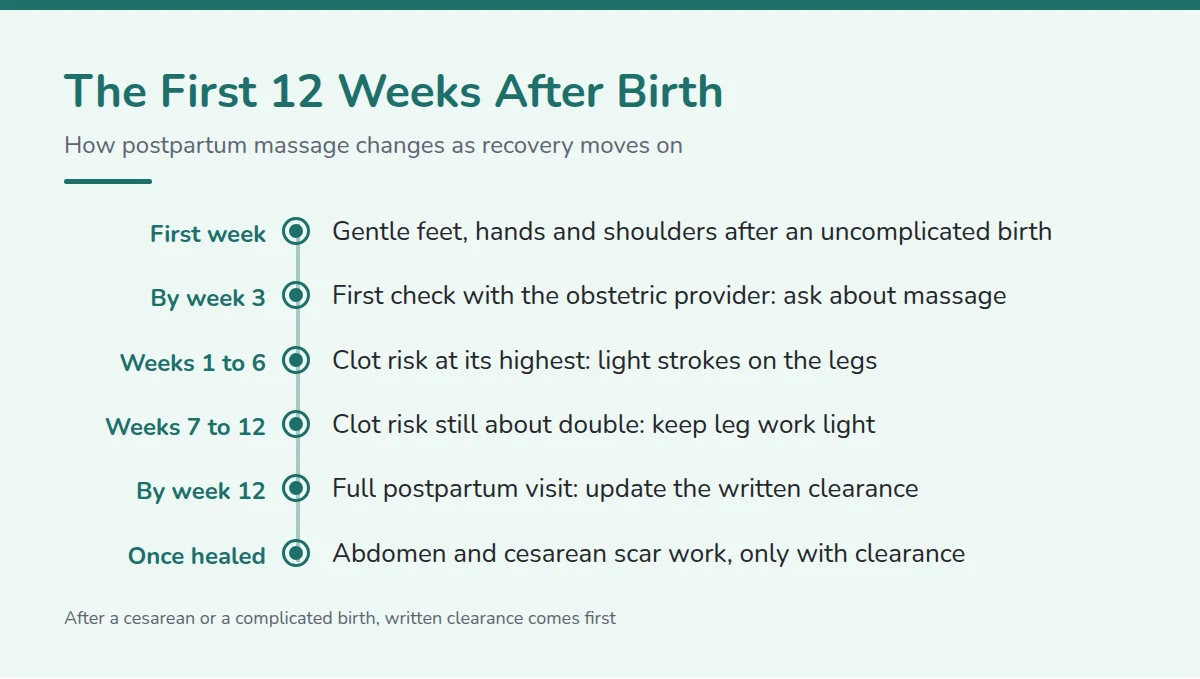
No guideline sets a start date for postpartum massage, and hospital trials have begun gentle massage within a day or two of the birth. In a 2026 trial in Japan, Yamasaki and colleagues randomized 112 women who had given birth vaginally to a massage on the second day after birth or to bed rest, and the massage group reported less physical discomfort, fewer negative moods and more positive ones. After cesarean births in a Turkish university hospital, Gürsan and Çatalgöl found that a foot massage 8 and 33 hours after surgery left pain lower an hour later than kinesiology taping or usual care did, with no serious side effects and only brief, mild discomfort in a few women.
Both trials took place in hospitals, with screened volunteers and clinical staff close by. At home you are the only professional in the room, so the right starting point depends on how the birth went.
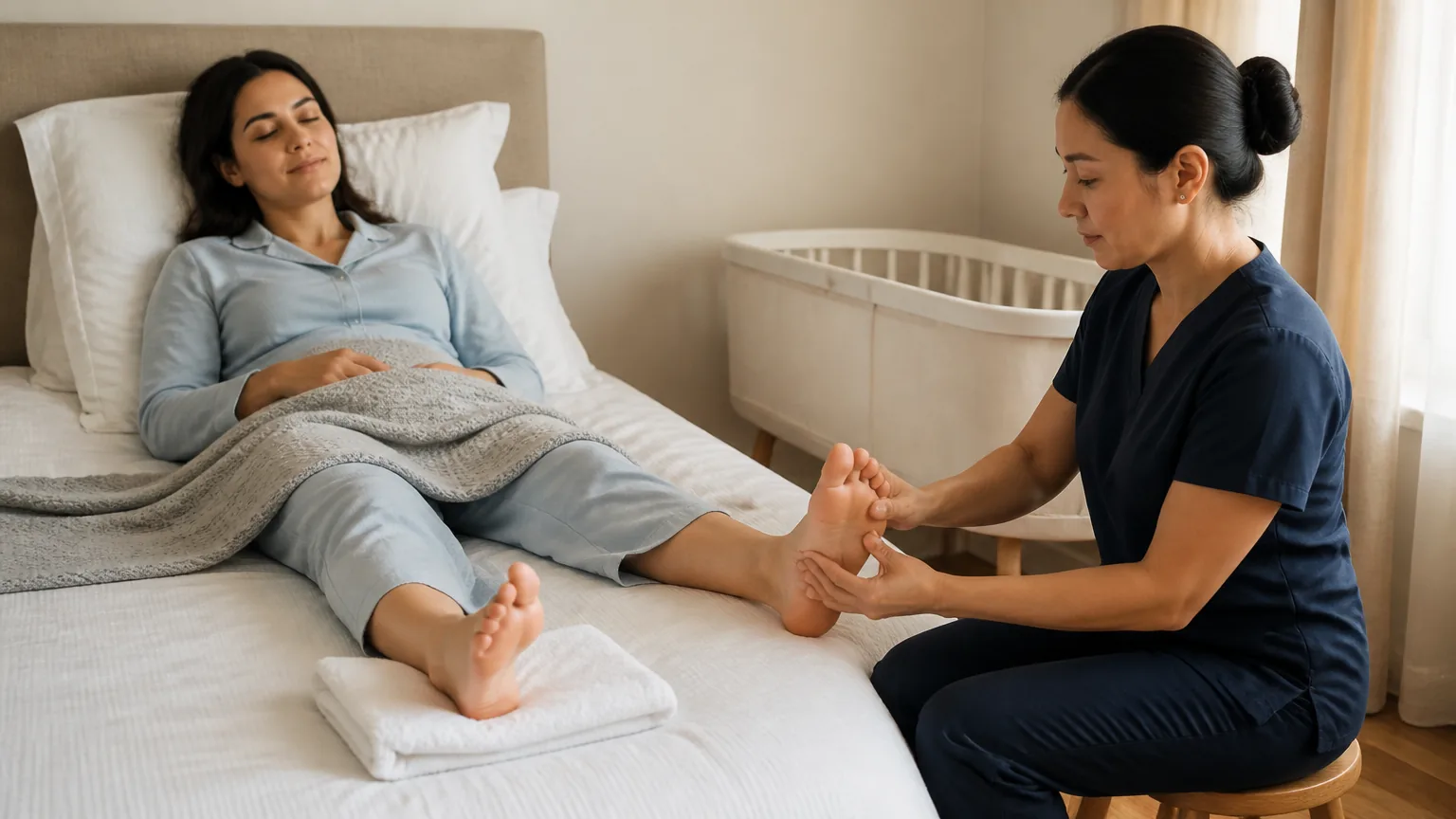
After an uncomplicated vaginal birth, gentle work can start once the parent is home and wants it: feet, hands, shoulders, neck and scalp, in whatever position is comfortable, for 30 to 45 minutes. Feet are a good place to begin. Keçeli and Öztaş gave 35 first-time mothers 30 minutes of foot massage three times a week for four weeks, starting in the first week after a vaginal birth. Their breastfeeding scores rose above those of mothers in standard care, and their sleep improved while the control group’s did not. Stitches from a tear can make sitting sore, so side-lying or lying back on pillows usually beats a chair.
After a cesarean, the client is recovering from abdominal surgery. The NHS notes that non-dissolvable stitches or staples usually come out after five to seven days, and that driving, exercise and carrying anything heavier than the baby may not feel possible for six weeks or so. Get the obstetric team’s written okay before the first visit. Until they confirm the wound has healed, nothing touches the incision or the skin around it, the abdomen is off limits, and face down is out. A small pillow held against the belly makes side-lying easier.
Go lightly on the legs for the first 12 weeks, whatever the birth. In California hospital records covering nearly 1.7 million women, Kamel and colleagues found that the odds of a stroke, heart attack or blood clot in the six weeks after delivery were 10.8 times those for the same six weeks a year later. From week seven to week twelve the odds were still about twice as high, and after that the excess was no longer significant. The absolute numbers are small, about 22 extra events per 100,000 deliveries in the first six weeks, but each one is serious. Use light, broad strokes on the legs through this period, skip deep calf work, and stop if one leg or arm is swollen, painful or warm.
Scar work is a separate, later service. It has early evidence: in Poland, physiotherapists led by Olszewska gave 15 women four weeks of manual scar therapy and their scars became more pliable and flatter than those of 15 women in a control group, and in Canada, Gilbert and colleagues measured less scar stiffness after two sessions with a trained osteopath. Both studies are small, and both used clinicians trained in scar work. Wait until the wound has fully closed and the obstetric provider agrees, confirm that scar work sits inside your state’s scope of practice, and get the training first.
ACOG’s timeline gives you two natural checkpoints. Ask the client to raise massage at the three-week contact and again at the full postpartum visit, and update your clearance after each.
Clearance First, and the Signs That End a Session
Ask for written clearance from the obstetrician, midwife or family doctor before the first session if any of these apply:
- A cesarean, or a vaginal birth with heavy bleeding, a severe tear or a longer hospital stay than expected.
- Preeclampsia or high blood pressure, during pregnancy or since the birth. ACOG warns that preeclampsia can develop in the weeks after childbirth and can lead to seizures and stroke, and for people with long-term high blood pressure it notes that readings often climb in those same weeks.
- A blood clot now or in the past, a clotting disorder, or blood thinners prescribed after the birth.
- An infection being treated, such as a wound infection or mastitis.
Then agree on the stop signs. The CDC’s Hear Her campaign lists urgent maternal warning signs that can appear up to a year after delivery and says to seek medical care immediately for any of them. These are the ones most relevant to a massage visit. If a client mentions or shows one, the session ends and they call their provider, or 911 if it looks life threatening:
- A headache that will not go away or keeps getting worse, changes in vision, dizziness or fainting
- A fever of 100.4°F (38°C) or higher
- Extreme swelling of the hands or face
- Trouble breathing, chest pain or a racing heart
- Severe belly pain that does not go away
- Heavy bleeding, meaning a pad soaked through in an hour, or clots bigger than an egg
- Swelling, redness or pain in one leg or arm
- Thoughts of harming themselves or the baby
After a cesarean, add the NHS list: a wound that becomes redder, more painful or swollen, or leaks pus or foul-smelling fluid, and swelling or pain in the lower leg. Some bleeding after birth is normal (the NHS advises pads rather than tampons), so a waterproof pad under the bottom sheet is routine kit.
Positioning a Body That Is Feeding a Baby
Book the session straight after a feed or a pumping session, when the breasts are softest. With feeds about two hours apart, that gives you a window rather than an appointment.
Face down is usually the wrong default. Full or tender breasts make it uncomfortable, and after a cesarean it presses on the wound. Better options:
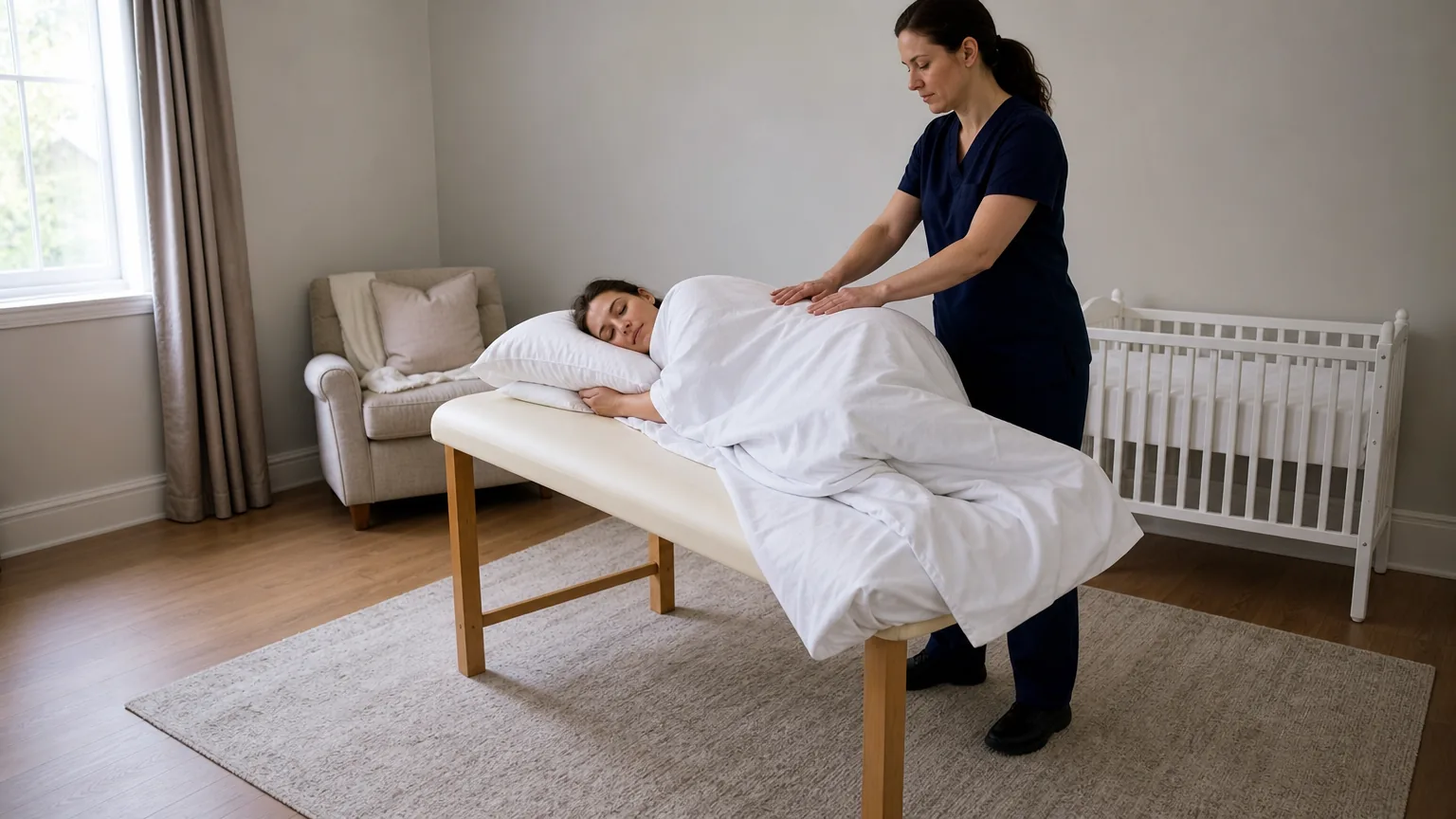
- Side-lying, with a pillow between the knees, a second pillow hugged in front of the chest, and a head pillow thick enough to keep the neck level. Most postpartum sessions live here.
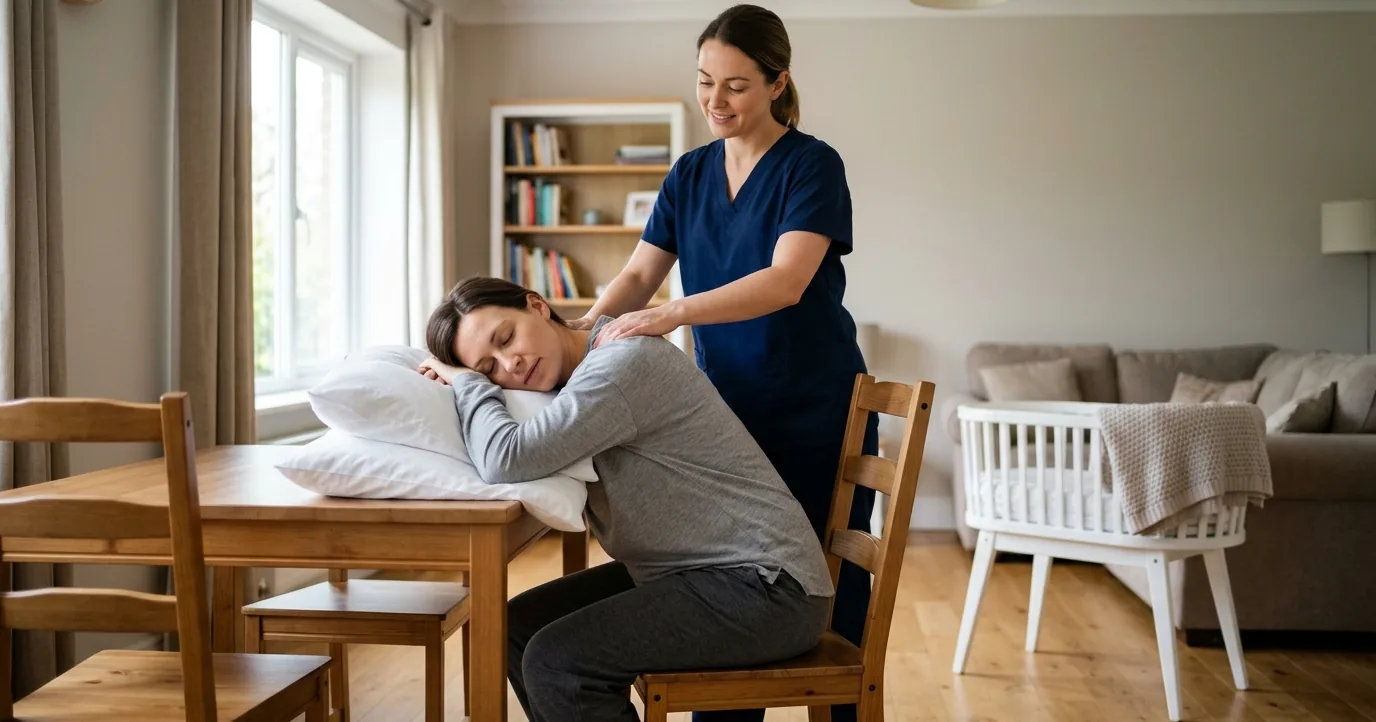
- Seated and leaning forward onto stacked pillows at a table, for the upper back, neck, forearms and hands that spend hours a day holding and feeding a baby.
- On the back, with a bolster under the knees and the head raised, for feet, legs, hands, scalp and face.
- Face down only when the client asks for it, the incision allows it, and folded towels or a breast cushion take the weight off the chest.
Keep breast pads and a spare towel within reach, because milk can leak once the body relaxes, and treat it as unremarkable.
The breast itself is not part of a postpartum session. Our guide to consent and draping in the client’s home keeps breast tissue covered unless state law, specific training and separate written consent all line up, and breastfeeding adds a clinical reason. In a 2024 evidence review in American Family Physician, Morcomb and colleagues put the incidence of mastitis during breastfeeding at about 10 percent in the United States, mostly in the first three months, and list tissue trauma from aggressive breast massage among its risk factors. Breast massage and heat are no longer recommended for it, because both may make it worse. A hot, red, painful area with a fever goes to the client’s doctor or lactation consultant, and hot stones and heat packs stay off the chest.
Oil matters more than usual, because the baby’s face goes where your hands have been. Use a plain, unscented oil and keep it off the chest. If you add scent at all, our essential oils guide explains why a home with a newborn is the place to leave it out.
What the Research Says About Massage and Postpartum Depression
Perinatal depression covers depression in pregnancy and in the months after birth, and NIMH says most episodes begin within four to eight weeks after the baby arrives. It is not the baby blues, the mild worry and low mood many parents feel in the first two weeks. Low mood or anxiety that is severe or lasts longer may be depression, which generally does not lift without treatment, and treatment usually means psychotherapy, medication or both.
Massage can sit alongside that care, and the strongest results pair the two. A 2025 network meta-analysis of 177 trials by Smith and colleagues ranked interpersonal therapy plus massage first for easing depressive symptoms in pregnancy and after birth, although its conclusions named cognitive behavioral therapy, mindfulness, physical activity, collaborative care, education and medication as the effective options. When Field and colleagues tested that pairing in 112 depressed pregnant women, those who got a 20-minute massage alongside weekly group therapy attended more sessions, finished more often, and saw their depression scores fall further.
Several of the other trials come from the same Miami research group, mostly in pregnancy. In Field’s trial of 84 depressed pregnant women, 20-minute massage or yoga sessions twice a week for 12 weeks cut depression, anxiety, and back and leg pain more than standard prenatal care did. With 32 depressed teenage mothers, massage and relaxation therapy both eased anxiety, but only massage lowered pulse and stress hormone levels. A 2019 review of body-centered therapies by Tarsha and colleagues found the most robust evidence for massage, with the caveat that high-quality studies are scarce.
Sleep is where the evidence from after birth is firmest. A 2018 meta-analysis of 15 studies by Owais and colleagues found that massage and exercise had the largest effects on mothers’ self-reported sleep, massage the larger of the two, although the sleep interventions as a group did not measurably improve depression. In 2025, Nguyen and colleagues pooled 19 trials and ranked foot reflexology, progressive muscle relaxation and massage as the most effective options for sleep in the first three months. And in Ko and Lee’s small trial at a Taiwanese postpartum center, 60 poorly sleeping women given a 20-minute back massage by a certified massage therapist every evening for five days slept better than controls, which reads like a plan for a home course.
So the honest claim is modest. Massage can help a new parent sleep, feel less tense and feel cared for, and it may help them stay with the treatment that works. It does not treat postpartum depression on its own.
If a client tells you they feel hopeless, or cannot sleep even when the baby sleeps, do not diagnose and do not talk them out of it. NIMH lists both among the symptoms of perinatal depression and advises seeing a health care provider. Give them the National Maternal Mental Health Hotline, 1-833-TLC-MAMA (1-833-852-6262), which is free, confidential, open around the clock in English and Spanish, and welcomes calls from partners and family. Thoughts of suicide or of harming the baby are an emergency: call or text 988, or call 911 if anyone is in immediate danger.
Running a Visit in a Newborn Household
Plan the visit around the baby rather than the clock:
- Book a 90-minute window for 60 minutes of hands-on time, and expect to pause for a feed. Do not bill the pause as overtime.
- Another adult minds the baby. If nobody else is home, the baby sleeps on their back in their own crib or bassinet, on the firm, flat surface the AAP recommends, never on the massage table or a pillow, and the session stops whenever the baby needs the parent. You are not the babysitter.
- Set up in a quiet room within earshot of the nursery, and keep the kit compact, because many first sessions happen in a bedroom.
- Hold your illness rule without exceptions. Our policy handbook waives the fee for illness at any notice, and a home with a newborn is where that rule matters most. Rescheduling after a sleepless night should cost the client nothing either.
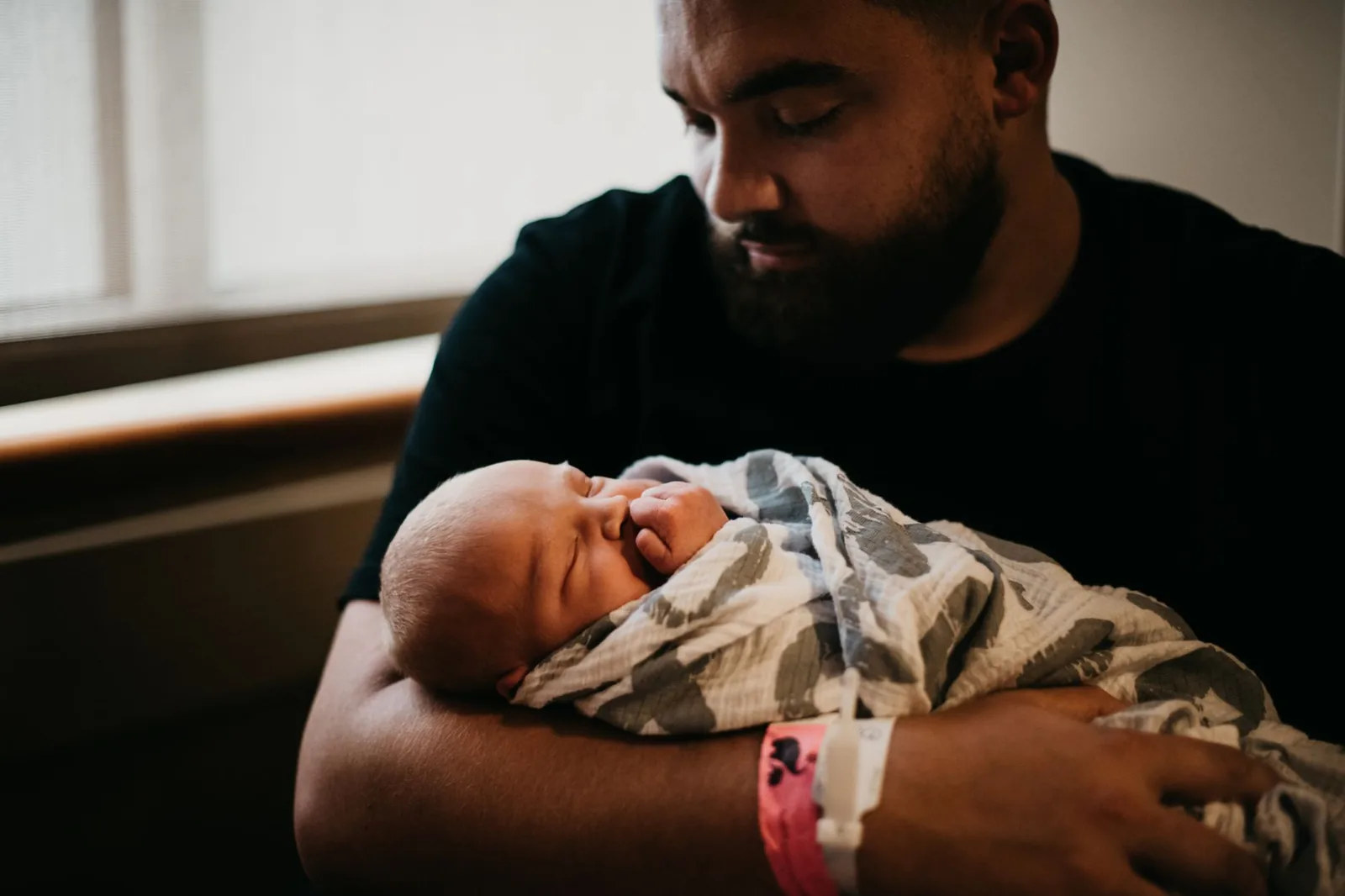
The other parent is short on sleep too. Parents already book massage more often than other adults, as our look at who books massage, and why shows, so offer the partner a back-to-back session on the same visit under one travel fee.
Where Infant Massage Fits
Sooner or later the parent on your table asks about the baby. That is a different service. In a postpartum session your hands are on the parent. In infant massage the parent’s hands are on the baby and you teach, as our infant massage guide explains, along with the certification and pediatric clearance the work needs.
The research supports keeping the two apart, because the benefit of infant massage seems to flow through the parent doing it. O’Higgins and colleagues randomized 62 mothers with high depression scores four weeks after birth to baby massage classes or a support group. More of the massage-class mothers showed a clinically meaningful fall in depression scores, and at one year they interacted with their babies as sensitively as mothers who had never been depressed, which the support group mothers did not. Other effects were limited, and neither group had caught up with non-depressed mothers on depression or anxiety by one year. A 2023 review by Geary and colleagues, covering eight studies and 521 women with postnatal depression, linked mother-led infant massage with fewer depressive symptoms, better interaction and more confidence.
So book the parent’s own sessions first, while recovery is fresh, and offer a teaching block later in the series if you hold the credential. If you do not, refer to someone who does.
For Therapists: The Intake and the Scope Line
A postpartum intake needs more than the standard health history. Ask for:
- The date of the birth and the type of delivery
- Complications: heavy bleeding, a tear, preeclampsia or high blood pressure, a longer hospital stay
- For a cesarean, who last checked the wound, and when
- Blood thinners, or any history of clots
- How the baby is fed, and when the next feed is due
- Where it hurts, and how they are sleeping
- An open question about mood, with the hotline number ready
- Written clearance where it is needed, with its date
Then hold the scope line in your words as well as your hands. Do not promise that massage will shrink the uterus, close the hips, balance hormones, increase milk supply or flatten the belly. The claims the evidence supports are modest ones about comfort, sleep and stress. Separated abdominal muscles and pelvic floor problems belong to a pelvic health physical therapist. Scope of practice varies by state, so check your practice act, and make sure your professional liability policy covers postpartum clients.
The Honest Pitch
The fourth trimester is long, tiring and lived mostly at home, which is exactly where a mobile therapist is useful. Massage is not a treatment for postpartum depression or for a cesarean wound. What the evidence does support is gentle, regular sessions that help a new parent sleep and feel less tense, timed around feeds, positioned around a sore body, and cleared by a doctor whenever the birth calls for it. Bring the table to them, leave the baby with someone else, and let them nap when you go.
Sources
- American College of Obstetricians and Gynecologists on the fourth trimester and the timing of postpartum care and preeclampsia in the weeks after childbirth
- American Academy of Pediatrics with how often newborns feed and where a baby should sleep
- NHS on recovering from a caesarean section
- CDC Hear Her campaign for urgent maternal warning signs in the year after birth
- National Institute of Mental Health on perinatal depression, its symptoms and its treatment
- HRSA with the National Maternal Mental Health Hotline
- Yamasaki and colleagues testing massage on the second day after a vaginal birth
- Gürsan and Çatalgöl comparing foot massage and taping after cesarean birth
- Keçeli and Öztaş on four weeks of foot massage for new mothers
- Kamel and colleagues with how long clot risk stays raised after delivery
- Olszewska and colleagues on manual therapy for cesarean scars
- Gilbert and colleagues for osteopathic mobilization of the cesarean scar
- Morcomb and colleagues with current evidence on mastitis and breast massage
- Smith and colleagues ranking treatments for perinatal depression
- Field and colleagues on massage alongside group therapy in pregnancy, massage and yoga for prenatal depression and massage for depressed teenage mothers
- Tarsha and colleagues reviewing body-centered therapies for mood
- Owais and colleagues pooling non-drug ways to improve postpartum sleep
- Nguyen and colleagues ranking sleep interventions in the first year after birth
- Ko and Lee testing evening back massage for postpartum insomnia
- O’Higgins and colleagues on baby massage classes for mothers with postnatal depression
- Geary and colleagues reviewing mother-led infant massage and postnatal depression
Further reading
- Teaching Infant Massage in the Family Home: Scope, Safety, and the Newborn Niche
- Ethics, Consent, and Draping in the Client’s Home: A Professional Boundaries Guide
- Essential Oils on the Road: Aromatherapy Scope, Evidence, and Scent in Someone Else’s Home
- The Mobile Massage Policy Handbook: Cancellations, Deposits, No-Shows, and House Rules
- Who Actually Books Massage, and Why: Turning the 2026 Fact Sheet Into a Mobile Client Strategy