The Mobile Massage Policy Handbook: Cancellations, Deposits, No-Shows, and House Rules
Published on September 16, 2026

A Late Cancellation Costs You the Drive, Not Just the Hour
A late cancellation at a clinic leaves an empty room that is already paid for. A late cancellation in mobile work lands after you have loaded the car, routed the afternoon around that address, and turned away whoever would have filled the gap. A San Diego therapist who built an in-home practice from the ground up named this as a significant challenge: coordinating schedules and managing travel times across a whole metro area. One late change breaks the loop the day was built on.
The fix is a written policy set, published before anyone books. This handbook covers each policy in turn with wording to adapt. It deals with business terms only; conduct inside the session is covered in our guide to ethics, consent, and draping in the client’s home.
Cancellation Windows and Fees
Twenty-four hours is the familiar cancellation window in massage, built for a treatment room where a waiting client can walk in. A mobile slot is harder to refill, because the replacement has to live near a route you already planned.
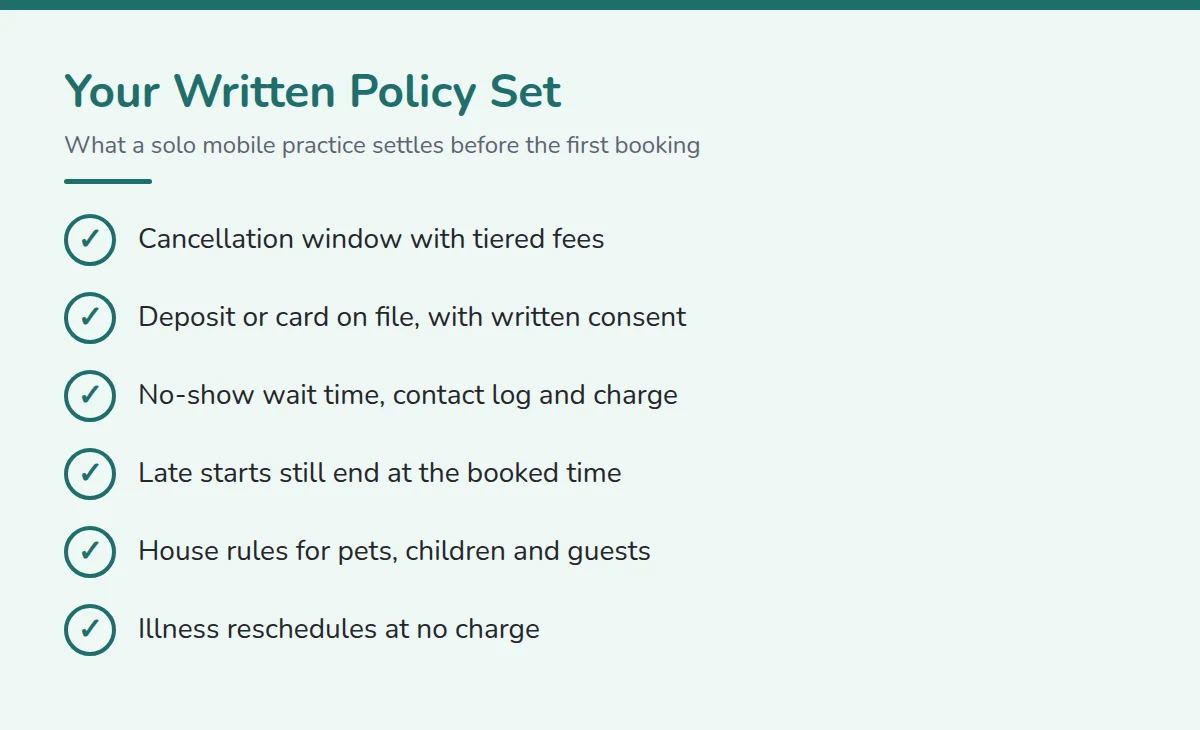
A 48-hour window suits most mobile schedules better, with 24 hours kept as a courtesy for regulars on a standing booking. Price the fee against what the gap really costs, not as a punishment: nothing outside the window, part of the price inside it, and the full price on the day, when the time cannot be filled. A fee that tracks your real loss is easier to explain, and easier to defend if a charge is disputed.
Treat a reschedule more gently than a cancellation. A client who moves inside the window but rebooks the same week has cost you far less than one who disappears, and charging both the same teaches people to cancel outright.
Cancellations or changes made more than 48 hours ahead carry no charge. Inside 48 hours, 50% of the session price applies, waived if you rebook within seven days. Same-day cancellations are charged in full. Because I plan each day’s route around your address, a slot released late can rarely be filled.
Deposits and Card-on-File Authorization
A deposit moves money at booking. It suits first-time clients, long sessions, weekend slots, addresses at the edge of your service area, and group bookings. Say whether it comes off the session price and whether it is refunded when someone cancels outside the window.
A card on file moves no money until something goes wrong, which suits established clients. It is also where therapists get caught out, because saving a card is not permission to charge it. Processor documentation is blunt that compliance is your job: the client opts in to your terms, and the card can be used only as those terms describe. For charges made when the client is not present, the terms should cover their agreement to payments for specified transactions, when those charges could happen, and how the amount is set. That means an unticked checkbox beside the policy text, not a link nobody opens.
An authorization hold is not a deposit either. Card holds typically lapse within about a week, so a hold placed a month ahead expires long before the appointment.
My booking system keeps your card on file to hold your appointment. By ticking the box, you authorize me to charge it only for a late cancellation or no-show fee, at the amount this policy sets for your service. You will receive an emailed receipt for any charge.
No-Shows and Doors That Stay Shut
A mobile no-show is you on a doorstep with a table bag while the next appointment counts down. Define what counts: nobody home, no answer at the door or phone, a gate code that fails, a building that will not let you up.
Set a wait period and a contact routine. Fifteen minutes, with a call and a text on arrival and again ten minutes later, is fair, and the timestamped messages are your evidence if the charge is questioned. Charge the full price for a genuine no-show, and after a second one, require payment at booking.
Reminders prevent more no-shows than fees recover. A Cochrane review of eight randomized trials found that text reminders raised attendance at healthcare appointments, with overall attendance of 67.8% in the no-reminder groups against 78.6% in the text groups, and worked about as well as phone calls. Those were medical appointments, not massage, but forgetting a booking is universal. Send yours just before the free cancellation window closes, and restate the window in it.
If no one answers the door or phone at the booked time, or the access details you gave do not work, I will call, text, and wait 15 minutes. After that, the appointment counts as a no-show and the full session price is charged. After a second no-show, future bookings are paid in full when made.
Late Starts and Shortened Sessions
When the client is not ready, the session still ends at its booked time, because the next client and the drive to reach them are already fixed. Define ready: someone is home to let you in, the space is clear for the table, and pets are shut away or crated. A client twenty minutes late for a sixty-minute booking gets forty minutes at full price, and a written policy lets you say so kindly.
When you are the late one, hold yourself to a stricter standard. Text as soon as you know, give an honest arrival time, and offer the full session if your schedule allows, or a price reduced for the time lost.
Sessions start at the booked time. If we cannot begin on time because the space is not ready or no one can let me in, the session ends as scheduled and the full price applies. If I am running late, I will text you an updated arrival time and either give you your full session or reduce the price for the time lost.
Minimum Bookings and Travel Minimums
A thirty-minute massage forty minutes from your last stop eats most of a two-hour block once setup, teardown, and the drive are counted. Set a minimum session length, and a higher minimum for the outer edge of your service area. How to draw those zones and price the drive itself is covered in our guide to vehicle setup, route planning, and travel zones.

Let the booking system enforce your minimums, and show travel fees before the client confirms, never on the invoice afterward.
The minimum booking is 60 minutes. In the outer travel zone, the minimum is 90 minutes, or two sessions back to back at one address. Any travel fee for your address is shown before you confirm.
House Rules: Pets, Children, and Other People in the Home
You work in someone else’s space, so its rules need settling before you arrive, and households vary widely. One Delaware LMT’s mobile clients include children, teenagers, and whole families, and as a certified canine massage therapist she massages dogs too. Ask about pets, children, and anyone else at home when the client books.
Pets belong behind a closed door or settled in their crate for the whole session. A calm dog can rest in its crate with the door open, but shut it the moment the dog starts to wander. A dog nosing the face cradle breaks the client’s focus, a cat underfoot is a trip hazard, and dander rides out on your linens to the next household, where someone may be allergic.
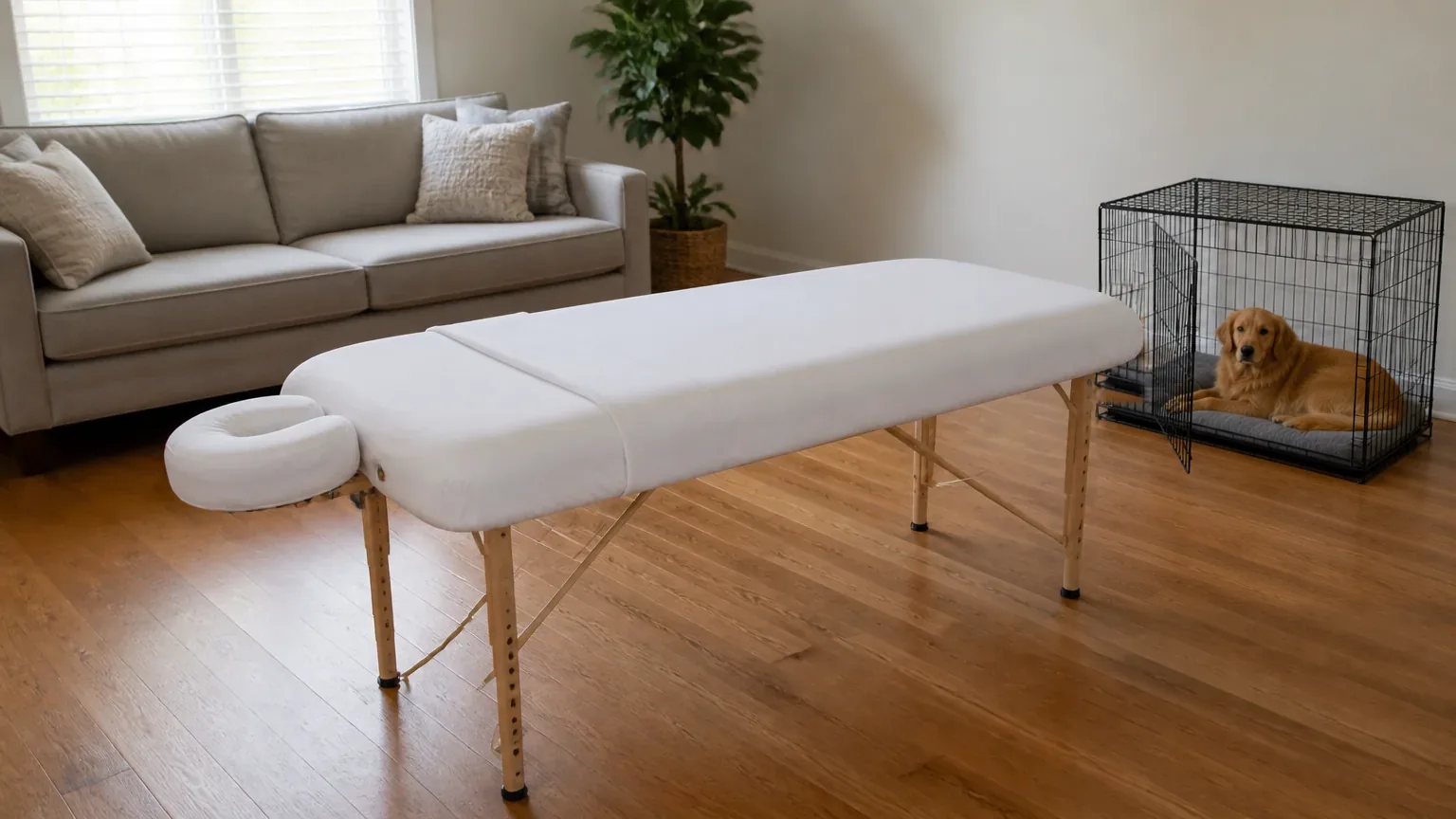
Children at home need another adult watching them, because you cannot supervise a toddler and work. Treating a minor is a separate legal question that varies by state. Pennsylvania’s massage board requires written permission from a parent, guardian, or their representative, and one of them physically present in the room. Delaware law requires a parent or legal guardian to be present unless that guardian consents in writing to the minor declining. Check your own board before booking anyone under 18.
Other adults at home are the client’s business, within limits you set. Nobody records the session, and you keep the right to end it if the situation changes, a principle our personal safety protocol for solo mobile therapists treats as non-negotiable.
Please tell me about any pets when you book, and keep them behind a closed door or in a crate during your appointment. Children at home must be looked after by another adult. Clients under 18 need written consent from a parent or guardian, who stays in the room throughout. No photo, audio, or video recording. If these conditions are not met, I may shorten or end the session, and the full price applies.
Illness, Clearance, and the Fee You Always Waive
Go soft here on purpose. Charge sick clients for cancelling and you teach clients to hide symptoms, which puts you beside a feverish stranger and carries the illness to every household on your route. Waive the fee for genuine illness at any notice, in writing.
Give clients a neutral benchmark rather than a judgment call. The CDC’s respiratory illness guidance works: return to normal activities once, for at least 24 hours, symptoms have been improving overall and there has been no fever without fever-reducing medication. Hold yourself to the same rule. Fever and active infection rule out massage anyway.
The waiver covers two more cases. If intake reveals something that needs physician clearance before massage, such as recent surgery, a recent blood clot, or active cancer treatment, postponing is a clinical decision, not a chargeable cancellation. And clients whose chronic conditions flare without warning need flexibility; our guide to massage for endometriosis and chronic pelvic pain explains why a rigid 24-hour rule fails that group.
Please reschedule if you are unwell. There is no fee for cancelling because of illness, at any notice. Wait until your symptoms have been improving for at least 24 hours and you have had no fever for 24 hours without fever-reducing medication. I follow the same rule. If your health history needs your doctor’s clearance, we will postpone at no charge until you have it.
Gratuity, Receipts, and Invoices That Match the Work
Publish your tipping stance so clients never have to guess. Optional tips, gratuity built into your prices, and no tipping at all are all honest positions; an automatic gratuity dressed up as a tip is not. The IRS treats a payment as a tip only when the customer chooses to pay it and decides the amount, and treats an automatic charge added to a bill as a service charge. The final federal rules for the new tip deduction, which include massage therapists among tipped occupations, also exclude non-negotiable automatic charges from qualified tips. If you need a guaranteed amount, raise your prices, and ask a tax professional how the deduction applies to you.
Invoices describe the service you delivered, even when a client wants wording that fits their expense rules. A Maryland investigative news team reported that a state agency employee asked a mobile massage business to reword its invoice so massages for eight staff read as a “wellness activity,” because the agency did not pay for massages. The $400 invoice was paid with public funds and became the subject of a news investigation and an agency review. Billing for contract clients is covered in our guide to on-site and corporate massage contracts.
Tips are welcome but never expected, and your price is complete without one. Receipts and invoices always state the date, the session length, and the type of massage, and that description cannot be changed.
Where Policies Live So They Hold Up
A policy protects you only if the client saw it before booking and you can prove it, which is what a card dispute turns on. Processor guidance for disputes over cancelled services asks for the policy language as the customer saw it, plus an explanation of how and where it was disclosed before the purchase. Publish yours in four places:
- The booking page, with the policy text beside the checkbox that saves the card.
- The confirmation message, restating the window, fees, and no-show rule in two or three lines.
- The reminder, sent just before the free cancellation window closes.
- The intake form, signed at the first visit, so clients who later book by text are covered too.

Date every version of the policy and keep the old ones. When a term changes, tell existing clients first, and apply the new version only to bookings made after the notice.
Enforcing It Without Losing Good Clients
Consistency makes a policy feel fair, and written discretion keeps your regulars. Allow one waived late cancellation per client per year, logged in their record. Always waive illness, bereavement, and unsafe weather. Let a regular who has to move a standing appointment turn the fee into a credit by rebooking within the week. Beyond that, let the booking system apply the policy automatically, so the charge never feels personal.
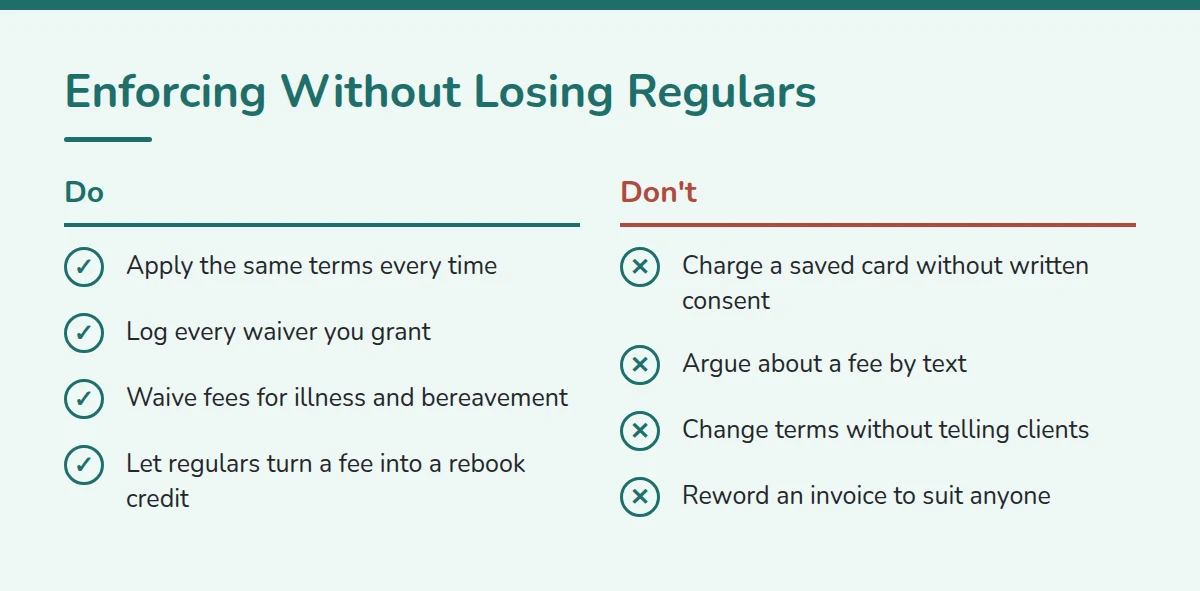
When you do charge, send a short, neutral message: the date, the term that applied, the amount, and an invitation to rebook. Do not apologize for the policy or argue about it by text. A client who fights a fair, disclosed fee after a second no-show is telling you how they value your time. Move them to payment at booking and let the calendar decide.
The Policy Protects the Clients Who Show Up
The clients who book weeks ahead, clear the living room, crate the dog, and open the door on the first knock are the people a policy actually serves. Every slot lost to a late cancellation is one of them turned away. Write the terms once, publish them where they will be seen, and apply them evenly. Policies protect your time; professional liability insurance protects everything else, and no one should work in clients’ homes without both.
Sources
- SDVoyager on a San Diego therapist’s hardest logistics of scheduling and travel time
- Town Square Delaware for a mobile LMT whose clients include families, teens, and dogs
- WBFF Spotlight on Maryland with the agency invoice reworded to hide eight staff massages
- Stripe documentation on the consent terms needed before a saved card is charged
- Stripe dispute guidelines for the cancellation policy evidence card issuers ask to see
- Gurol-Urganci and colleagues on text message reminders and attendance at healthcare appointments
- Centers for Disease Control and Prevention with when to resume normal activities after a respiratory illness
- Pennsylvania Code for the massage board’s consent and parent-in-the-room rules for minors
- Delaware Code on the parent or guardian presence requirement for massage of minors
- Internal Revenue Service with how a voluntary tip differs from a service charge
- RSM US on the final no-tax-on-tips rules and what counts as a qualified tip
Further reading
- Your Car Is the Clinic: Vehicle Setup, Route Planning, and Travel Zones for Mobile Massage
- Personal Safety for Mobile Massage Therapists: A Comprehensive Protocol
- Launching a Mobile Massage Business From Scratch: Your First Year Roadmap
- Understanding the Price Range of Mobile Massage Services
- On-Site and Corporate Mobile Massage: The Complete Guide to Workplace and Event Contracts