When the Client Is the Problem: Reporting and Documenting Client Misconduct as a Solo Mobile Therapist
Published on September 30, 2026
You Did Everything Right, and the Client Books Someone Else Tomorrow
Massage Magazine has given the problem a name. In the first part of a series on the massage reporting gap, Kaci Jones, a massage therapist who teaches practitioner safety, describes a therapist who ends an appointment after a client intentionally exposes himself. The therapist gets safe, documents what happened, tells the owner and reports it to police, and the business puts the client on its do-not-book list. The next morning the same client books another therapist 200 miles away, across a state line, who knows nothing about it. “Each therapist has a piece of information,” Jones writes, “but the client possesses the entire puzzle.”
That scenario still has an owner to tell and a list to go on. A solo mobile therapist has neither: no manager, no franchise do-not-book list, no front desk to catch the rebooking under a new email address. Federal advice for the nearest comparable workforce shows the hole. NIOSH, the federal institute for workplace safety, tells home healthcare workers, “Report to your employer all incidents of violence, no matter how minor,” and tells employers to investigate every report. When you work for yourself, both instructions land on one person, and OSHA lists self-employed workers among those its law does not cover.
So you are the institution. Our personal safety protocol for solo mobile therapists covers vetting, check-ins and getting out of the room. This guide is the other half: the hours and weeks after you have left.
The First Hour: Get Safe, Then Write It Down
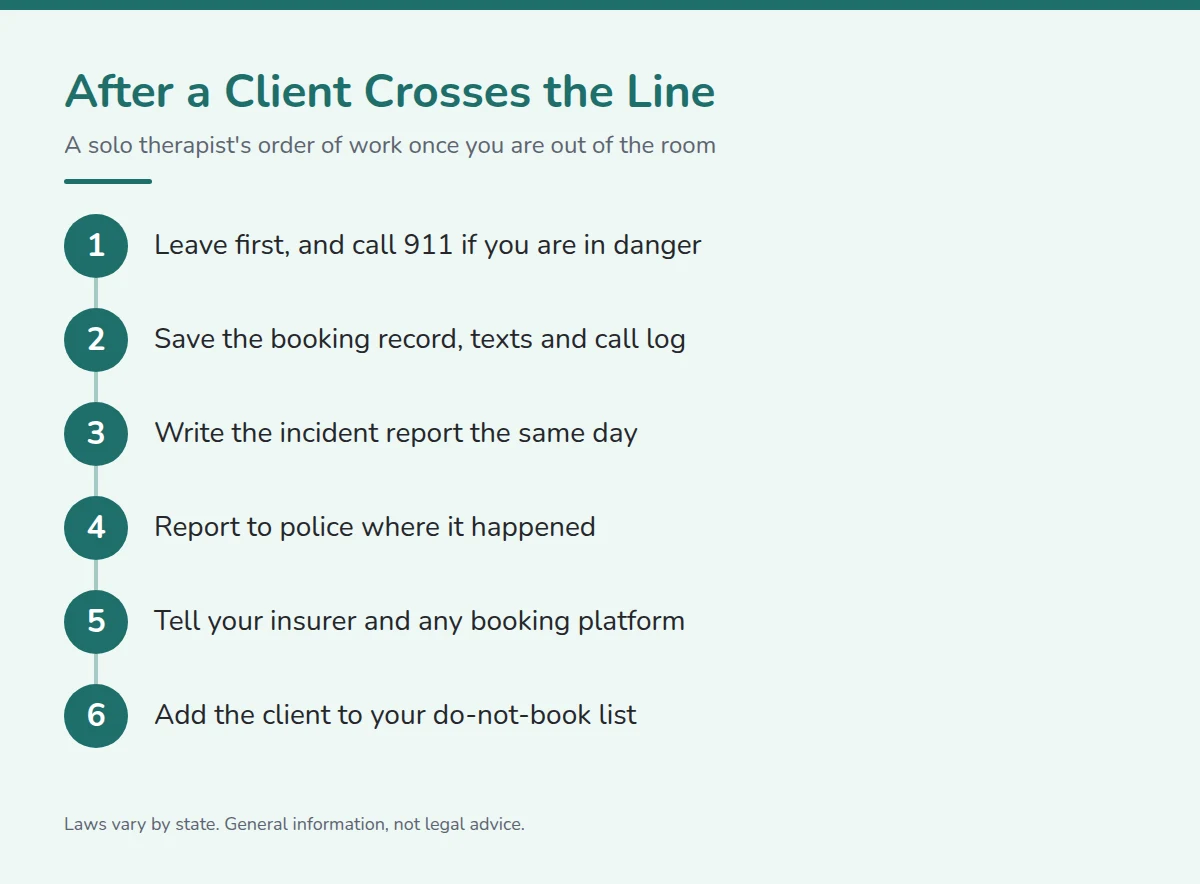
Leave first. NIOSH tells home health workers, “If you feel threatened, leave immediately.” Writing in Massage Magazine, ethics educator Ben Benjamin gives the in-home version: get off the premises and come back for your equipment later, with someone beside you. A table can wait.
Call 911 if you are in danger or hurt. For an assault that is already over, the federal Office on Women’s Health says you can call the police non-emergency number or report in person at a station, and that the National Sexual Assault Hotline (800-656-4673) can talk you through reporting first.
Then park somewhere public, tell your check-in contact, and write down everything you remember while it is fresh. After a sexual assault, the same office advises against washing, changing clothes or disturbing anything at the scene, so police have physical evidence. In mobile work, part of the scene leaves with you: the sheets from that session are in your laundry bag. Keep them unwashed and separate, and tell the officer you have them.
What to Preserve the Same Day
Evidence in a mobile practice is mostly digital, and much of it can vanish on its own. The Safety Net project at the National Network to End Domestic Violence, which writes documentation guidance for people being harassed or stalked, advises keeping a log and saving everything, even if you are unsure you will ever involve police. Before you block a number or report an account, collect:
- The booking record. Export the appointment as the client made it: name, phone, email, service address, booking time, payment receipt, signed intake form and policy checkbox. It is the same trail that shows a visit was a booked therapy appointment if anyone asks why you were at the address.
- Texts, with the contact page. Messages stored only on a phone can be lost when storage runs low. Safety Net recommends a screenshot of the thread plus one of the contact page, which ties the messages to the client’s number.
- Emails, in the original. A forwarded copy loses the header information that can help identify the sender.
- App messages. Some apps tell the other person when you take a screenshot. If unsure, photograph the screen with a second device.
- Calls and check-ins. Photograph the call log with dates and times showing, save any voicemail, and keep the check-in texts that fix when you arrived and left.

Then write the incident report. Safety Net’s log format is a good skeleton: date and time, location, witnesses, the technology involved, a brief description of what the person did and, once you have reported, the officer’s details. Add the client’s exact words, what you said and the time you left.
Write what you saw and heard, not what you concluded, in the factual register our ethics and documentation guide asks of session notes. “At about 2:40 he pulled the sheet off, exposed himself and asked whether I offered extras. I said no, ended the session and left at 2:46” is a record. “He is a predator” is a conclusion, and the sentence most likely to cause you trouble later. Safety Net’s caution applies to every line: documentation may become evidence in court, and it may end up in front of the person it describes.
Carriers keep text message content for a limited time, and police can ask a carrier to preserve it, so raise that when you report. Keep a second copy of everything off your phone.
Where a Report Actually Goes
Jones’s point is that there is no shortage of places to report. Each is built for a different job, and none passes what it knows to the others.
The police. Report to the department covering the address where it happened, which in mobile work may not be your home department. Ask for the report number and the officer’s name. A report creates an official record and can lead to investigation and charges. It does not travel: as Jones notes, police reports can be separated by city, county and state lines.
Victim compensation. A police report also matters for money when you have no employer benefits behind you. Every state has a crime victim compensation program that can pay for medical care, mental health treatment and lost wages after a violent crime. The National Association of Crime Victim Compensation Boards lists the usual conditions: report promptly to law enforcement and cooperate, apply on time, and have costs that insurance does not cover.
The booking platform, if one sent you the client. On a marketplace the client is the platform’s customer, not yours, so the platform holds the identity and payment details and can remove the account. It cannot warn a therapist on another app. Save the in-app messages first: Safety Net warns that reporting content can get it removed, and the evidence goes with it.
Your liability insurer. Ask how to log an incident that has not produced a claim, because, as Benjamin notes, a client may decide to lodge a complaint against you. One national association’s member policy lists attorney fees for defending a licensing complaint, coverage for allegations such as libel, slander or assault, and assault coverage that reimburses your own medical and property costs if you are assaulted at work or on the way to or from it. Policies differ, and the assault coverage is not offered in every state.
Your state board. The board licenses you, so it is easy to assume it can help. It cannot. The Federation of State Massage Therapy Boards describes its members’ work as ensuring massage “is provided to the public safely and competently,” and their authority runs to license holders. Pennsylvania’s conduct rule lists 22 things a massage therapist must do and 12 a therapist must not, and none binds a client. The board matters for the opposite reason: it is where the client can complain about you, and your same-day record is your answer.
When Inappropriate Becomes Potentially Criminal
Jones argues that therapists need enough legal literacy to recognize when behavior “may have crossed from inappropriate into potentially criminal.” A rough map:
- Sexual comments, requests to lower the drape. Often not crimes on their own. End the session, write it up and decline future bookings.
- An offer of money for sexual contact. Prostitution is a crime throughout the United States outside a few rural Nevada counties, and the client is asking you to commit it.
- Sexual touching without your consent. The Justice Department’s Office on Violence Against Women defines sexual assault as “any nonconsensual sexual act proscribed by federal, tribal, or state law.”
- Blocking the door or keeping your keys. False imprisonment is both a crime and a civil wrong, and a locked door or a threat of immediate force can be enough.
- Repeated contact after you cut it off. Stalking is a crime in all 50 states. The Stalking Prevention, Awareness, and Resource Center defines it as a pattern of behavior directed at one person that would make a reasonable person fear for their safety or suffer substantial emotional distress, which is why every text goes in the log.
- Deliberate exposure. Indecent exposure in many states, with a catch.
The catch is that the same act can be charged differently depending on the state, and exposure shows it, because in mobile work it happens inside the client’s home. California’s statute covers exposure “in any public place, or in any place where there are present other persons to be offended or annoyed thereby,” which reaches a living room with you standing in it. New York’s exposure offense is written around appearing “in a public place,” so the same conduct in a private home may have to be charged as something else, if at all.
So do not try to name the charge. Describe exactly what happened and let the officer and prosecutor classify it. Jones, too, warns therapists against becoming investigators or trying to determine guilt themselves.
A Do-Not-Book List That Actually Holds
A franchise bans a client with one entry at the front desk. Your list has to work across your booking software, phone and inbox, and survive the client trying again under another name. It protects only you, which is why it follows the report and does not replace it. “Ten blocked phone numbers,” Jones writes, “do not create a warning.”
Give each entry every name used, phone numbers, emails, the service address, the card type and last four digits from the receipt, the date, a one-line factual reason and any police report number. Then enforce it in layers:
- Booking software. Block or flag the client record, and make first-time clients wait for your approval.
- Phone and email. Block after you have taken your screenshots, not before.
- The address. A new name, number and email take five minutes to create. The house does not move. Check the address on every new booking against your list.

Keep the list private and limited to conduct. The NCBTMB Code of Ethics recognizes the right “to refuse to treat any person or part of the body for just and reasonable cause” and tells certificants to refuse to unjustly discriminate. A dated entry tied to an incident report shows which of the two your refusal was.
Tell the client once, in writing, then stop replying: “I am no longer able to offer you appointments. Please do not contact me again.” Give no reasons. If you think any message could inflame things, skip it and tell the police. Whatever arrives afterward goes in the log, which Safety Net notes is what helps if you later seek a restraining order.
Settle the money on purpose. Our policy handbook recommends a house rule that lets you end a session and still charge for it, but check your board first: Pennsylvania’s rule says a therapist may not refuse a client’s request to refund the unearned portion of prepaid services. When in doubt, refund the unused minutes and close the file.
Warning Other Therapists Without Defaming Anyone
Wanting to warn the therapist two towns over is the right instinct, and it is where the legal risk shifts from the client to you. Two rules apply.
Defamation. Cornell’s Legal Information Institute gives the general elements: a false statement presented as fact, communicated to a third party, with the required level of fault, that causes reputational harm. Truth is generally a complete defense, and under the traditional rule it is yours to prove, which is what the same-day record is for. Three details matter before you post:
- Falsely accusing someone of a serious crime or serious sexual misconduct is among the traditional categories where a court may presume damages.
- Calling a statement your opinion does not protect it if it implies facts that can be proven false.
- A qualified privilege can protect a statement made to someone who shares a legitimate interest in the subject, and malice defeats it. A private message to the two colleagues who cover your zip codes fits that far better than a post in a regional group of thousands.
California goes further and makes privileged a factual account, given without malice, of a sexual assault or harassment incident the speaker experienced. Do not assume your state has an equivalent.
Confidentiality. Your profession’s rules still treat this person as a client. The NCBTMB code requires certificants to safeguard “the confidentiality of the client’s identity and information in all conversations” unless disclosure is requested by the client in writing, medically necessary or required by law. Pennsylvania’s board rule says to keep client information “private and confidential.” Naming a client in a group chat is a disclosure, and the client can take it to your board.
Reporting a crime to police is a different act, and federal privacy law shows where the line usually sits. Even under HIPAA, a staff member who is the victim of a crime may give police identifying details about the suspect: name and address, date and time of treatment, a physical description. Health history is not on that list, and it does not belong in a message to peers.
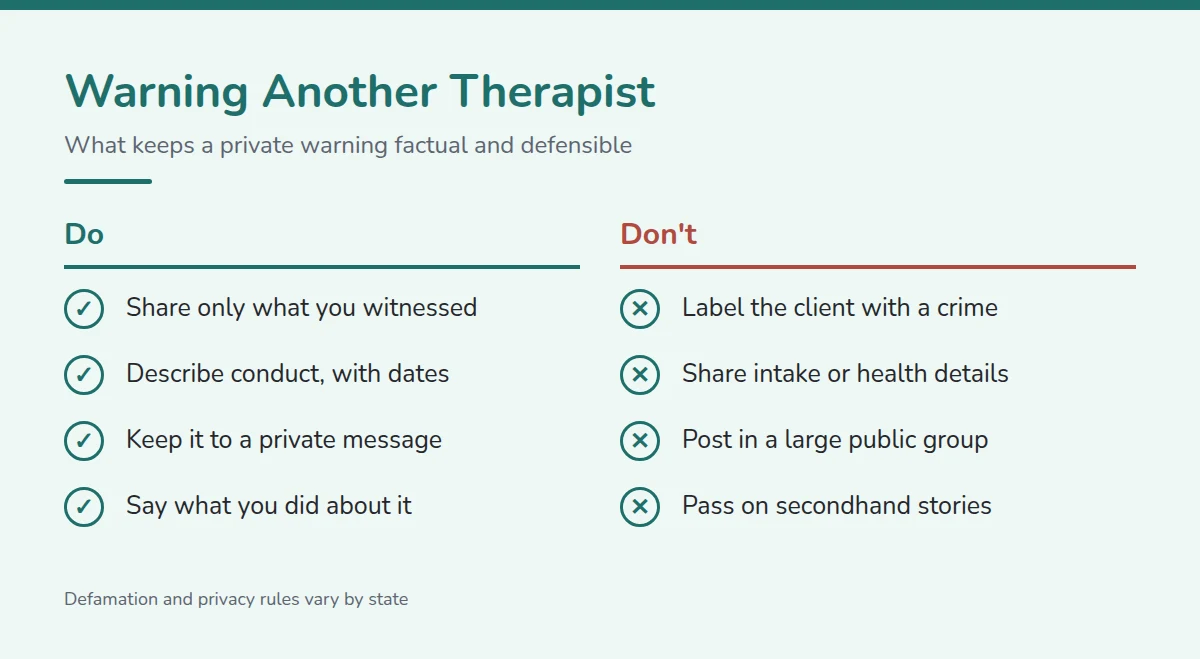
So share only what you saw and heard, with dates and what you did about it, in a private message. Leave out the intake form and anything secondhand. You can get support from a peer without naming anyone. Before going wider, talk to an attorney in your state.
None of this closes the gap. Jones is clear that a public national blacklist of clients is not the answer, because of the due process, mistaken identity, privacy and defamation problems it would raise. What you can build alone is smaller: a record that police, an insurer and a court can each use, and a list that keeps one client off your calendar.
You Are the Institution, So Write the Procedure
An employer would have a one-page procedure for this. Write yours before you need it: the numbers to call, the evidence checklist, a blank incident form, the cut-off message and the questions for your insurer. Professional liability insurance is non-negotiable for anyone working alone in clients’ homes, and this is one of the days it earns its premium.
Criminal, defamation, privacy and licensing rules vary by state, and nothing here is legal advice. The client may hold the whole puzzle. Make sure your piece of it is dated, saved and in the right hands.
Sources
- Massage Magazine on the reporting gap that lets a banned client start fresh with the next therapist and what to do in the minutes after a client crosses a boundary
- National Institute for Occupational Safety and Health with violence prevention advice for workers who visit clients at home
- Occupational Safety and Health Administration on who the OSH Act does and does not cover
- Office on Women’s Health for what to do, and how to report, after a sexual assault
- NNEDV Safety Net with documentation tips for texts, emails, call logs and incident logs
- National Association of Crime Victim Compensation Boards for what victim compensation pays for and who qualifies
- American Massage Therapy Association listing what its member liability policy covers, including license defense and assault
- Federation of State Massage Therapy Boards on the public protection mission of state massage boards
- Pennsylvania Code with the massage board’s conduct standards on confidentiality and refunds
- Cornell Legal Information Institute explaining the elements of defamation, its defenses and its privileges, where prostitution is a crime and what counts as false imprisonment
- Office on Violence Against Women for the federal definition of sexual assault
- Stalking Prevention, Awareness, and Resource Center on how stalking is defined and why single incidents are worth logging
- California Legislature with the state’s indecent exposure statute and its privilege for statements about sexual assault and harassment
- New York Penal Law for an exposure offense limited to public places
- National Certification Board for Therapeutic Massage and Bodywork on the code of ethics clauses covering confidentiality and the right to refuse treatment
- Code of Federal Regulations for the HIPAA rule letting a crime victim on a provider’s staff identify the suspect to police
Further reading
- Personal Safety for Mobile Massage Therapists: A Comprehensive Protocol
- The Mobile Massage Policy Handbook: Cancellations, Deposits, No-Shows, and House Rules
- Ethics, Consent, and Draping in the Client’s Home: A Professional Boundaries Guide
- When Anti-Trafficking Massage Ordinances Hit Legitimate Outcall Therapists
- State Licensing and Scope of Practice: A Mobile Therapist’s Compliance Guide