Mobile Massage for Pain Management: Bringing Relief Home
Published on September 6, 2026
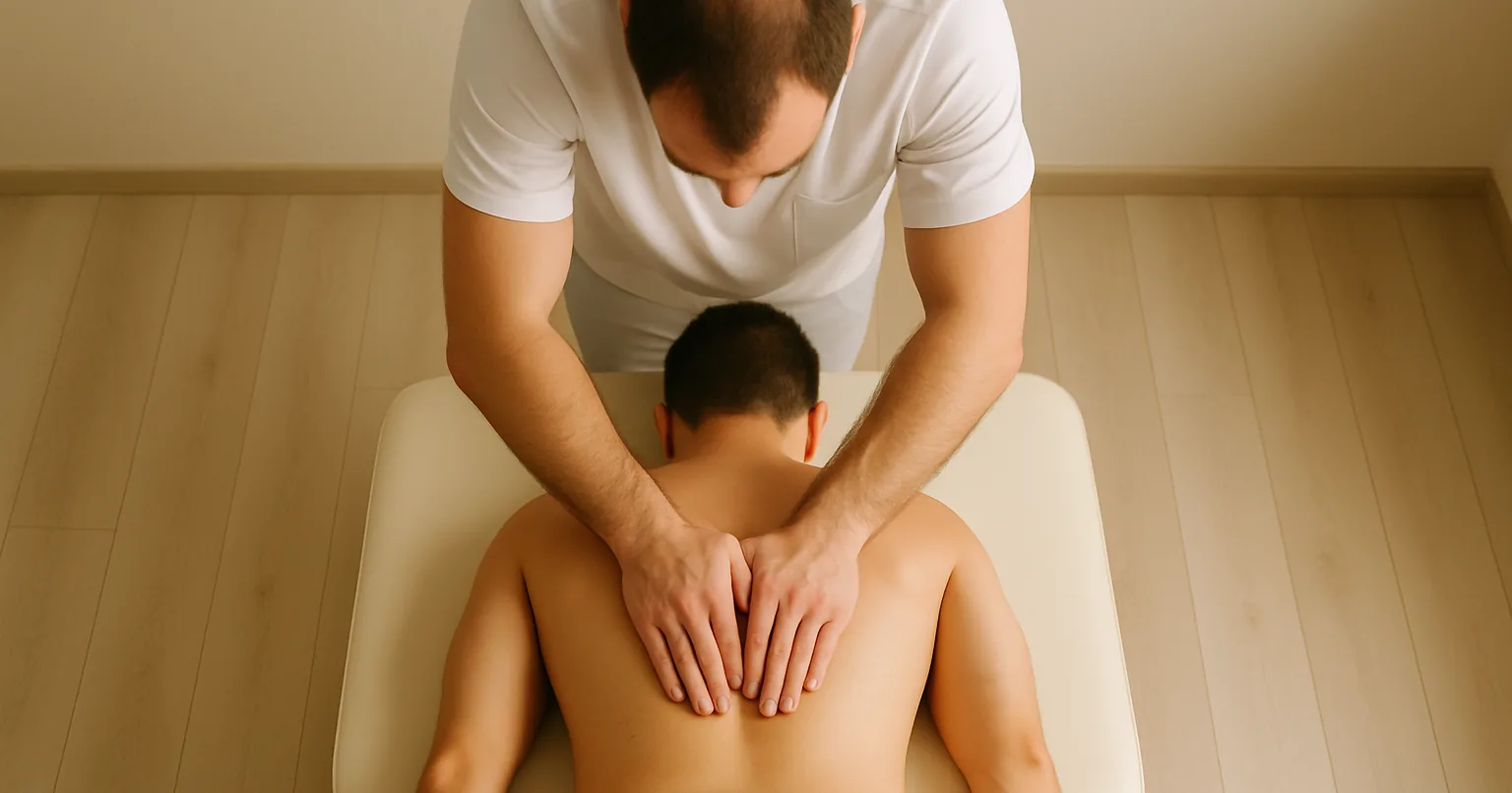
Pain Is the Reason Most People Book
Ask a room of massage clients why they made the appointment and the answer is rarely “pampering.” AMTA’s consumer research puts numbers on it: 94 percent of people surveyed believe massage can be effective for reducing pain, and 29 percent say they used massage for pain relief or pain management in the past year. Eighty-six percent now agree massage therapy should be considered a form of health care. Among consumers who raised massage with their doctor, 51 percent were discussing acute or chronic pain, 49 percent soreness and spasms, and 36 percent injury recovery or rehabilitation.
That is a large group of people trying to solve a physical problem. A meaningful slice of them cannot easily get to a clinic to do it, because the pain itself, a recent surgery, or a mobility limitation makes the trip the hardest part of the appointment. This guide is for both sides of that equation: the person weighing whether an in-home session is worth booking, and the therapist deciding whether to build a practice around pain clients.
What the Evidence Actually Supports
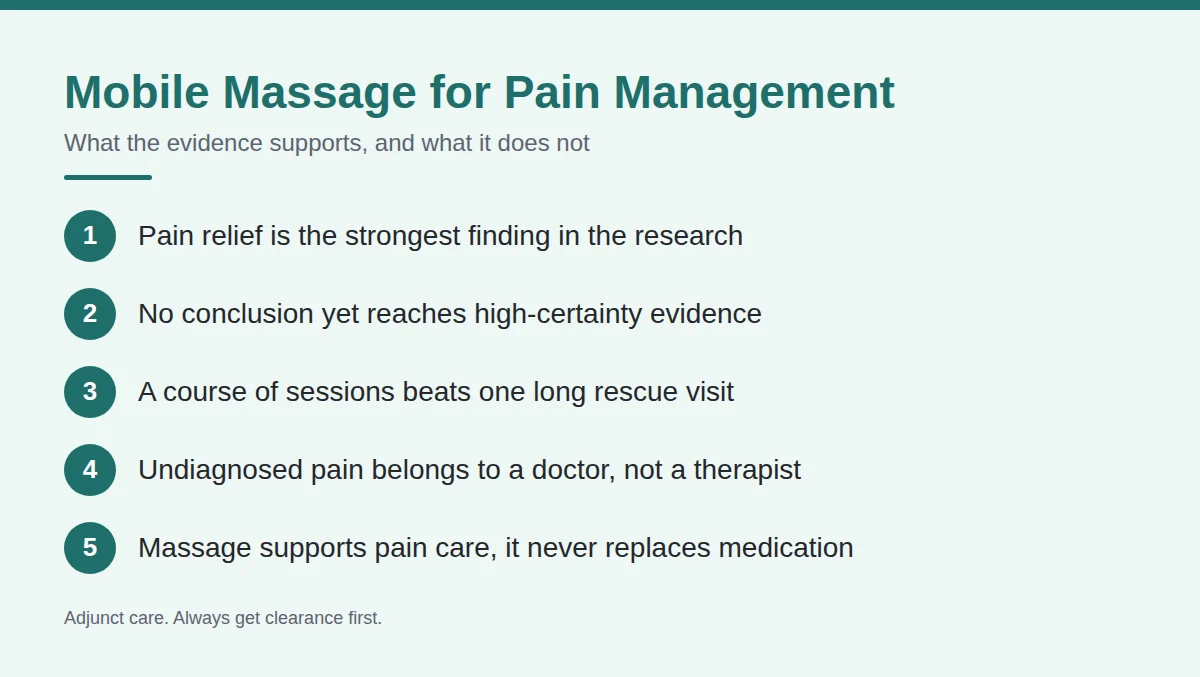
Honesty here is worth more than enthusiasm, and the best available map of this research is a 2024 systematic review in JAMA Network Open. The authors located 129 systematic reviews of massage therapy for painful adult conditions, found that only 41 had formally rated the certainty of their own conclusions, and mapped 17 of those across 13 health conditions. Their finding is the one every therapist should be able to recite: not a single conclusion was rated high-certainty evidence. Seven conclusions reached moderate certainty, and every one of those seven was that massage therapy had a beneficial association with pain. Everything else sat at low or very low certainty, and evidence that massage beats other active treatments was rare.
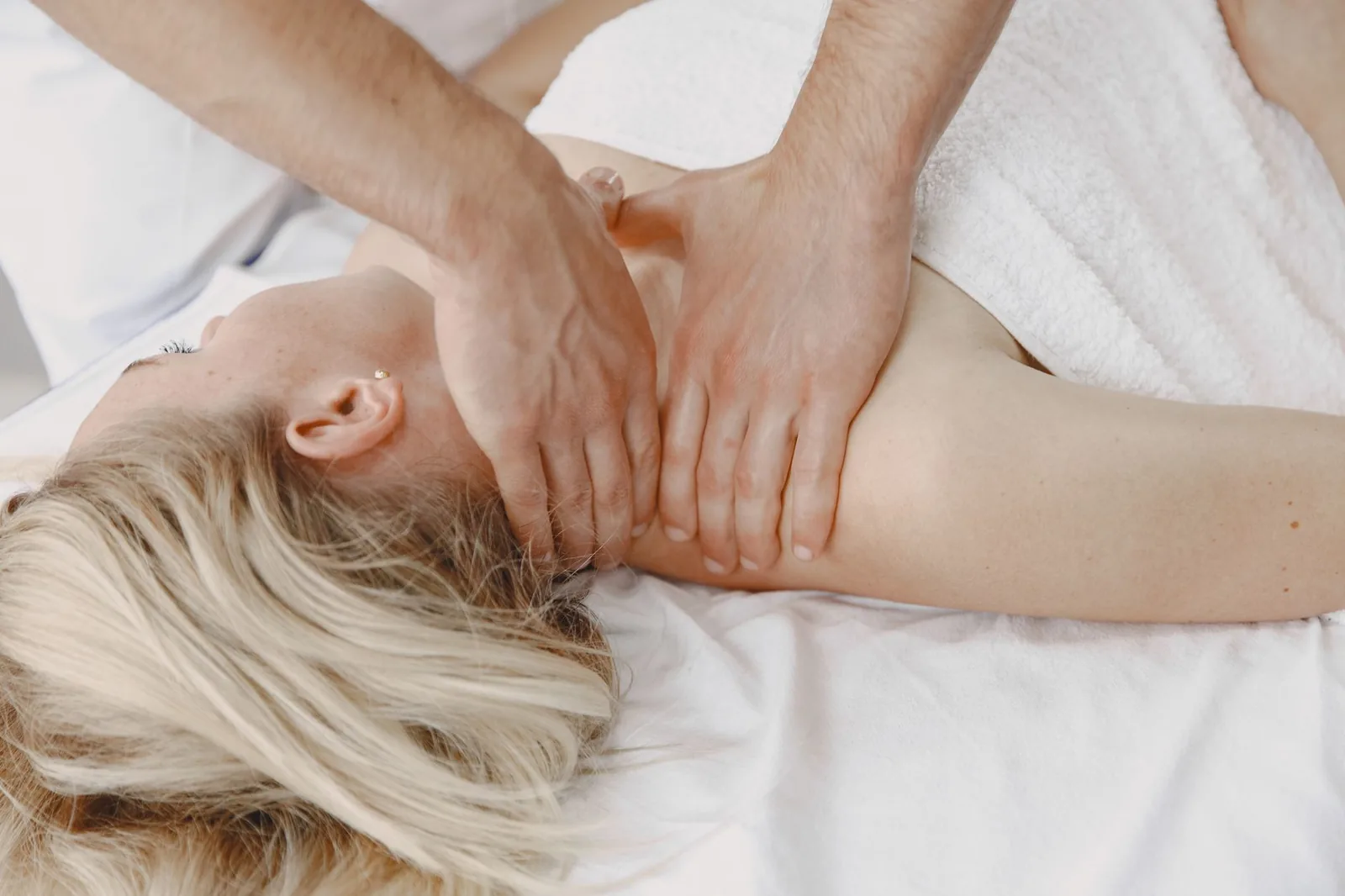
Read that carefully, because it cuts both ways. The strongest signal in a very large literature points at pain relief, which is exactly the outcome clients are buying. What the literature does not support is a claim that massage outperforms physical therapy, exercise, or medication, or that the relief is permanent.
The condition-specific reviews fill in the shape. Cochrane’s review of massage for low back pain pooled 25 trials with 3,096 participants and found massage better than inactive controls for both pain and function in subacute and chronic cases, while rating the overall quality of that evidence low to very low, mostly because these trials are almost impossible to blind. Cochrane’s 2024 neck pain review, covering 33 trials and 1,994 participants, was cooler still: compared against a placebo, massage produced little to no difference in pain or disability at up to 12 weeks. The interesting detail is buried in the subgroup analysis, where a clinically important difference favored a higher dose of eight or more sessions.
So the fair summary is this. Massage produces real, measurable short-term relief for musculoskeletal pain, most convincingly in the low back. A single session is a comfort measure. A course of sessions is where the therapeutic argument lives. And nobody should promise a cure. If you want the physiology underneath the effect, our explainer on how touch modulates the nervous system covers gate-control theory and the autonomic shift that makes a session feel the way it does.
Where Massage Sits Beside Medication
AMTA’s updated report on massage in integrative care frames massage as a nonpharmacological option that works alongside medical procedures and pharmaceutical treatment across hundreds of conditions, and estimates that building it into comprehensive care models could cut roughly 11.1 billion dollars a year from US health system costs while creating more than 63,000 jobs. That is the policy case, and it is why hospitals and pain programs have added massage to the menu as clinicians look for options that are not opioids.
Here is the line a therapist must never blur. Massage can be part of a pain plan that reduces reliance on medication. Deciding whether a client takes less of a drug, or stops one, belongs to the prescriber, full stop. You do not counsel anyone on tapering, you do not suggest a client “shouldn’t need” their pills after a good session, and you do not market yourself as an opioid alternative. Say the accurate thing instead: massage is a drug-free approach some people use alongside their medical care, and any change to medication is a conversation with their doctor.
Why the Home Visit Changes the Equation
For a healthy client, the difference between a clinic and a living room is convenience. For a client in pain, it can be the difference between getting care and going without.
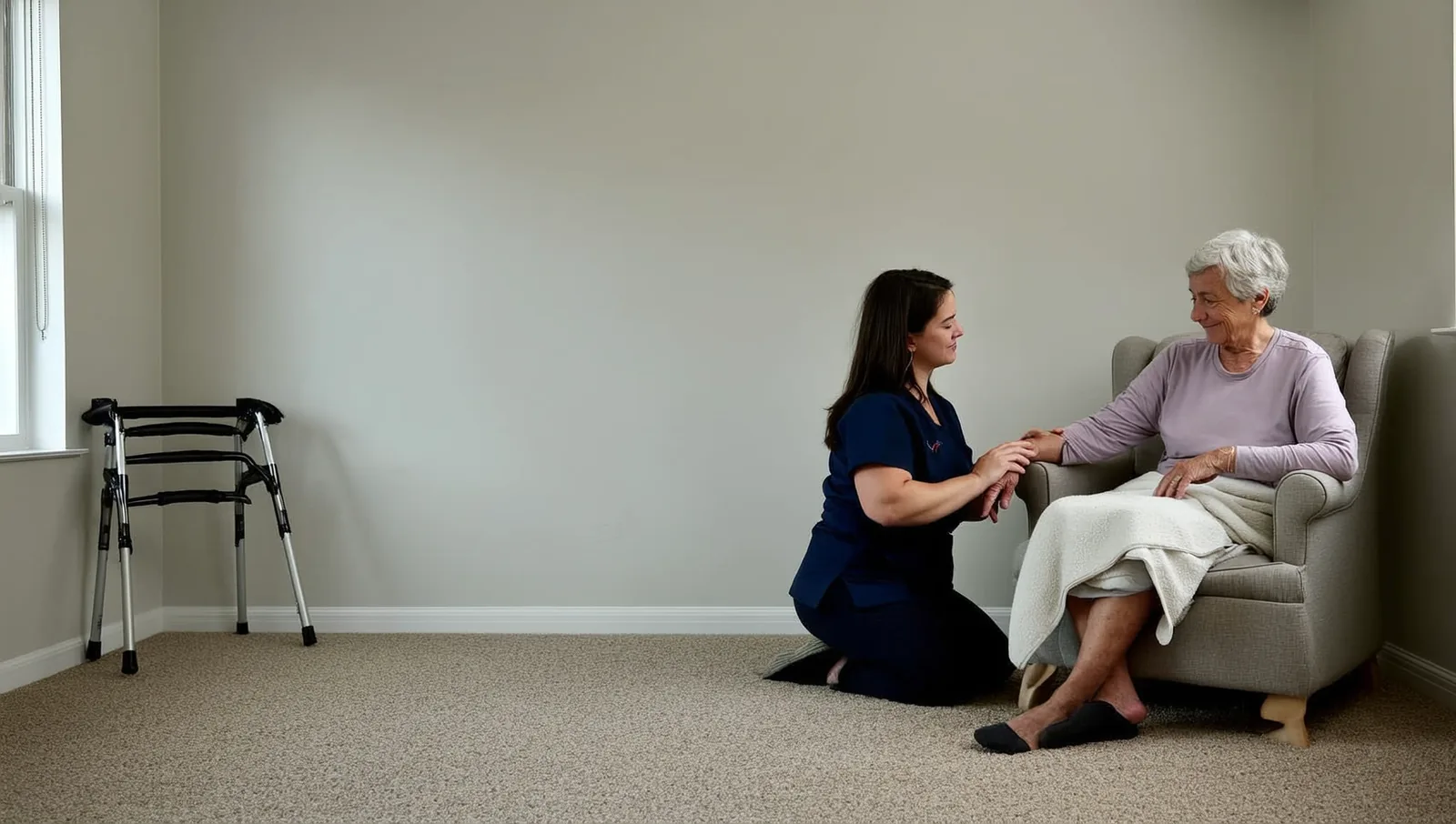
Sitting in a car is one of the least comfortable positions for an inflamed lower back or a fresh surgical site. A post-operative client may be under driving restrictions for weeks, or unable to manage a parking lot with a walker. Someone with fibromyalgia or a fluctuating condition cannot reliably predict which days are functional, and mobile scheduling flexes around a flare in a way a clinic waiting room does not. The stairs, the reception desk, the transfer on and off an unfamiliar high table all cost energy that the person did not have to spend.
Then there is what happens afterward. The half hour of loose, sleepy calm following a good session is the part clients most want to keep, and driving home wipes it out. In their own home they can lie down, and the relief holds. For older clients this compounds with everything covered in our guide to in-home massage for seniors, where getting to an appointment is often the single largest barrier to receiving one at all.
The Three Groups This Work Serves Best
Chronic musculoskeletal pain. Persistent low back and neck pain, shoulder and hip complaints, tension headaches, and widespread pain conditions. This is where the evidence is strongest and where a regular cadence beats occasional rescue sessions.
Post-surgical recovery. Joint replacements, spinal surgery, abdominal procedures, and reconstructive work all leave people sore, guarded, and often housebound for a stretch. Massage here is about the whole body around the surgery: the compensating muscles, the sleep debt, the shoulder that has been carrying a crutch. Scar work is popular and the evidence is genuinely thin. A scoping review in the Journal of Hand Therapy pulled together 25 studies on massage for post-operative scarring and found favorable reports across the board, but with 45 different outcome measures and protocols ranging from one session to three treatments daily for six months, the authors concluded the research base is too heterogeneous to substantiate the practice properly. Offer it as comfort and mobility work, not as a proven scar treatment, and never touch an incision that has not been cleared by the surgeon.
Limited mobility and progressive conditions. Clients with multiple sclerosis, Parkinson’s, stroke recovery, arthritis, or spinal cord injury frequently have both persistent pain and a real transport problem. This is often the most loyal segment of a mobile book, and it demands the most careful screening.
Intake and Physician Clearance
Every pain client starts with a written health history, not a chat at the door. Build it on the same disciplined intake and client vetting that protects you on any booking, then add the questions pain work requires: what the diagnosis is and who made it, how long the pain has been present, what makes it better or worse, what other treatment is underway, and a full medication list.
Get written physician clearance before the first session when any of these are present: recent surgery, active cancer, a diagnosed clotting disorder or current anticoagulant therapy, uncontrolled cardiovascular disease, pregnancy with complications, an implanted device or pump, or a neurological condition with changing symptoms.
Medications matter more than most therapists expect. Anticoagulants mean lighter pressure and easier bruising. Opioids, muscle relaxants, and nerve pain drugs blunt a client’s ability to give you accurate feedback about pressure, so their “that’s fine” is less reliable than usual and you work more conservatively than the words suggest. Steroid use can thin skin and weaken bone.
The single most important rule in pain work: undiagnosed pain is not yours to treat. If a client cannot tell you what a physician has said about the pain, your job is to refer, not to guess at it.
Red Flags That Stop the Session
- Signs of deep vein thrombosis. One-sided calf or leg swelling, pain, warmth, and red or discolored skin. Do not massage the limb, do not “work it out,” advise urgent medical care. Sudden chest pain, breathlessness, or coughing blood is a 911 call.
- New, severe, or unexplained pain, especially pain that wakes someone at night or comes with unintended weight loss.
- Numbness, tingling, or weakness that is spreading, and any loss of bladder or bowel control with back pain. That last combination is an emergency referral, not a massage.
- Fever, active infection, or inflamed skin over the area you would work.
- Acute injury within the first 48 to 72 hours, or any suspected fracture.
- An incision or wound that is not fully healed and cleared.
- Pain the client cannot explain and no clinician has assessed.
Designing the Session Around a Painful Body
Dose beats intensity. The neck pain subgroup finding, where eight or more sessions produced a clinically important difference, matches what experienced therapists see: a course of shorter, gentler visits outperforms one heroic ninety-minute session that leaves someone wrecked for two days. Thirty to sixty minutes on a regular weekly or fortnightly cadence is a better prescription than an occasional rescue booking.
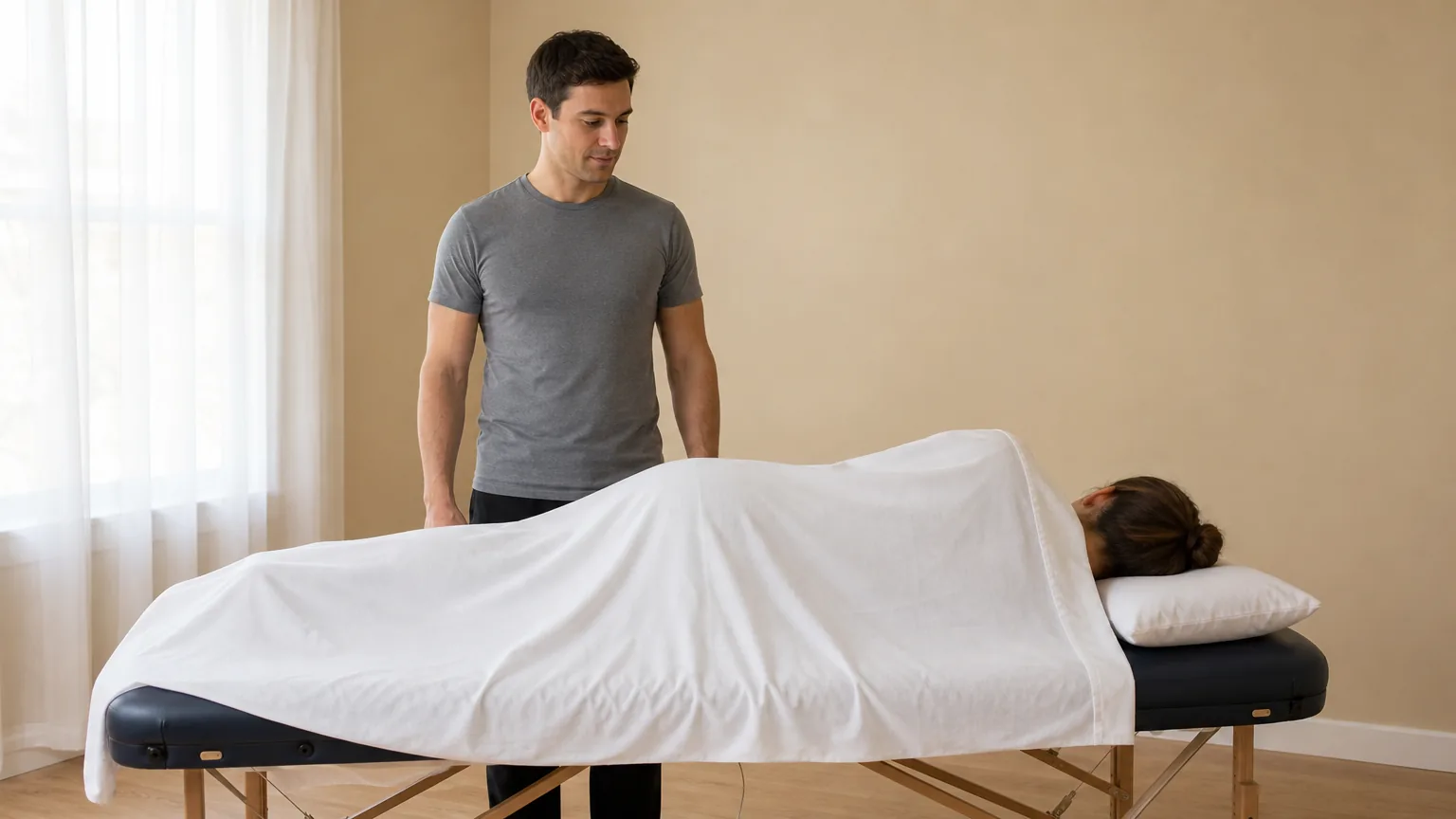
Positioning is most of the skill. Side-lying with generous bolstering is often the only tolerable option after hip or abdominal surgery. Some clients are better worked seated in their own recliner, or on their own bed, than transferred onto a table at all, and a mobile therapist should be equally competent in all three. Set a plain pressure scale at the start, agree that anything above a five out of ten means back off, and check in verbally rather than reading a face that is already braced.
Tell clients what to expect afterward, because a pain client who is surprised by next-day soreness will assume you hurt them. Mild tenderness for a day is normal, a flare that lasts three days means the dose was too high, and you adjust next time. Between visits, simple self-care and the sensible use of handheld tools at home can extend the benefit, provided you coach the client on where not to use them.
The Scope Line You Cannot Cross
A licensed massage therapist does not diagnose, does not prescribe, does not adjust anyone’s medication, and does not claim to treat or cure a medical condition. You can describe what you do, what clients commonly report, and what the research shows. You cannot tell someone their sciatica is caused by a disc, and you cannot tell them massage will fix it.
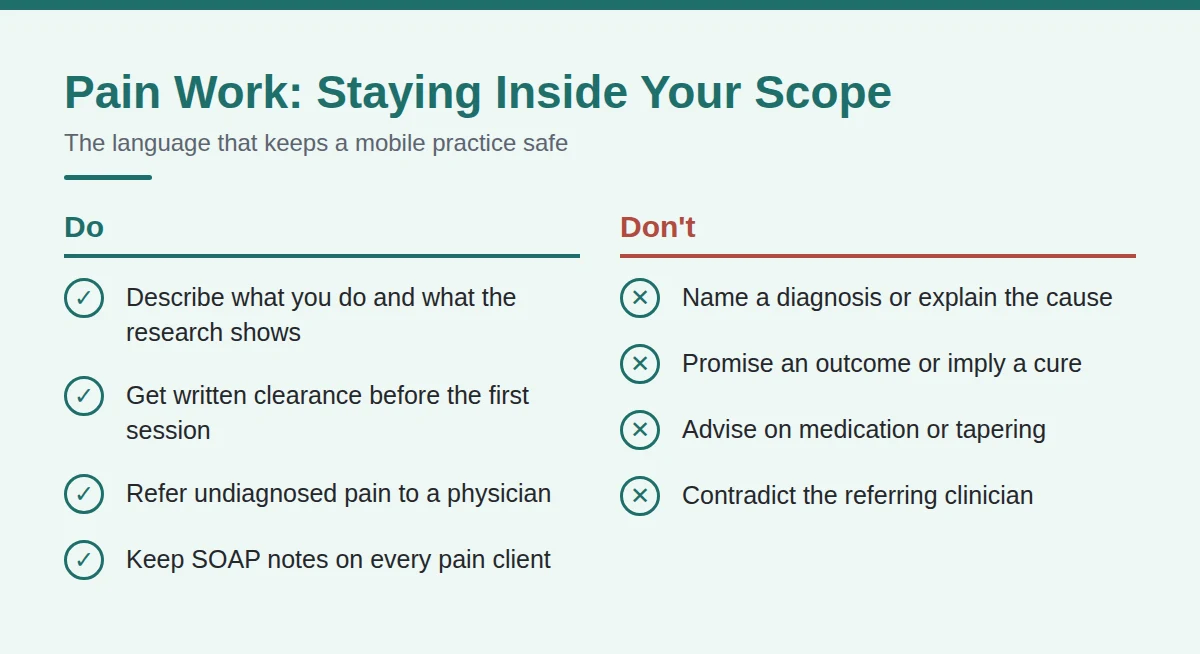
The specific traps in pain work are naming a pathology, promising an outcome, positioning yourself against a treatment the client’s doctor prescribed, and drifting into techniques your license does not cover. Scope, title protection, and the boundary between licensed massage therapy and unlicensed bodywork all vary by state, and your own state’s practice act is the binding authority. Our compliance guide to licensing and scope walks through how to verify yours. Keep SOAP notes on every pain client, both because clinicians who refer expect them and because good documentation is your defense if anything is ever questioned. Professional liability insurance is non-negotiable, and mobile therapists should confirm the policy follows them into private homes.
Building a Referral Practice, Carefully
Pain clients are the most referable segment there is. AMTA found that among consumers who discussed massage with a medical provider, 22 percent were referred to a therapist outright and 24 percent were strongly recommended to get one. Physical therapists, chiropractors, pain clinics, and orthopedic practices all have patients who fit and no easy way to get them treated at home.
What earns those referrals is not a glossy brochure. It is respecting clearance, communicating in writing, staying inside your scope, and never contradicting the referring clinician. Describe your service in accurate language on your site and forms, avoid medical claims entirely, and let the documentation do the persuading. Whether that work arrives through an app or your own bookings changes the economics considerably, which our comparison of platform work and an independent book breaks down in detail.
Done well, this is quiet, unglamorous, genuinely useful work. You are not curing anyone. You are making a painful week more bearable for someone who could not have made it to a clinic to ask, and the evidence says that relief is real even if it is modest and temporary. That is worth saying plainly, and it is enough.
Sources
- JAMA Network Open on how much of the massage-for-pain literature actually holds up
- Cochrane for what 25 trials show about massage and low back pain
- Cochrane with a 2024 review of massage for neck pain and the dose effect
- AMTA on massage therapy in integrative care and pain management
- AMTA for what consumers say about using massage for pain
- Journal of Hand Therapy reviewing the patchy evidence behind post-operative scar massage
Further reading
- The Science of Touch: How Mobile Massage Affects the Nervous System
- Personal Safety for Mobile Massage Therapists: A Comprehensive Protocol
- Mobile Massage in Aged Care: Bringing Wellbeing Home to Seniors
- State Licensing and Scope of Practice: A Mobile Therapist’s Compliance Guide
- Handheld Massage Tools Worth Recommending Between Sessions: A Therapist’s Picks