Massage for Dialysis Fatigue: Working With Clients Whose Week Is Already Spent
Published on October 8, 2026
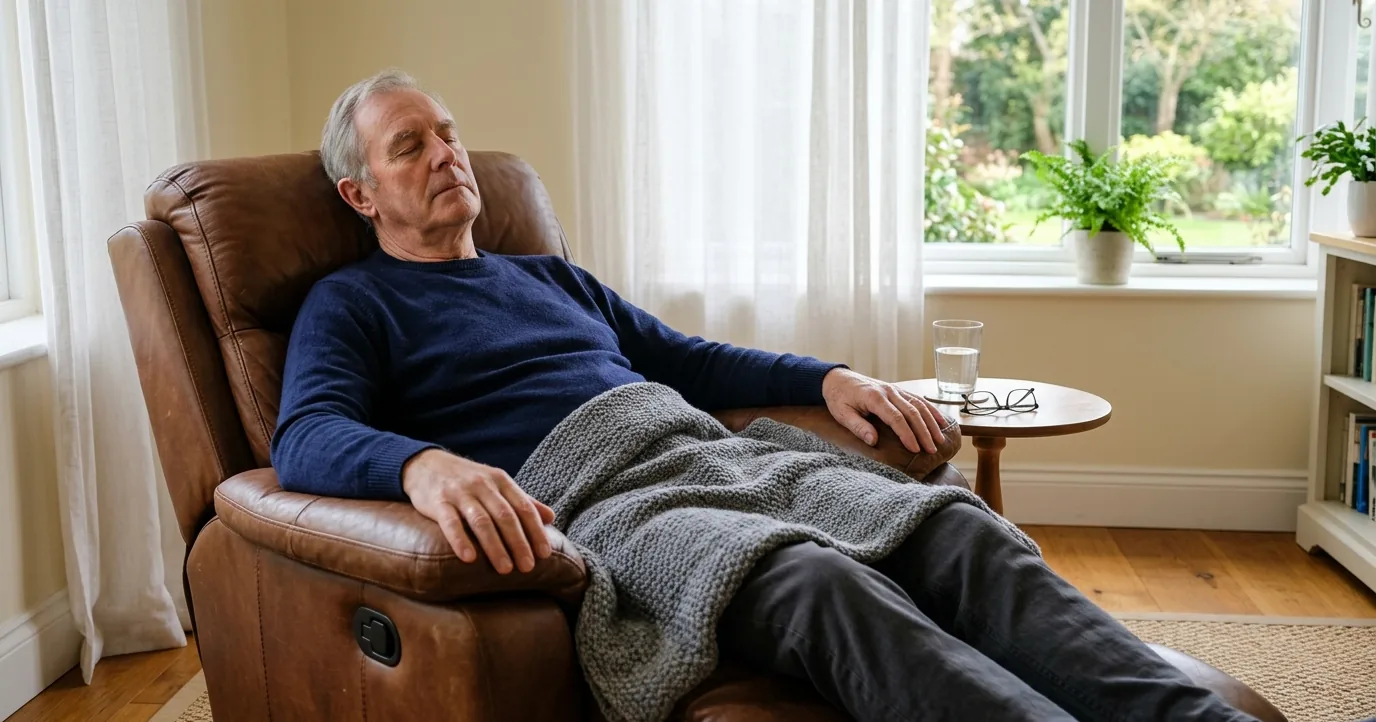
A Week That Belongs to the Dialysis Unit
Ask someone on in-center hemodialysis how their week looks and you get a timetable before you get an answer. Three days a week, on a fixed Monday, Wednesday and Friday or Tuesday, Thursday and Saturday rotation, they spend about four hours in a chair while a machine does part of the work their kidneys no longer can. Add the ride there, the wait to be connected and the ride home, and a treatment day is largely gone.
It does not end when the needles come out. When the Dialysis Outcomes and Practice Patterns Study asked 6,040 patients how long they took to recover from a session, Rayner and colleagues found that 32% said under two hours, 41% said two to six, 17% said seven to twelve, and 10% said longer than twelve. For more than a quarter of patients, a dialysis day takes the whole day. Longer recovery went with older age, diabetes and more fluid removed during treatment, and it tracked with poorer quality of life and higher rates of hospital admission and death.
Almost no massage content addresses this client, and few clients suit a mobile practice better. Someone who is exhausted, may depend on others for every journey, and already travels to a clinic three times a week has no realistic capacity to add a fourth trip to a spa. This guide is for them, their families, and therapists weighing the renal niche: what the evidence supports, the access arm rule that has no exceptions, fluid, skin and catheters, when in the week to book, and where a doctor’s clearance comes first.
What the Evidence Says About Massage and Dialysis Fatigue
Fatigue is not a side complaint in kidney failure. Patients, caregivers and clinicians have named it a core outcome for hemodialysis, and it is linked to depression, cardiovascular disease and a higher risk of death. In 2023 a Cochrane review led by Natale and colleagues gathered 94 trials with 8,191 participants to see what helps.
Massage came out among the better options, with a caveat attached. Across seven trials and 657 people on hemodialysis, massage may improve fatigue compared with no intervention, and two trials suggest it may raise energy. Exercise, aromatherapy and acupressure earned the same cautious verdict, while drugs and other approaches had uncertain effects. All of it is rated low certainty: risk of bias was unclear or high in most of the areas the reviewers assessed, results varied widely, the trials were generally short, and harms were rarely reported. And when the comparison is no treatment at all, some of the benefit may simply be an attentive, quiet hour, a problem our explainer on how to read massage research covers in depth.
The trials themselves were mostly about feet, hands and backs. In a Turkish hospital dialysis unit, Çeçen and Lafcı randomized 82 patients to hand massage, foot massage or standard care, and both massage groups reported less fatigue. Unal and Balci Akpinar gave patients at a private dialysis clinic foot reflexology or back massage twice a week for four weeks, and both improved fatigue and sleep. In a 2025 trial in the International Journal of Therapeutic Massage and Bodywork, Chinnusamy and colleagues gave 60 patients 30 minutes of back massage lying on their side, the position they found most comfortable, either alone or followed by 30 minutes of foot reflexology, twice a week for four weeks. The combination eased pain and fatigue more.
Three lessons follow. The evidence is for a course, not a single visit: twice a week for a month is the common pattern. It covers parts of the body you can reach without laying anyone flat or face down. And it says almost nothing about safety. When Şahan and Güler pooled eight reflexology trials in 2023, none had reported on possible side effects, so the precautions below come from the kidney care team’s own rules. If you add scent, our essential oils guide covers dilution and scope, and check your state practice act before offering reflexology or acupressure by name.
The Access Arm Is Off Limits, Every Session
For long-term hemodialysis the preferred access is an arteriovenous fistula, or a graft when a fistula is not possible: a surgical connection between an artery and a vein, usually in the arm, which the needles enter at every treatment. The National Kidney Foundation calls it a lifeline. NIDDK, the NIH institute that covers kidney disease, ranks access trouble as the top reason people on hemodialysis end up at the hospital, and a graft that keeps clotting can leave treatment difficult or stop it altogether.
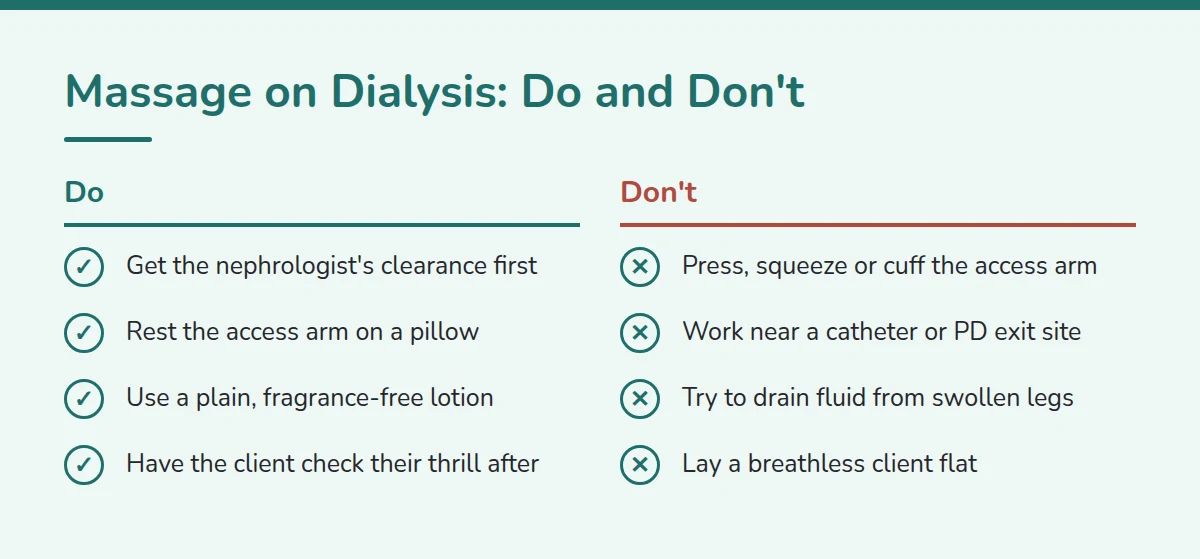
The foundation’s rules are short: no blood pressure cuff on the access arm, no tight sleeves, watches or jewelry over it, no sleeping on it, and no heavy bags or heavy pressure. Even the needle sites get only light pressure after treatment, since pressing hard can slow or even halt the flow through the access.
For a therapist that becomes one absolute rule: the access arm is not part of the massage. No strokes, compression, squeezing or stretching, nothing resting on it, and no lotion over the needle sites. In practice:
- Ask which limb holds the access before you set up, and look before you touch.
- Rest that arm on a pillow with no sheet tucked tight around it, and keep it on top in side-lying, never underneath.
- Leave your own watch and bracelets in the car.
- At the end, ask the client to check the buzz in their access the way their unit taught them. A working fistula or graft has a vibration called a thrill, and if it has stopped or changed, the foundation says to call the dialysis unit right away rather than wait for the next treatment.
Clients not yet on dialysis may be saving an arm for a future access, with no blood pressure readings, blood draws or IVs on that side. Ask, and give a saved arm the same respect. If an access bleeds during a visit, press steadily with clean gauze or a clean towel, and get emergency help if the bleeding is heavy, spurting or will not stop.
Catheters, Belly Fluid and Where Not to Work
A hemodialysis catheter is a soft tube in a large vein in the neck, chest or groin, often used while a fistula heals or when dialysis has to start quickly, and it carries a higher risk of infection. The foundation’s rules are to keep the dressing clean and dry and never to pull, twist or tug the line. Work well clear of it, keep oil and lotion away, and never put a client face down on a chest catheter. A dressing that gets wet or loose during a visit is something the unit needs to hear about that day.
Peritoneal dialysis puts the catheter in the belly, its exit site usually a little below the navel and off to one side. Between exchanges the abdomen holds dialysis solution, which NIDDK notes can leave people feeling bloated. For these clients abdominal massage is off the table, face down is often uncomfortable, and the exit site stays covered, dry and untouched.
Swelling and Breathlessness Are the Unit’s Job
Healthy kidneys remove extra water around the clock. On dialysis, fluid builds up between treatments, which is why clients live with fluid limits and why NIDDK counts less swelling and less shortness of breath among the signs that treatment is working.
That swelling is not a massage problem to solve. The only exit for the fluid is dialysis, and massage can at most move it around. Manual lymphatic drainage, or any work meant to push fluid back toward the heart, needs the nephrologist’s explicit sign-off, the same standard our aged care guide applies to swelling from heart, kidney or liver failure. Work puffy ankles lightly, if at all, and treat new swelling in one calf with pain, warmth or redness as a possible clot that needs a doctor first.
A client carrying extra fluid may breathe more easily propped up, so never insist on lying flat. Chest pain, trouble breathing, fainting and severe weakness are on the foundation’s list of symptoms that need a call right away, and in a living room that means stopping the session and calling 911.
Itchy, Dry, Easily Damaged Skin
Itch is among the most common and least discussed symptoms of kidney failure. In DOPPS data from 18,801 hemodialysis patients, Pisoni and colleagues found that 42% had moderate to extreme itch, and those patients were more likely to feel drained and to sleep poorly, which ties the itch straight back to fatigue. A 2025 clinical review by Latus and colleagues puts moderate to severe itch at 31% to 40% of patients, often on the back, limbs, chest and head, with dry skin common and likely to make it worse. NIDDK adds that high phosphate levels can make skin itch and weaken bones.
For the session:
- A plain, fragrance-free lotion or the client’s own prescribed cream.
- Slow, broad strokes rather than brisk friction or anything that feels like scratching.
- A look at the skin first, and no work over scratch marks, scabs or broken skin.
- A question about blood thinners, with lighter pressure if the answer is yes.
- Moderate pressure over bone, and no forceful joint work.
Gentle massage may even calm the itch. Khorsand and colleagues gave 57 itchy hemodialysis patients a seven-minute hand massage six times over two weeks, with or without violet oil, and both groups reported less itch and dryness. Note which hand they massaged: the one without the fistula.
Book the Day After Dialysis, Not the Day Of
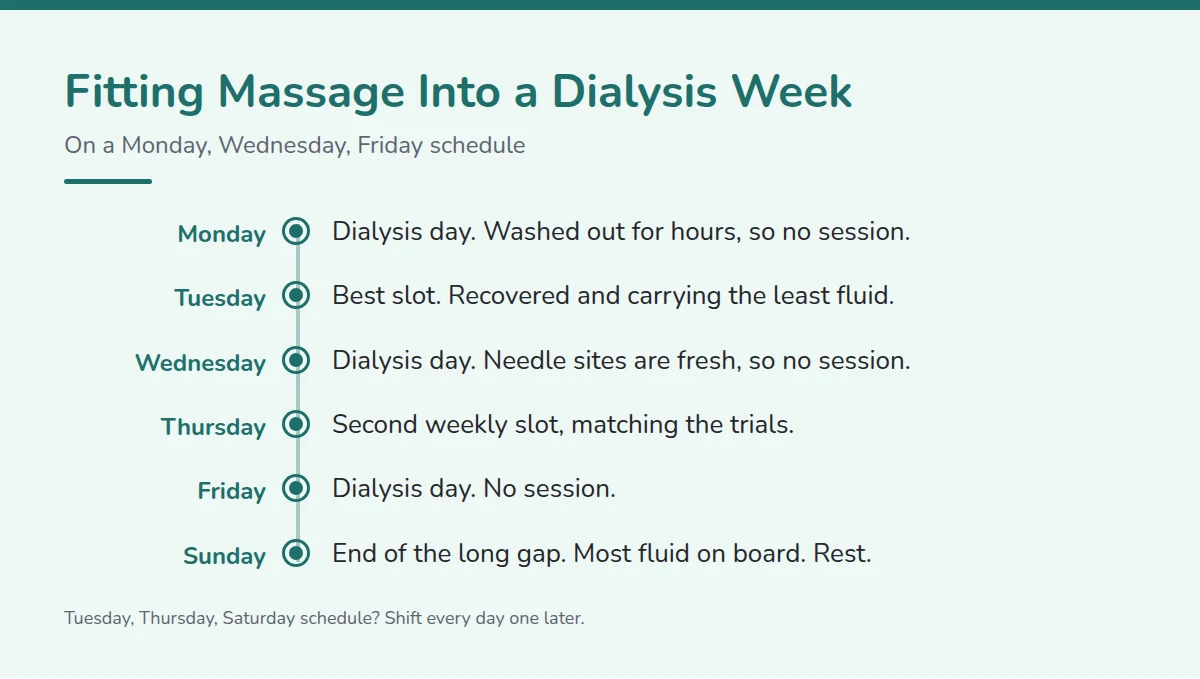
For a home visit, the default is no massage on a dialysis day. NIDDK notes that standard hemodialysis can leave people wiped out for hours afterward, and the fast fluid and chemical swings of a session can bring on cramping and low blood pressure that leaves people weak, light-headed or queasy. The needle sites are hours old. Treatment also needs an anticoagulant, often a form of heparin, to stop blood clotting in the machine’s circuit, a balance the 2024 Cochrane review by Natale, Palmer and colleagues frames as preventing clots while keeping bleeding to a minimum. The trials that massaged patients at the unit had clinical staff a few steps away. At a home visit, you are on your own.
The other end of the week has its own problem. Fluid builds between treatments, and most of all across the two-day weekend gap. Foley and colleagues followed 32,065 US hemodialysis patients and found that deaths and cardiovascular hospital admissions were both higher on the day after that long gap than on other days, with the admissions more than twice as high. Treat the last day of the long gap as a rest day.
That leaves the day after a treatment, when most people have recovered and carry the least fluid of the week: Tuesday and Thursday on a Monday, Wednesday and Friday schedule. Ask which hour of that day the client feels best and keep the slot every week. Twice a week matches the trials, and once a week is a fair start. Forty-five minutes is plenty for a first visit.
Home treatment changes the rhythm. Someone on peritoneal dialysis drains and refills several times a day, each exchange taking 30 to 40 minutes, or uses a machine overnight, so book between exchanges and ask how full they feel. Home hemodialysis schedules vary, so ask for the calendar rather than assuming. And write a medical exception into your cancellation policy from day one, because access procedures, hospital stays and changed dialysis slots come with this client.
Positioning When Lying Flat Is Not an Option
A face-down hour on a portable table is often the wrong default here. A belly full of dialysis solution, a chest catheter, an access arm that cannot take weight and breathing that is easier propped up all argue against it.
The client’s own recliner. If there is one, use it. Feet, lower legs, the hand without the access, the scalp and the face are all within reach while the client stays semi-upright, and you can work from a low stool by the footrest.

Side-lying. This is the position the Chinnusamy patients found most comfortable for back massage: access arm on top on a pillow, a pillow between the knees, and a head pillow thick enough to keep the neck level.
Seated and leaning forward. For the shoulders and upper back, the client sits at their own table and leans onto stacked pillows, with the access arm resting free beside them rather than folded under the head.
Face down only if the client is comfortable there, with no chest catheter or full belly and nothing pressing on the access arm.
If the feet are part of the plan, as they were in most of these trials, ask about diabetes. The CDC says about half of people with diabetes have some nerve damage, most often in the feet and legs, which can dull the sense of pain, heat or cold and let a cut or blister go unnoticed. Look at both feet first, skip heat on numb feet, and if you find a sore or wound, leave that foot alone and ask the client to show it to their care team.
Getting up is part of the session. Low blood pressure can make people faint or more likely to fall, so have the client sit for a minute before standing, and stay close while they do.
Clearance Before the First Session
Kidney failure on dialysis needs a physician’s clearance before any massage, with no exceptions. Ask the client or family to get it in writing from the nephrologist or the dialysis unit, covering:
- The type of access, which limb it is on, and whether any arm is being saved.
- Any catheter, and where it sits.
- Fluid limits, swelling or breathlessness to work around.
- Blood thinners.
- Bone disease, diabetes, nerve damage in the feet, or heart conditions.
- Whether lymphatic drainage or other fluid-moving work is permitted.
- How long the client usually takes to recover after treatment.

Agree on the stop signs before you need them. Chest pain, trouble breathing, fainting, severe weakness or access bleeding that will not stop means ending the session and calling for emergency help. A fistula or graft that has stopped buzzing, or a catheter dressing that is wet, loose or off, means calling the dialysis unit straight away, not at the next treatment.
Hold the scope line in your language too. Massage does not filter the blood, flush toxins or do any part of what dialysis does, and it replaces nothing in the treatment plan, from fluid limits to medicines. Scope of practice varies by state, and your practice act governs what you may claim as well as what you may do.
For Therapists Weighing the Renal Niche
If you have worked from our cancer guide, do not carry it across wholesale. Renal disease is a separate condition set: the governing precaution is vascular access, not lymph nodes or treatment cycles, and dialysis days set the rhythm of the week. A workable service looks like this:
- A standing slot on the client’s best non-dialysis day, sold as a course rather than a one-off.
- Short sessions built around the feet, the free hand and side-lying back work.
- The access limb, any catheter site and the clearance date on the client file, checked at every visit, because access sites and dialysis slots change.
- A good line to whoever handles the booking. The average patient in Foley’s national sample was 62, and the person who calls you may well be a spouse or an adult child.
The Honest Pitch
Massage will not fix dialysis fatigue, and nobody should sell it as if it could. The best review available rates the evidence low certainty, built on short trials of foot, hand and back massage. What that evidence does support is a gentle, regular course, timed for the day after treatment, that stays away from the access arm, the catheter and the swollen ankles, and asks nothing of a client whose week is already spent except that they stay where they are.
Sources
- Natale and colleagues on Cochrane’s review of interventions for fatigue in people on dialysis
- Rayner and colleagues with how long hemodialysis patients take to recover from a session
- Çeçen and Lafcı testing hand and foot massage for fatigue in a dialysis unit
- Unal and Balci Akpinar comparing foot reflexology with back massage for fatigue and sleep
- Chinnusamy and colleagues for side-lying back massage combined with foot reflexology
- Şahan and Güler pooling eight trials of foot reflexology for dialysis fatigue
- National Kidney Foundation on caring for a fistula, graft or catheter
- NIDDK on what to expect from hemodialysis and how peritoneal dialysis exchanges work
- Pisoni and colleagues with international DOPPS results on itch in hemodialysis
- Latus and colleagues for a clinical road map to kidney-related itch
- Khorsand and colleagues testing hand massage for itch and dry skin on dialysis
- Natale, Palmer and colleagues on anticoagulation during long-term hemodialysis
- Foley and colleagues on deaths and admissions after the long weekend gap
- CDC with how diabetes affects feeling in the feet
Further reading
- Mobile Massage for Cancer Patients: An Evidence-Based In-Home Guide
- Mobile Massage in Aged Care: Bringing Wellbeing Home to Seniors
- What the Research Actually Says About Massage: An Evidence Guide for Clients
- Essential Oils on the Road: Aromatherapy Scope, Evidence, and Scent in Someone Else’s Home
- The Mobile Massage Policy Handbook: Cancellations, Deposits, No-Shows, and House Rules