Massage for Endometriosis and Chronic Pelvic Pain: What a Mobile Therapist Can Safely Offer at Home
Published on September 15, 2026
The Client Who Has Been Told to Live With It
Endometriosis affects roughly one in ten women and girls of reproductive age worldwide, around 190 million people by the World Health Organization’s estimate. There is no cure. Treatment aims at controlling symptoms, and for a large number of women it only partly succeeds. The diagnosis itself arrives late, on average somewhere between four and twelve years after the symptoms start, partly because confirming it has traditionally required surgery. Many of the people booking you have spent years being told that bad periods are normal.
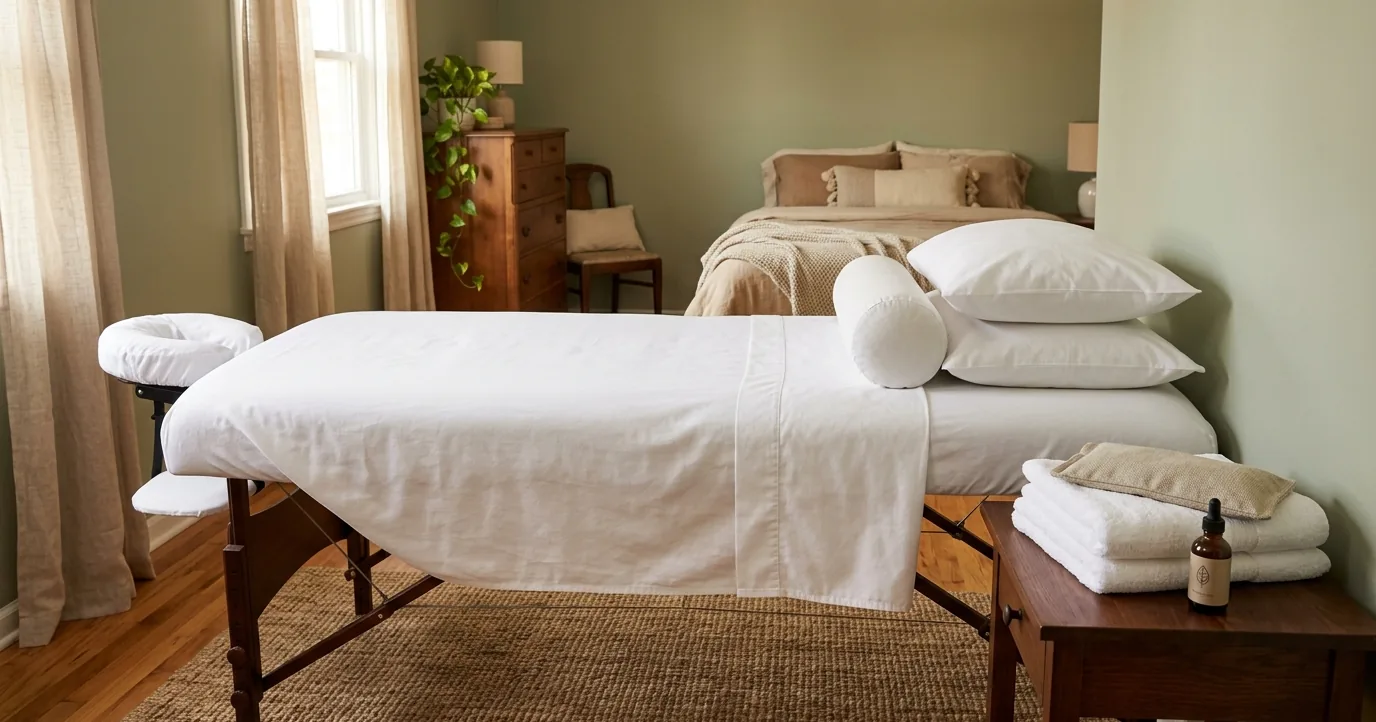
That is the client who calls a mobile therapist. On a flare day, the drive to a spa is the part of the appointment she cannot do. Getting dressed, sitting upright in a car, walking through a reception area and lying on a table someone else set the height of are all obstacles standing between her and the thing that might help. A therapist who arrives at the house removes every one of them, and can also reschedule around a cycle rather than around a calendar.
The question is what you can honestly offer once you get there. The answer is narrower than the marketing in this corner of wellness suggests, and more useful than nothing.
What the Trial Actually Found
The study that put this on the map is a 2024 randomized controlled trial from the University of Granada, published in Medicina. Forty-four women with endometriosis-related chronic pelvic pain that had not responded to conventional treatment were randomized into a four-week program combining hydrotherapy and Swedish massage in a multisensory immersive environment modelled on a hammam, or into a control group.
The results are genuinely encouraging and genuinely limited, and both halves matter. Menstrual pain improved with a large effect size. Pain during intercourse improved with a moderate one. Pain interference with sleep improved, as did pressure pain thresholds measured in the pelvic region, which is an objective measure rather than a self-report. Adherence was 100 percent, mean satisfaction was 9.71 out of 10, and no notable health problems occurred during the trial.
Now the part most summaries leave out. The program produced no measurable effect on pain catastrophizing, no effect on subjective well-being, and no effect on overall quality of life apart from the sleep subscale. Forty-four participants is a small sample. And the intervention tested was a package: warm water, a heated multisensory room, and massage together. Nobody isolated the massage.
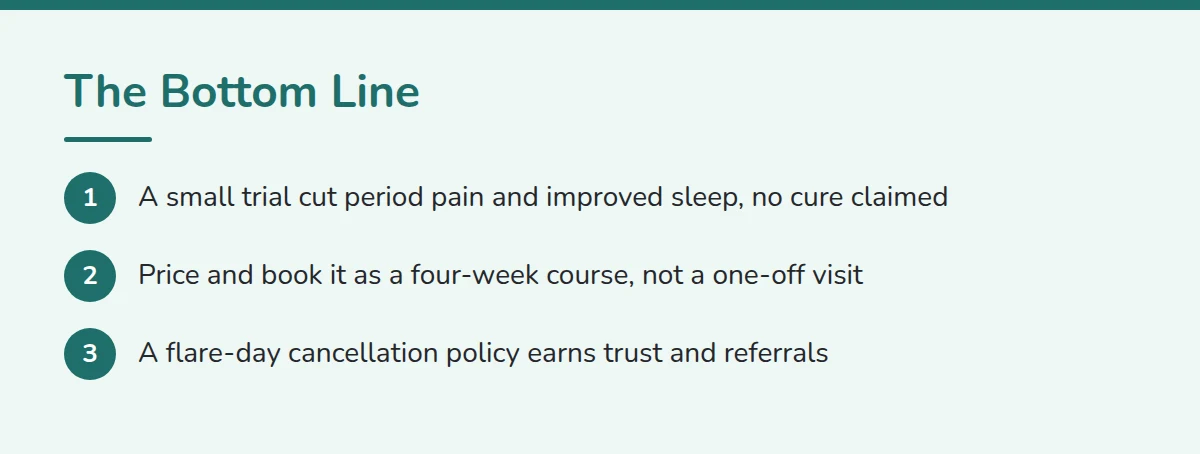
So the defensible sentence to a client is this. A four-week program of warmth and Swedish massage reduced period pain and pain during sex in a small trial of women whose standard treatment had stopped working, and improved how much pain interfered with their sleep. It did not change their overall quality of life, and it was not massage alone. Anything stronger than that is overselling, and clients with endometriosis have usually been oversold to before.
The Wider Evidence on Period Pain
A handful of other trials point the same direction, with the same caveat that they studied primary dysmenorrhea rather than endometriosis. The two conditions are not interchangeable: primary dysmenorrhea is painful menstruation without underlying disease, and endometriosis is disease.
Toprak Celenay and colleagues, writing in the Journal of Manipulative and Physiological Therapeutics, randomized 38 women to connective tissue massage or classic massage, applied five days a week from the estimated date of ovulation to the start of the next period. Both groups saw menstrual pain intensity and duration fall, along with medication use and scores on a functional and emotional dysmenorrhea scale. Connective tissue massage did better on pain duration, function and sleeplessness. Ozturk and colleagues, in Health Care for Women International, randomized 63 students to abdominal massage, stretching exercise or control, and found massage helped abdominal and back pain and fatigue, though visual analog pain scores did not separate between groups.
Read as a set, these are small studies with real but modest findings, which is the honest shape of most massage research. Our guide to what the research actually says about massage covers why the studies in this field are so hard to run well and how to read one before you quote it to a client.
What You Are Actually Working On
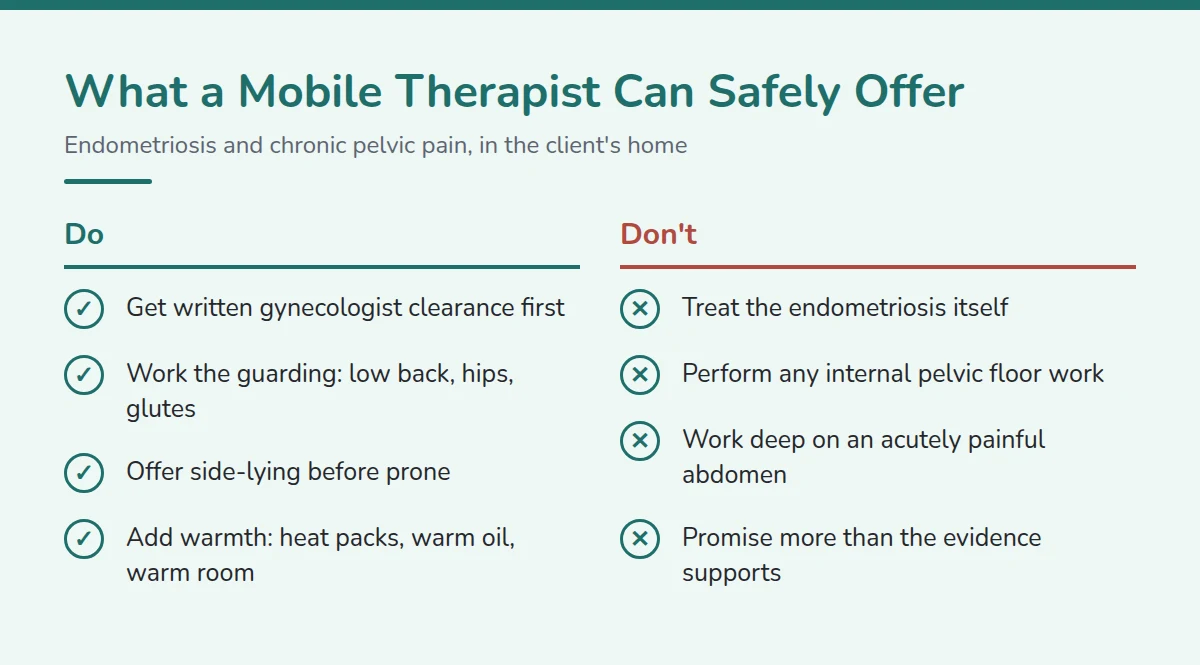
Here is the reframe that makes this work make sense. You are not treating endometriosis. Lesions, adhesions and hormonal drivers are a gynecologist’s territory and nothing you do with your hands will touch them.

What you are working on is everything the body has done in response. Years of pain produce years of guarding. The abdominal wall stays braced. The quadratus lumborum and the thoracolumbar erectors take up the slack. Hip flexors shorten from curling up on the bad days, the adductors and glutes get involved, and the whole pattern feeds back into more pain and worse sleep. None of that is endometriosis, and all of it is squarely within massage scope.
That distinction protects your client and it protects you. Soft tissue work on a guarded, overworked, chronically braced musculoskeletal system is a real intervention with a real rationale. Claiming to shrink a lesion is not.
Clearance, Intake, and the Line You Do Not Cross
Chronic pelvic pain needs a diagnosis before it needs a massage therapist. Get written clearance from the treating gynecologist before the first session, the same standard applied to any condition-specific work in our in-home pain management guide. If the client has pelvic pain and no diagnosis at all, that is a referral, not a booking.
Your intake needs to ask: the diagnosis and how it was confirmed, current medications including hormonal treatment and anticoagulants, any surgery and when, whether pregnancy is possible, where the pain actually sits and what makes it worse, bowel and bladder symptoms, and where she is in her cycle today.
Then the hard line. Internal pelvic floor work is not massage therapy. In most states it sits outside the massage scope of practice entirely, and where any practitioner may do it, it belongs to pelvic health physical therapists with specific training and credentialing. Do not do it, do not offer it, and do not let a client who has read about it talk you into it. Refer instead, and you will get referrals back. Scope varies by state and your own practice act is the binding authority, so check it rather than assuming.
Abdominal work sits close enough to a sensitive area that consent has to be explicit and renewable, every session, using the same framework as the rest of your consent and draping standards in a client’s home. Name the region, explain what you intend to do, ask, and re-check during the work.
Red Flags That Stop the Session
Some presentations are a phone call, not a massage. Do not work, and advise medical review, if you encounter:
- Sudden severe one-sided pelvic pain, especially with nausea or vomiting. Ovarian torsion and a ruptured cyst are emergencies.
- Fever, chills, or pain with unusual vaginal discharge, which can signal infection.
- Bleeding that soaks through protection hourly, or any bleeding the client describes as unlike her normal.
- New pain that is different in character from her usual pattern, or pain that has sharply escalated.
- Unexplained weight loss, or a new change in bowel or bladder function.
- Recent abdominal or pelvic surgery without surgical clearance.
- Any possibility of pregnancy that has not been resolved.
Say plainly that you are not the right person today and that you want her seen. Clients with long diagnostic delays are used to being disbelieved, and a therapist who takes a symptom seriously is doing something most of their care has not.
Positioning Around a Flare
Prone is frequently the worst position for this client, because it puts direct pressure on an abdomen that already hurts. Do not make her ask. Offer alternatives first.
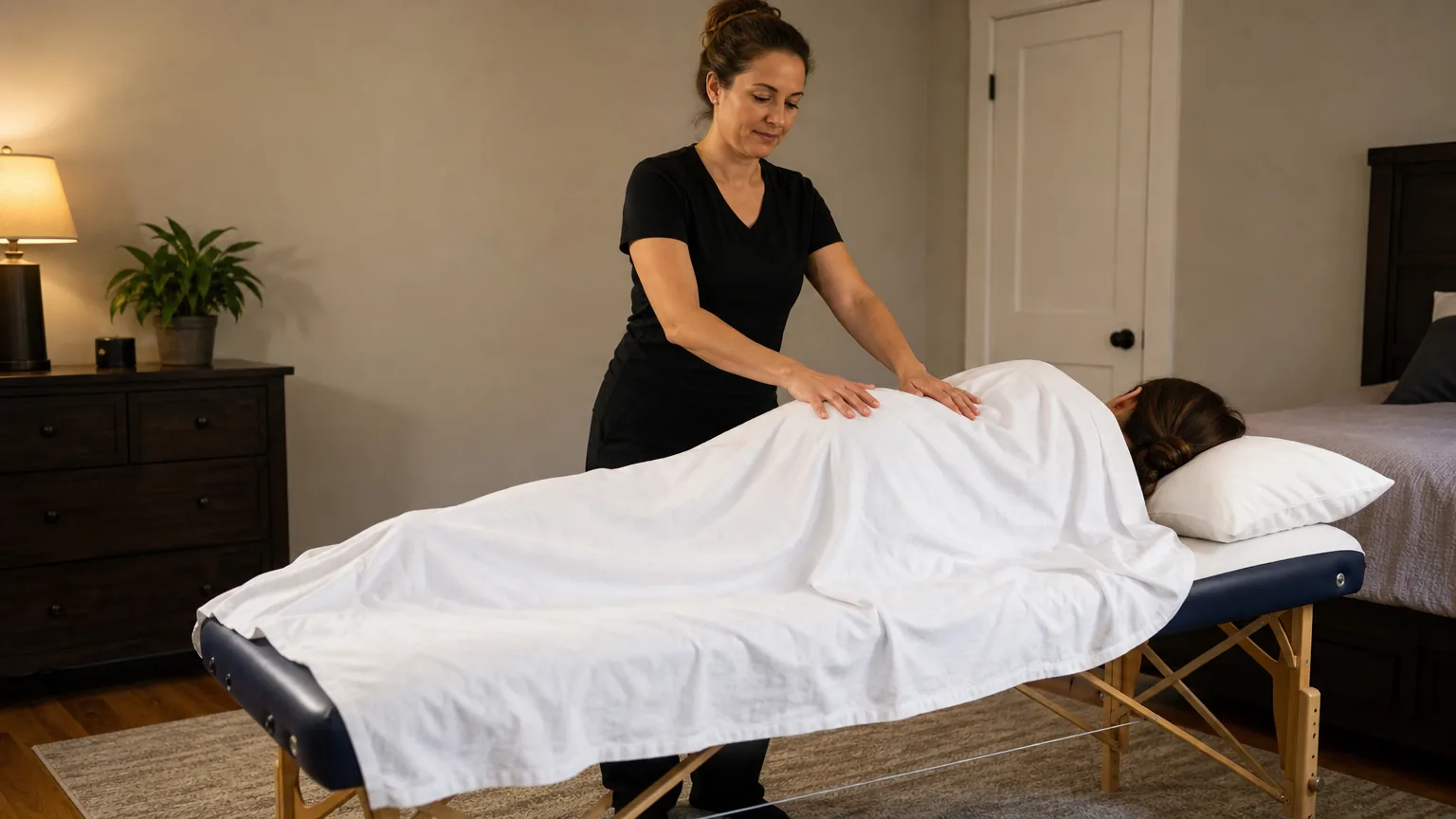
Side-lying, with a pillow between the knees, one supporting the upper arm and often one tucked under the waist, opens up the low back, the glutes and the quadratus lumborum without loading the abdomen. Semi-reclined with the head raised and a bolster under the knees works when hip flexion is what brings relief, and lets you work the neck, shoulders and upper back on a day when nothing below the ribs is tolerable. Keep sessions shorter than usual. Forty-five minutes of well-tolerated work beats ninety minutes she endures.
This is a positioning problem more than a technique problem, so travel with enough support. A decent bolster set, two or three firm pillows and an adjustable face cradle earn their space in the car, and our equipment buyer’s guide covers what actually holds up on the road. Confirm the position works before you start rather than after, and re-offer the alternative if her breathing changes.
Bringing the Warmth Part Home
Warmth was half of what the Granada trial tested, and it is the half a mobile therapist can genuinely reproduce in a bedroom. It also has its own evidence. Akin and colleagues, in Obstetrics and Gynecology, ran a randomized double dummy trial of a continuous low-level abdominal heat patch against ibuprofen for menstrual pain and found topical heat as effective as the drug, with the combination reaching noticeable relief faster than ibuprofen alone.
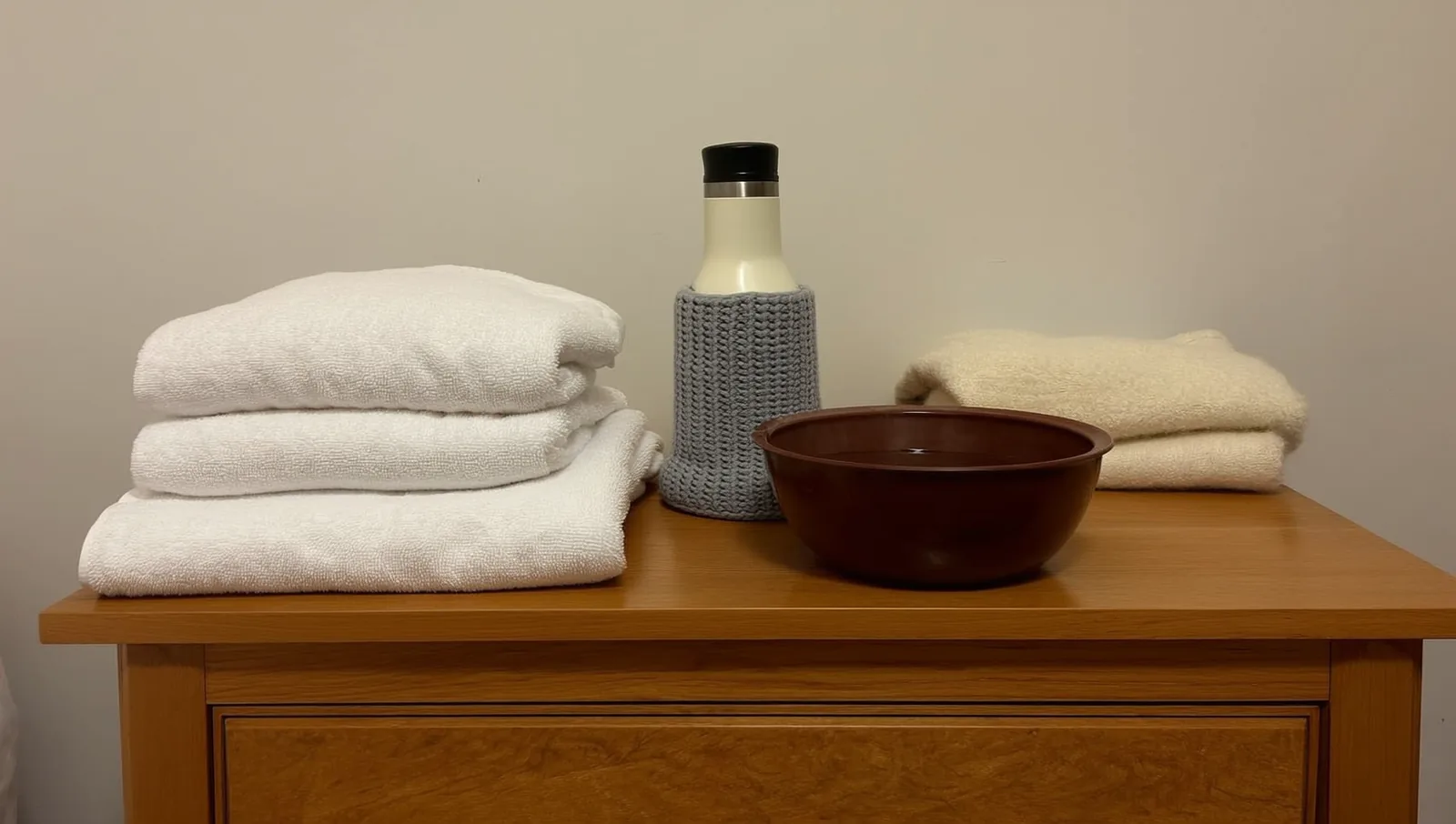
In practice that means: heat the room before she gets on the table, warm your oil, bring extra blankets, and use a covered heat pack over the low back or lower abdomen through part of the session. Hot towels work well and cost nothing. If you already carry stones, the warmth of a hot stone session is a natural fit here, provided the stones stay off the abdomen and away from any area of altered sensation.
Heat safety is not optional. Never apply heat over numb or altered skin, over a recent surgical site, or to a client who cannot reliably tell you it is too hot. Always put a barrier between the pack and the skin, check the skin, and keep it moderate. A burn on a client whose pain nobody has taken seriously is a particularly bad outcome.
Abdominal Work Within Scope
When the client is comfortable and clearance is in hand, gentle abdominal work is reasonable and is what the dysmenorrhea trials were mostly testing. Keep it light, slow and superficial. Follow the direction of the colon, stay off anything that feels firm or resistant, and stop at any increase in pain rather than working through it. Deep or forceful abdominal work has no place here.
Skip abdominal work entirely during an acute flare, over a known cyst or mass, during heavy bleeding if the client prefers, and any time pregnancy is in question. When the abdomen is out, the low back, hips and glutes are still fully available and are often where the useful work is anyway.
Building It Into the Practice
The trial’s structure is the practical lesson: four weeks, repeated sessions, not a one-off. Price and book accordingly, as a short course rather than a single visit, and fold it into your service menu as a considered offering rather than a novelty add-on.
Two operational notes. Write a flare-day cancellation policy that does not punish her for a bad cycle, because a rigid 24-hour rule is exactly wrong for this population and word travels fast in endometriosis communities. And build the referral network deliberately: gynecologists, pelvic health physical therapists, and local or online endometriosis support groups. This fits alongside the rest of a women’s health service line, including postpartum visits and infant massage teaching, where the same households often come back to you years later.
Offer this work honestly and it holds up. You are not curing anything. You are reducing the muscular cost of living with a painful disease, bringing warmth and skilled touch to someone on the day she cannot leave the house, and helping her sleep. That is a real thing to be able to do, and the evidence supports saying exactly that much.
Sources
- Rodríguez-Ruiz and colleagues on the four-week hydrotherapy and Swedish massage trial in endometriosis-related pelvic pain
- Akin and colleagues for continuous low-level topical heat compared against ibuprofen for menstrual pain
- Toprak Celenay and colleagues with connective tissue massage versus classic massage in primary dysmenorrhea
- Ozturk and colleagues testing abdominal massage and stretching against period pain and fatigue
- World Health Organization on how common endometriosis is and why there is no cure
- American College of Obstetricians and Gynecologists for how chronic pelvic pain is defined and assessed
- NICHD on why the condition still has to be confirmed surgically
Further reading
- Mobile Massage for Pain Management: Bringing Relief Home
- What the Research Actually Says About Massage: An Evidence Guide for Clients
- Ethics, Consent, and Draping in the Client’s Home: A Professional Boundaries Guide
- The Healing Power of Hot Stones in Mobile Massage
- Teaching Infant Massage in the Family Home: Scope, Safety, and the Newborn Niche