On-Site and Corporate Mobile Massage: The Complete Guide to Workplace and Event Contracts
Published on August 19, 2026
Why On-Site Work Pays Better Than Residential
A residential mobile appointment has a fixed overhead that never goes away. You drive, you park, you carry the table up a flight of stairs, you set up, you work, you break down, and you drive again. One client, one setup, one fee. On-site corporate and event work breaks that ratio. You drive once, set up once, and then treat eight, twenty, or sixty people from the same square metre of floor. The travel time that eats your margin on residential visits gets amortized across an entire day of billable hands-on work.
That is the whole economic case for moving into B2B, and it is why established mobile therapists tend to end up with a book that is part residential and part contract. It is also work with a different rhythm: you are no longer selling an hour of relaxation to an individual, you are selling an outcome to a company, and companies buy differently. They need a quote, a certificate of insurance, an invoice, and a purchase order. Learning to speak that language is most of the job.
The Five On-Site Markets Worth Pursuing
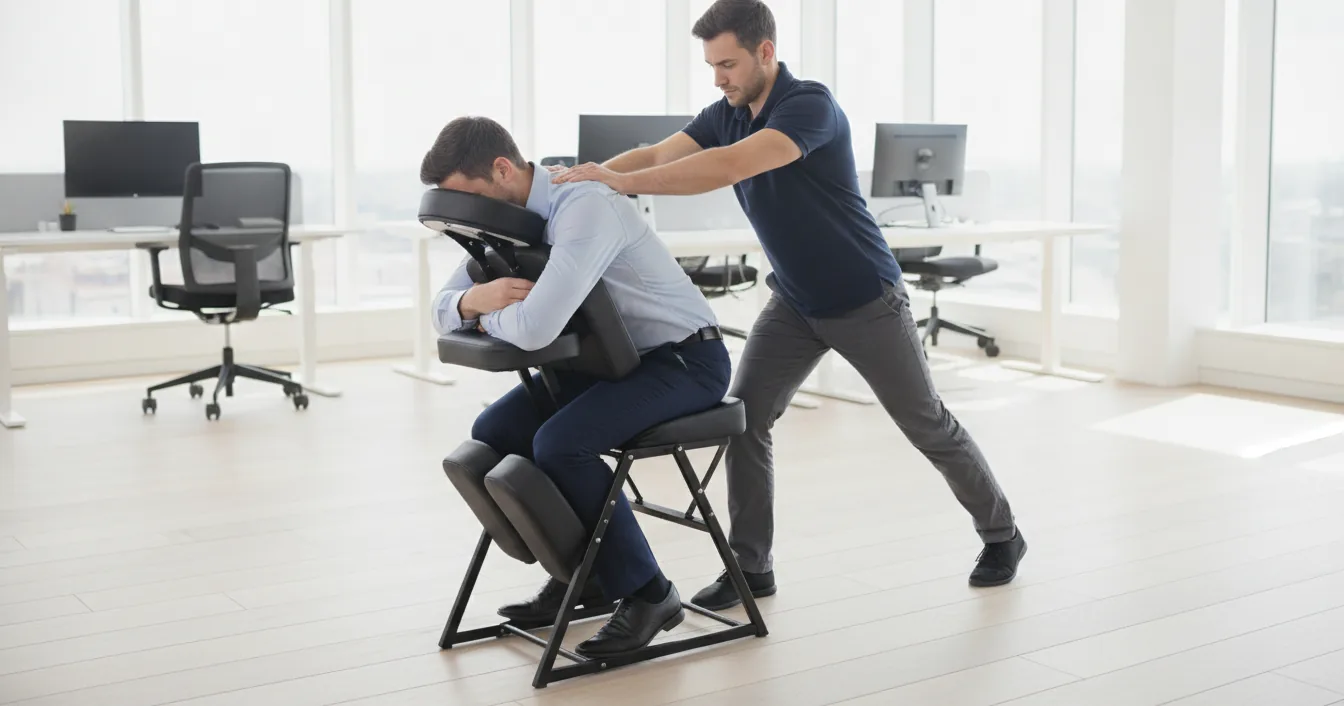
Workplace wellness is the steadiest of the five and the one most likely to recur. The pitch has moved on from perks. Work-related stress, anxiety and burnout now cost the UK economy over 28 billion pounds a year in lost productivity, absenteeism and staff turnover, and the same pattern shows up in high-pressure sectors everywhere: finance, technology, law, and creative agencies. Employers booking chair massage today are increasingly framing it as recovery capacity rather than a treat, which means your proposal should talk about desk-posture strain, focus, and retention, not about pampering.
Conferences and trade shows buy massage as a traffic magnet. A booth with a massage chair pulls a queue, and the queue is the point. These contracts are usually booked by a marketing team or an events agency rather than HR, they pay well, and they often want branded shirts or a lead-capture form built into the flow.
Sports events and festivals are physically demanding and seasonally lucrative. Recovery demand around major festivals is real and increasingly pre-booked: reporting on the Coachella circuit found attendees scheduling their post-festival recovery treatments before they had even left for the desert. Finish lines, marathon expos, and cycling events want fast, clothed, ten to fifteen minute turnarounds.
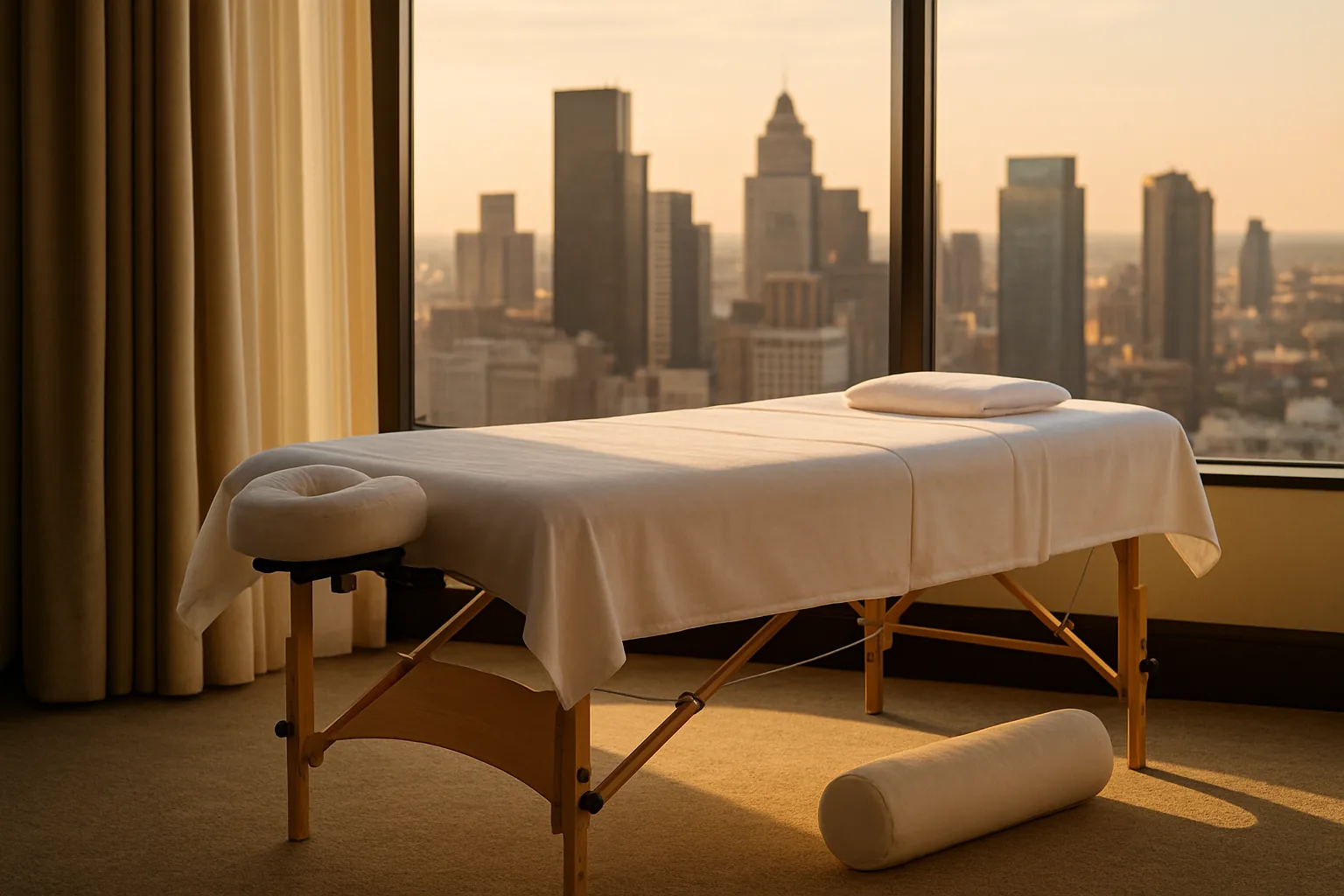
Hotels and luxury travel is the highest per-session rate of the five. Business and high-net-worth travellers increasingly prefer an in-room session to navigating a resort spa, because it removes the shared waiting areas, the fixed appointment slots, and the walk across a property the size of a small town. Las Vegas has become the clearest example of this, where in-room therapy is now written into travel itineraries alongside dinner reservations. These are table sessions, not chair sessions, and they are usually referred through concierge desks, villa managers, or executive assistants rather than booked directly.
Crisis and first-responder relief is not a revenue market, but it belongs on the list because it is real on-site work with real logistics. When wildfires burned through more than 37,000 acres of Los Angeles in January 2025, a wellness brand partnered with the LA Fire Department Foundation and a mobile massage service to send therapists to a first responders base for short sessions between shifts. Deployments like these are usually funded by a foundation or a sponsor rather than by the recipients, and they run on the same contract mechanics as any other event: a named point of contact, an insurance certificate, and a fixed window.
Chair or Table: Let the Setting Decide
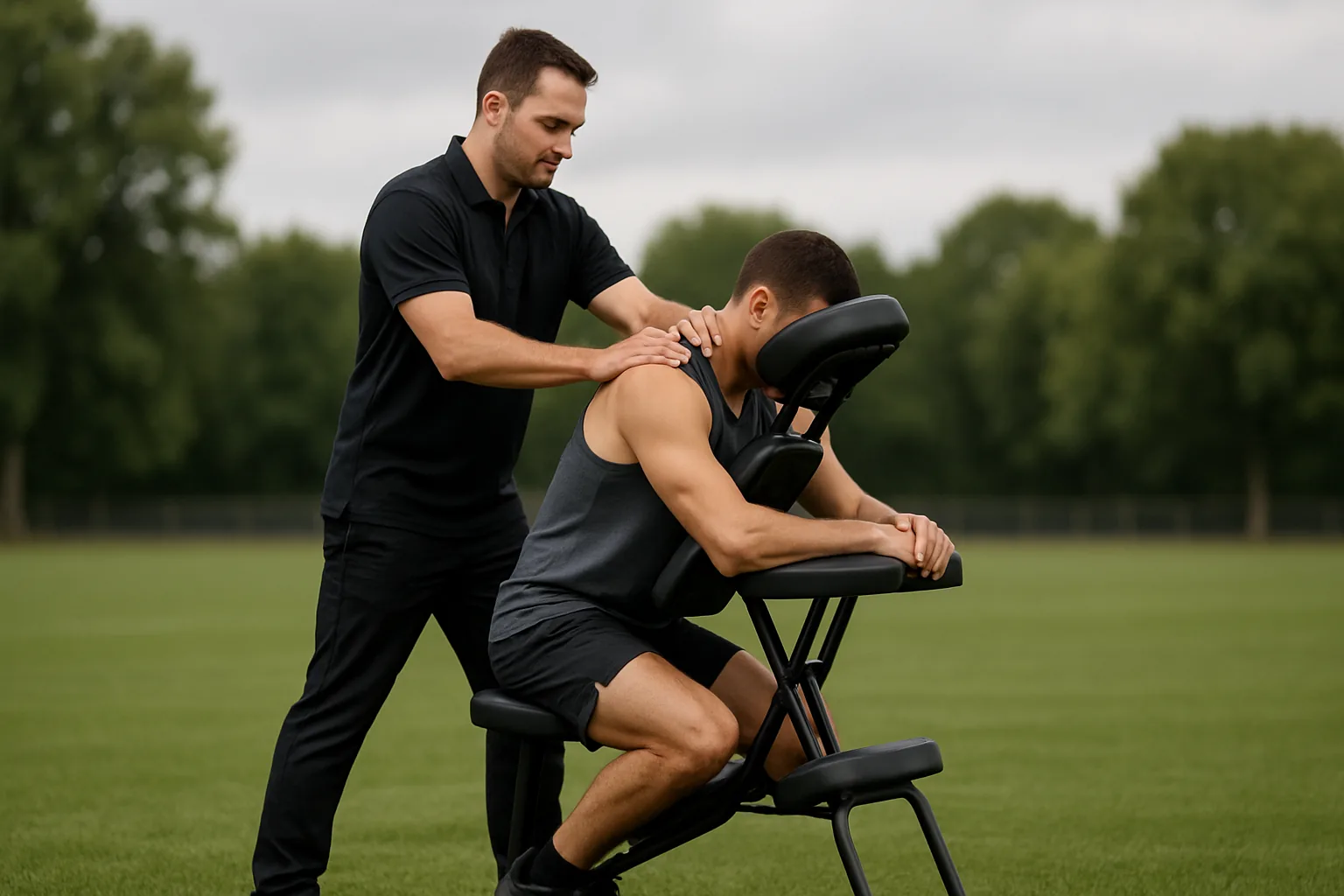
Chair massage is the default for anything with a queue. Clothed, seated, ten to twenty minutes, focused on the upper back, neck, shoulders, arms and hands. It needs about two square metres of floor space, no draping, no oil, and no privacy screen, which is exactly why offices and expo halls can accommodate it at short notice. A good portable chair sets up in about a minute and weighs roughly twenty pounds, and our mobile massage equipment buyer’s guide covers which models hold up to being loaded and unloaded four times a day.
Table work belongs in hotel rooms, executive suites, private offices with a lockable door, green rooms at festivals, and any setting where a full session is being sold to one person. The moment you put a table in a corporate building you inherit a set of requirements the chair does not have: a private room, a place to wash your hands, somewhere to change linens between clients, and a conversation with the client about draping standards so nobody is surprised. Do not let an office manager talk you into table work in an unlockable conference room with a glass wall. The personal safety protocol for mobile therapists applies on a corporate site exactly as it does in a stranger’s living room, and on-site work adds the wrinkle that the person who booked you is often not in the room.
Some operators run both from a converted vehicle. One Long Island practice built a spa on wheels out of a Winnebago and markets it for product launches, grand openings, trade shows, conferences and holiday parties, where the vehicle itself is part of the draw. It is a serious capital commitment, but it shows the ceiling on this market: at the top end, corporate clients are buying spectacle as much as bodywork.
Per Hour or Per Head: Pricing the Contract
There are two defensible structures and one that will hurt you.
Per hour, per therapist is the industry default and the one to quote first. The client buys a block of therapist hours, commonly with a two-hour minimum, and you deliver as many sessions as fit inside it. Rates in most US markets land somewhere between 100 and 160 dollars per therapist hour for chair work, higher for short-notice, evening, or heavily branded event bookings. The advantage is that you get paid for the time you hold open, regardless of whether the sign-up sheet fills.
Per head, per session works when the client is paying only for the employees who actually book. It sounds fairer to the buyer and it is usually worse for you, because a rainy Tuesday with a half-full sheet leaves you underpaid for a full day held. If a client insists on it, protect yourself with a guaranteed minimum: a per-head rate with a floor equal to your hourly block.
Never quote a day rate without a defined session count and end time. Open-ended day rates are how a four-hour booking becomes seven hours of standing.
Whichever structure you use, bill setup, breakdown and travel separately or build them explicitly into the quoted block, and state whether the block starts when you arrive or when the first client sits down. Employer-paid, employee-paid, and split models all exist; employer-paid produces the highest utilisation because nobody hesitates at the sign-up sheet. Our breakdown of how mobile massage services are priced covers the residential side, which is a useful floor: a corporate hour should never net you less than a residential one.
The COI Question, and Everything Else Procurement Will Ask For
The single most common reason a mobile therapist loses a corporate booking is that they cannot produce a certificate of insurance fast enough. Larger clients will ask for a COI showing general liability and professional liability, frequently at one million dollars per occurrence and two million aggregate, with the client entity named as an additional insured. That endorsement is a specific request you make to your insurer, not something that appears automatically, and it can take a few days to issue. Get a template COI in hand before you pitch, not after you win.
Expect to be asked for some combination of the following: a W-9, a signed vendor agreement, proof of your massage licence in the state where the work happens, and evidence of workers’ compensation coverage if you are bringing other therapists. Facilities teams often add their own layer: a building access form, a badge request, or a site induction.
Two compliance points catch people out. First, licensure follows the location of the work, not your home base. An event three hours away in a neighbouring state means you either hold a licence there or you do not take the booking. Reciprocity is uneven and some states have no meaningful pathway for short visits. Our state licensing and scope of practice guide lays out how to verify this before you sign anything. Second, some municipalities require an event or transient vendor permit for on-site services, which the venue may or may not handle for you. Ask in writing who is responsible.
Lead Times, and What Goes In the Contract
Workplace wellness days are typically booked two to six weeks out. Conferences and trade shows book three to six months out, because exhibitor packages are locked early. Festivals and large sports events book on the same long cycle. Hotel and concierge work is the exception and runs on same-day or next-day requests, which is why it commands a premium.
Whatever the lead time, put the following in writing every time: the number of therapists and hours, the session length and total session count, the exact address and room, arrival and start times, who provides tables, chairs and power, the cancellation window and fee, the payment terms in days, and a rain or relocation clause for anything outdoors. Add a short line on what you need from them: a defined space, a nearby hand-washing facility, and a named on-site contact who will be reachable on the day.
Scaling Staff Without Losing the Contract
A twenty-therapist festival is a different business from a solo chair booking, and the thing that breaks is never the massage. Plan roughly one therapist per fifteen to twenty employees for a standard office wellness day running fifteen-minute sessions, and appoint a lead therapist for anything over three practitioners. That lead does not treat clients; they run the schedule, meet the venue contact, and absorb the problems.
The classification question is genuinely consequential. Setting the hours, providing the equipment, and directing how the work is done may point toward employee status, but classification depends on the full working relationship and the applicable jurisdiction. Misclassification penalties can dwarf the margin on any single event. Take advice on this before your first multi-therapist booking, not after. Verify every therapist’s licence and insurance yourself rather than trusting a screenshot, because the contract is in your name and so is the liability.
Landing the First One
Corporate work compounds. One well-run wellness day inside a company of four hundred people produces the referral to the next department, and event agencies reuse vendors who show up early and leave the space clean. Start with the organisations you already touch: the gym that sends you clients, the office where three of your residential regulars work, the race director you met at a finish line. Lead with a one-page proposal and a ready COI rather than a rate card, and treat your first contract as the audition it is. The marketing playbook for mobile therapists covers the seasonal timing, and the short version is this: pitch corporate wellness in late summer for autumn delivery, when budgets are being set and consumer bookings are slow anyway.
Sources
- London Business News on mobile massage as a productivity tool for city professionals
- AZ Big Media for why in-room therapy has become standard for luxury travellers
- Essence on massage teams deployed to a first responders base during the LA wildfires
- The Hollywood Reporter for how festival crowds pre-book their recovery
Further reading
- The Mobile Massage Equipment Buyer’s Guide: Tables, Chairs, and Everything In Between
- State Licensing and Scope of Practice: A Mobile Therapist’s Compliance Guide
- Understanding the Price Range of Mobile Massage Services
- Personal Safety for Mobile Massage Therapists: A Comprehensive Protocol
- The Complete Marketing Playbook for Mobile Massage Therapists