The Mobile Massage Money Guide: Business Structure, Bookkeeping, and Taxes for Solo Therapists
Published on October 5, 2026

The Back Office Comes With the Job
More massage therapists work for themselves than in any single industry. The Bureau of Labor Statistics counts 36 percent of the occupation as self-employed, a larger share than work in personal care services such as spas and salons (33 percent). Each of them is also running a small business.
Mobile work makes that business busier than a studio’s. Money arrives as cash on a kitchen counter, card taps at the door, app transfers, platform payouts and corporate invoices, and it leaves as fuel, linens, lotion, insurance, training and a table that slowly wears out. This guide is for therapists who are already earning: how to structure the business, keep books in twenty minutes a week, pay tax on time and claim what the work genuinely costs. Figures are federal and current for 2026. State rules differ, and an accountant who knows your numbers beats any article, this one included.
Sole Proprietor, LLC, or S Corporation
Start taking clients without filing any paperwork and you are a sole proprietor. You and the practice are legally the same: profit goes on Schedule C of your personal return, and, in the Small Business Administration’s plain words, you can be held personally liable for the debts and obligations of the business. Plenty of solo therapists start there, and our first-year roadmap for launching a mobile practice walks through that setup in order.
A single-member limited liability company puts a wall between the business and your house, car and savings if the business is sued or cannot pay its debts. For federal tax it changes nothing by default. Treasury regulations treat a one-owner LLC as disregarded as an entity separate from its owner, so you still file Schedule C, and the SBA notes that LLC members still owe self-employment tax.
What an LLC does not do is shield you from your own work. New York’s law on professional LLCs spells it out: each member stays personally and fully liable for negligent or wrongful acts they commit while rendering professional services. A client hurt on your table can pursue you, not just the company, which is why professional liability insurance stays non-negotiable under every structure. Some states also require licensed professionals to form a professional LLC, so check with your secretary of state before filing.
The wall has a price that varies by state. California charges every LLC an $800 annual tax, due each year whether or not the business earns anything, until the LLC is cancelled. Weigh that against the protection, and give the LLC its own bank account: the SBA notes that keeping business funds apart from personal funds is itself a layer of liability protection.
When an S Corporation Election Pays
An S corporation is a tax election, not a different kind of business, and an LLC can make it. You become an employee of your own company, pay yourself a salary through payroll and pay payroll taxes on it. Profit above the salary reaches you as a distribution, free of self-employment tax. That gap is the entire appeal.
The salary has to be reasonable, and the IRS can challenge one that is not. In a 2012 Eighth Circuit case, a certified public accountant’s S corporation took in $203,651 and $175,470 of firm profits over two years, paid the accountant a $24,000 salary each year and distributed what was left after expenses as dividends. The government’s expert valued the accountant’s services at about $91,044 a year, and the courts treated the gap between that figure and the salary as wages subject to payroll tax. Massage therapists have public data for a defensible number: the BLS puts the occupation’s median annual wage at $58,450.
Run the numbers before paying anyone to set one up. A sole proprietor with $90,000 of profit owes about $12,700 in self-employment tax (15.3 percent on 92.35 percent of profit). An S corporation paying that $58,450 median as salary owes about $8,900 in payroll taxes on it, employer and employee halves together. The most the election could save is roughly $3,800 a year, before payroll processing, a separate corporate return and any state fees. Net nearer the median and there is nothing left to split off, so the election only adds cost. Distributions also do not count toward Social Security, so a smaller salary means a smaller future benefit. Revisit the question when your profit runs well above a fair salary for your hours, and work it through with a CPA or enrolled agent.
Separate the Money First
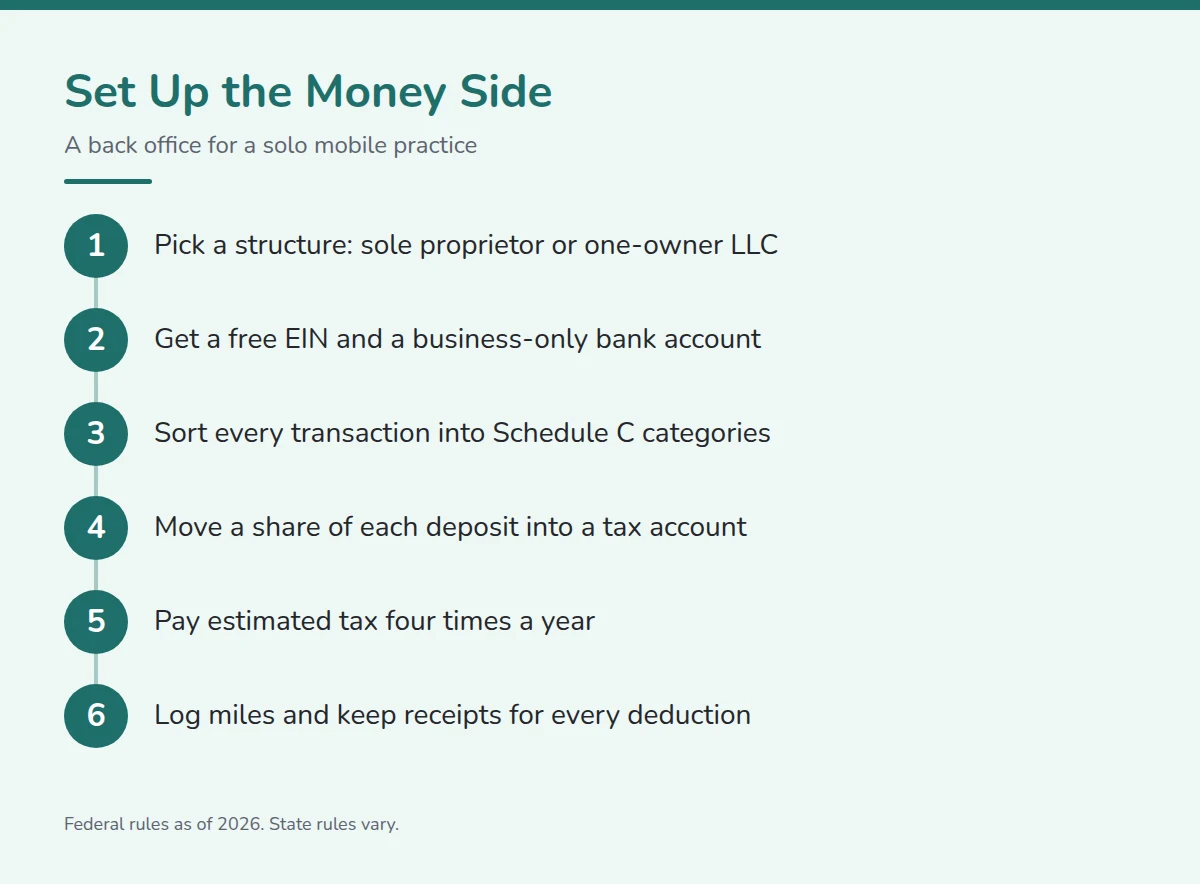
Clean books start with plumbing. An Employer Identification Number is free from the IRS and keeps your Social Security number off the W-9 forms corporate clients ask for. To open a business account, banks typically want the EIN (or your Social Security number if you are a sole proprietor), your formation documents and your business license. Then set up four things:
- A business checking account that every payment lands in and every business expense leaves from.
- A card used only for business purchases.
- A business profile on each payment app, so a friend repaying you for dinner never shows up as a sale.
- A savings account that holds tax money and nothing else.
Pay yourself by transfer to your personal account. A sole proprietor is not an employee of the business, the IRS notes, so your own salary and personal withdrawals are not deductible. A draw is just profit leaving the business.
Move a fixed share of every deposit into the tax account the day it lands. Self-employment tax alone takes about 14 cents of every dollar of profit before income tax starts, and your federal bracket and any state tax come on top. Whatever percentage your accountant sets, automating it is what makes quarterly payments painless.
A Chart of Accounts Built for Mobile Work
A chart of accounts is the list of categories every transaction gets sorted into. Build yours from the Schedule C expense lines and tax season becomes copying totals instead of reconstructing a year.
Track income separately as:
- Session fees from your own clients
- Platform payouts
- Corporate and event contracts
- Tips, kept apart from fees
- Cancellation and no-show fees
- Gift certificates sold, so you know how many hours of work you still owe
Name expenses the way Schedule C does, so each total drops straight onto the form:
- Car and truck expenses: your mileage log, or actual costs
- Commissions and fees: platform commissions and card processing
- Depreciation and section 179: equipment too costly to deduct in one go
- Insurance: professional and general liability premiums
- Legal and professional services: your accountant and any attorney
- Supplies: lotions, oils, linens, face cradle covers, sanitizer
- Taxes and licenses: license renewals and local business licenses
- Other expenses: continuing education, booking software, laundry, association dues

Spend twenty minutes a week categorizing transactions and attaching receipt photos, and reconcile against the bank statement monthly. Keep everything, mileage log included, for at least three years after you file, since that is how long the IRS generally has to assess more tax. Keep equipment and vehicle purchase records until that window has closed on the return for the year you sell or retire them.
Cash, Cards, Apps, and Platforms
Every dollar you are paid is income, whether or not a tax form reports it. The forms are the IRS’s cross-check, so your books need to explain each one.

Form 1099-K. Payment apps and online payment networks file a 1099-K once your payments through them exceed $20,000 and 200 transactions in a year, the threshold a 2025 law restored when it scrapped the planned drop to $600. Card payments processed through a merchant bank have no minimum at all. The IRS warns that a 1099-K total may not be the amount you should report, since it can include items that are not your receipts and miss some that are, so reconcile it against your books rather than copying it.
Form 1099-NEC. A business that pays you for services, such as an employer wellness program, an event company or a clinic that books you as a contractor, files a 1099-NEC once it pays you $2,000 or more in a year (for payments from 2026 on; the threshold used to be $600). Individual clients do not send one. When a business pays by card or app, the payment goes on the processor’s 1099-K instead, so the same money does not land on two forms. Our guide to on-site and corporate massage contracts covers how those engagements are quoted and invoiced.
Platform payouts. Check whether a platform reports your gross bookings or the net it paid you. If gross, report gross and deduct its commission. If net, the commission is already gone, and deducting it would count it twice. The full economics are in our guide to platform versus independent mobile practice.
Cash. Record it the day you receive it and deposit it whole, so your deposits and your books tell the same story.
Tips. Tips are business income, and not a small line: Treasury’s analysis of 2023 wage records found that tips made up 25.7 percent of pay for massage therapists who reported them. Massage therapists are on Treasury’s final list of tipped occupations for the temporary federal deduction of up to $25,000 a year (2025 through 2028, reduced at higher incomes). The law excludes tips earned in a specified service business, but until Treasury finalizes rules on that exclusion, the IRS treats listed occupations, self-employed workers included, as outside it. For the self-employed, the deduction cannot exceed the business’s net income, and because it is claimed on Schedule 1-A rather than Schedule C, it cuts income tax but not self-employment tax. Only voluntary tips count, one more reason to log them apart from fees.
Self-Employment Tax and Quarterly Payments
Nobody withholds tax from a mobile therapist’s fees, so you pay as you go. Self-employment tax is Social Security and Medicare for people without an employer: 15.3 percent (12.4 percent for Social Security, 2.9 percent for Medicare) on 92.35 percent of net profit, owed once net earnings reach $400. The Social Security part stops at $184,500 of combined earnings for 2026, and half the tax comes back as a deduction on your return.
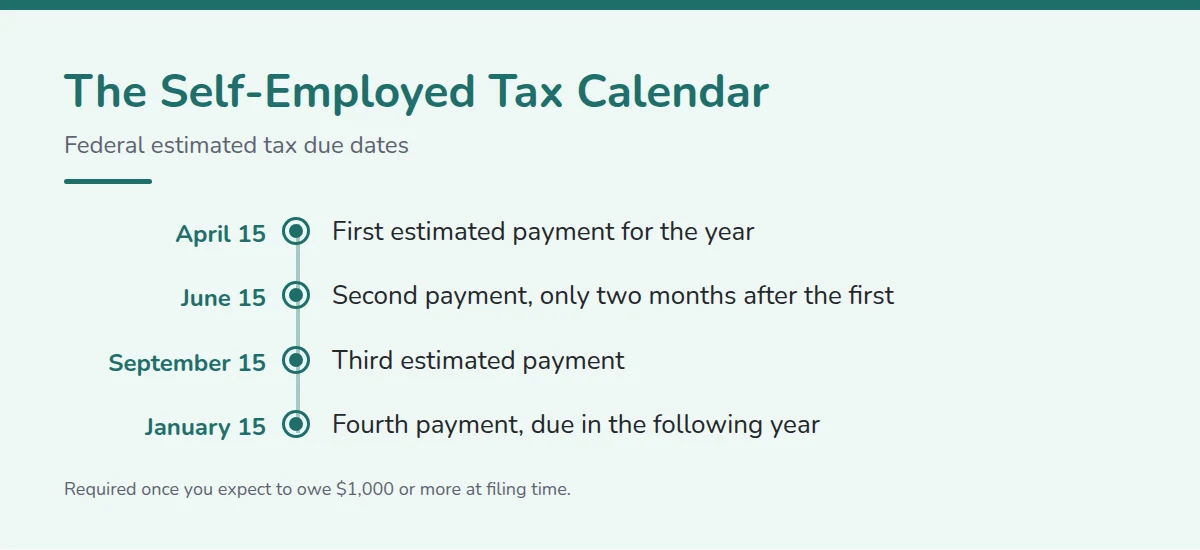
Once you expect to owe at least $1,000 at filing time, estimated payments are generally required. The federal due dates are April 15, June 15, September 15 and January 15 of the following year. The spacing is uneven: June’s payment comes two months after April’s, and January’s four months after September’s.
The simplest protection against an underpayment penalty is the safe harbor. Take last year’s total tax (or 110 percent of it, if your adjusted gross income last year was above $150,000) and pay it in four equal installments. Do that and no penalty applies, even if you owe more in April. Paying 90 percent of this year’s tax also works, if you can forecast it. The prior-year rule works in your first year of practice too, as long as you filed a return for last year, which can make the tax on last year’s wages a gentle target. It protects you from the penalty, not from the balance, so keep feeding the tax account.
Most states with an income tax run their own estimated payment schedule, so set those up at the same time. Pay federal installments through IRS Direct Pay, EFTPS or your IRS online account, and keep each confirmation with your books.
The Deductions Mobile Work Actually Earns
Deductions are where mobile practice differs most from a spa job. These are the ones that genuinely apply on the road; claim each only with records behind it.
Your car. The IRS business mileage rate for 2026 is 72.5 cents a mile through June 30 and 76 cents from July 1, after a midyear increase, so your log needs dates as well as miles. Business parking and tolls are deductible on top. The alternative is actual expenses (gas, oil, tires, repairs, insurance, registration, and depreciation or lease payments) multiplied by the business share of your miles. To keep both options open on a car you own, use the standard rate in its first year of business use; on a leased car, choosing the standard rate locks it in for the whole lease. Our guide to vehicle setup, route planning and travel zones covers what a log that survives an audit has to contain.
Your table and equipment. Equipment is normally depreciated over several years, but the de minimis safe harbor lets you elect to deduct items costing up to $2,500 per item or invoice in the year you buy them, as long as your books expense them too. That covers most portable tables, chairs and stone heaters. Bigger purchases, such as a high-end electric lift table or a vehicle used mostly for work, can often be written off faster through Section 179 or the special depreciation allowance, within limits (passenger vehicles carry their own caps). Our mobile massage equipment buyer’s guide covers which gear earns its price.
Linens, lotions and laundry. Sheets, face cradle covers, oils, lotions, sanitizer and the cost of washing it all are ordinary supplies, and in mobile work they add up fast.
Insurance and memberships. Professional and general liability premiums are deductible, malpractice coverage included. Many therapists buy that coverage through an association; AMTA’s professional membership, for example, includes $2 million per occurrence of professional and general liability coverage. Health insurance premiums go through the separate self-employed health insurance deduction, not Schedule C.
Continuing education. CE tuition, course materials and travel to a training are deductible when the education maintains or improves skills you use in your current work, or when your board requires it to keep your license. Education that meets the minimum requirements to enter a field, or qualifies you for a new trade, is not, which is why massage school itself does not count. License renewal fees go under taxes and licenses.
Phone and software. Deduct the business share of your phone bill, plus booking software, intake and SOAP note apps, card processing fees and your website.
A home office. Space used regularly and exclusively for the business, such as a desk where you book, chart and keep the books, earns $5 per square foot for up to 300 square feet under the simplified method. A kitchen table that doubles as the family dinner table does not qualify. A home office that counts as your principal place of business can also turn the drive to your first client into business mileage rather than commuting.
What does not count. Lunch eaten alone between appointments in your own area is personal; meals become deductible mainly when work keeps you away from home overnight, and then generally at 50 percent. Ordinary commuting stays personal too.
Twenty Minutes a Week
The money side of a mobile practice is one more safety system, and like the others it only works if it runs every week. Keep the accounts separate, sort transactions as they happen, move tax money on every deposit, pay four times a year and keep the mileage log honest. Bring in a CPA or enrolled agent for the structure decision and before any S corporation election; their fee is deductible too. And whatever structure you choose, keep professional liability insurance in force, because no entity protects you from a claim about your own hands.
Sources
- Bureau of Labor Statistics on massage therapist pay, jobs and the self-employed share
- U.S. Small Business Administration on choosing between a sole proprietorship, LLC and S corp and what a bank asks for to open a business account
- Treasury regulations for the default tax treatment of a single-owner LLC, when education expenses are deductible and why card and app payments skip the 1099-NEC
- New York Limited Liability Company Law with the personal liability of professional LLC members for their own negligence
- California Franchise Tax Board on the $800 annual tax every California LLC owes
- U.S. Court of Appeals for the Eighth Circuit in the Watson ruling on an unreasonably low S corporation salary
- Internal Revenue Code sections on estimated tax due dates and safe harbors, the restored 1099-K threshold, the new $2,000 threshold for 1099-NEC reporting, the qualified tips deduction and the three-year assessment window
- Internal Revenue Service with its tax guide for small businesses filing Schedule C and the 2026 business mileage rates, including the July change
- Federal Register for Treasury’s final list of tipped occupations and its tip data
- American Massage Therapy Association on the liability coverage included with professional membership
Further reading
- Launching a Mobile Massage Business From Scratch: Your First Year Roadmap
- What It Really Costs to Become a Mobile Massage Therapist
- Soothe, Zeel, or Your Own Book? A Mobile Therapist’s Guide to Platform vs Independent Work
- Your Car Is the Clinic: Vehicle Setup, Route Planning, and Travel Zones for Mobile Massage
- The Mobile Massage Policy Handbook: Cancellations, Deposits, No-Shows, and House Rules