Your Car Is the Clinic: Vehicle Setup, Route Planning, and Travel Zones for Mobile Massage
Published on September 8, 2026
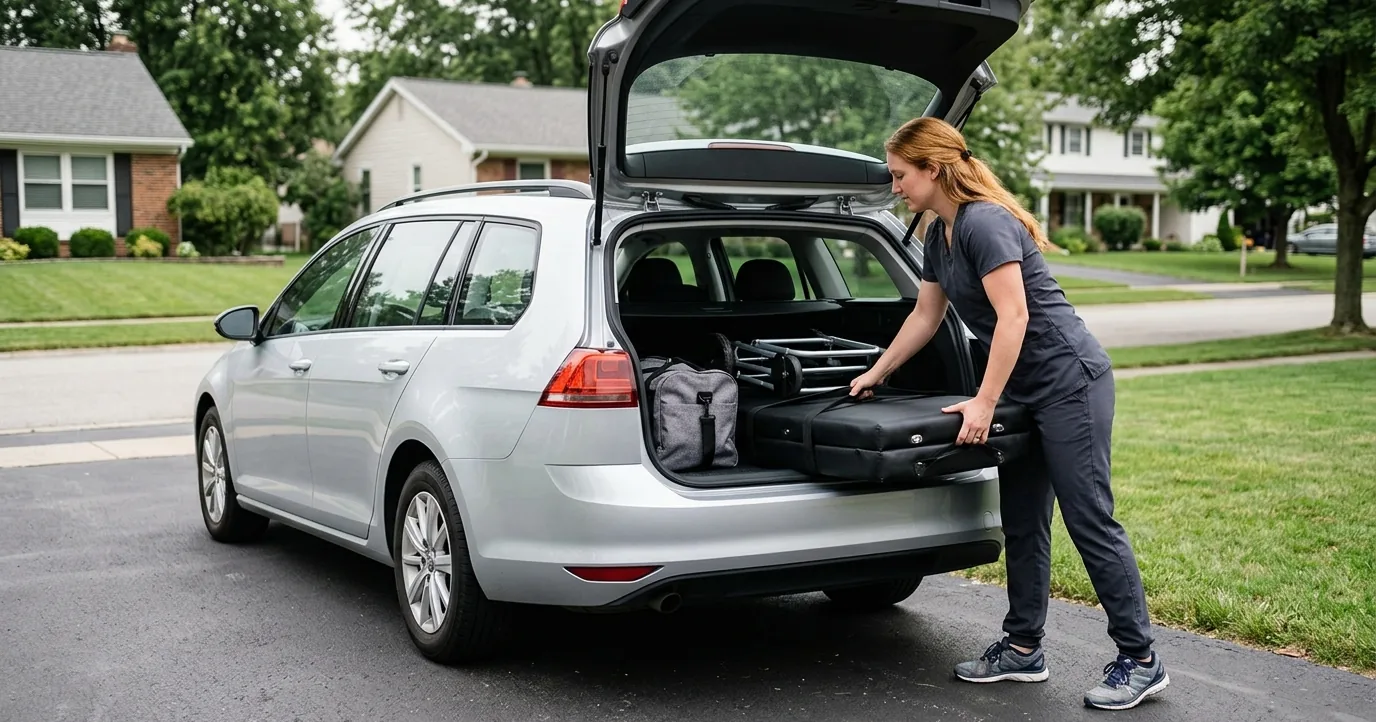
Half of This Job Happens Behind the Wheel
Massage school teaches you anatomy, technique, and draping. It does not teach you how to fit a table, a bolster set, six sheet sets, and a stone warmer into a hatchback in an order that still works at the fourth stop of the day. That gap shows up in almost every profile of a working mobile practice. Kristian Fennessy, who built Vitality Massage Therapy across San Diego, names the logistics of covering a sprawling metro area as one of the two hardest parts of the business, alongside building trust without a storefront. Coordinating schedules, managing travel times, and delivering a consistent session in wildly different rooms takes what he calls meticulous planning. Krista King, who runs a mobile practice in Delaware, lists the same obstacles: transporting equipment and coordinating appointments geographically, before you ever get to the massage itself.
That is the honest shape of the work. A clinic therapist sells hands-on hours. A mobile therapist sells hands-on hours minus the drive, minus the parking, minus the stairs, minus the setup and the teardown. Everything in this guide exists to protect the hours that actually pay. Get the vehicle, the route, and the travel fee right and a five-session day is sustainable. Get them wrong and three sessions will leave you wrecked and underpaid.
The Vehicle Is the Second-Biggest Piece of Equipment You Own
Most therapists drive whatever they already own, which is fine, but the car stops being personal transport the day you go mobile and becomes a piece of professional equipment with its own requirements.
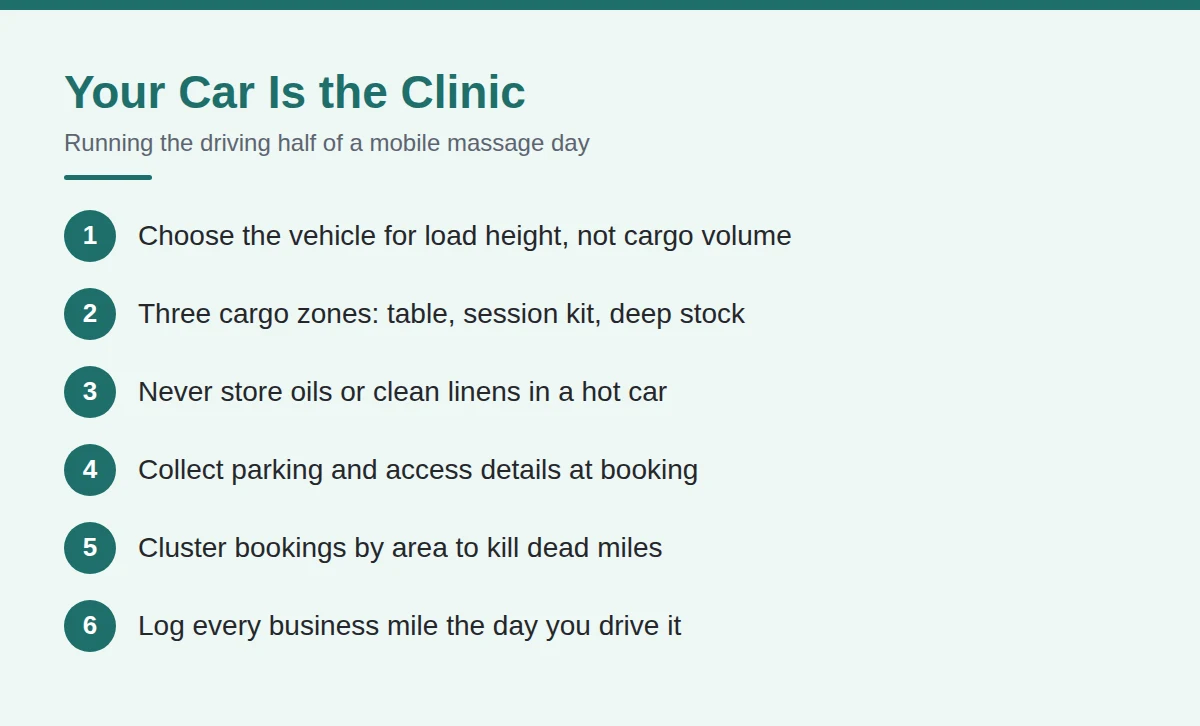
The specification that matters most is not cargo volume but load height and opening shape. A folded portable table is a wide, thin, awkward object, and a low flat load floor you can slide it onto beats a deeper trunk with a high lip every time. Hatchbacks, wagons, small SUVs, and minivans all work well. Sedans work too, but you will lift the table over a bumper several times a day, and that repeated hinge-at-the-waist lift is exactly the movement pattern that ends careers. The body mechanics and injury prevention habits that keep mobile therapists working apply in the parking lot just as much as at the table.
Three other things earn their cost quickly. A folding cart or a wheeled table case turns a long carry from a driveway or a parking garage into a manageable walk. A cargo mat protects both the load floor and the table case, which will otherwise wear through at the corners. And a second set of everything you cannot work without, meaning at minimum spare sheets and a spare bottle of lotion, lives permanently in the car and is never unloaded. Reliability of the gear itself matters here too, and the tables, cases, and linens that hold up to daily transport are a different purchase from the ones that sit in a treatment room.
A Cargo Layout That Survives Six Stops
The point of a cargo system is that nothing gets unpacked to reach something else. Build it in three zones.
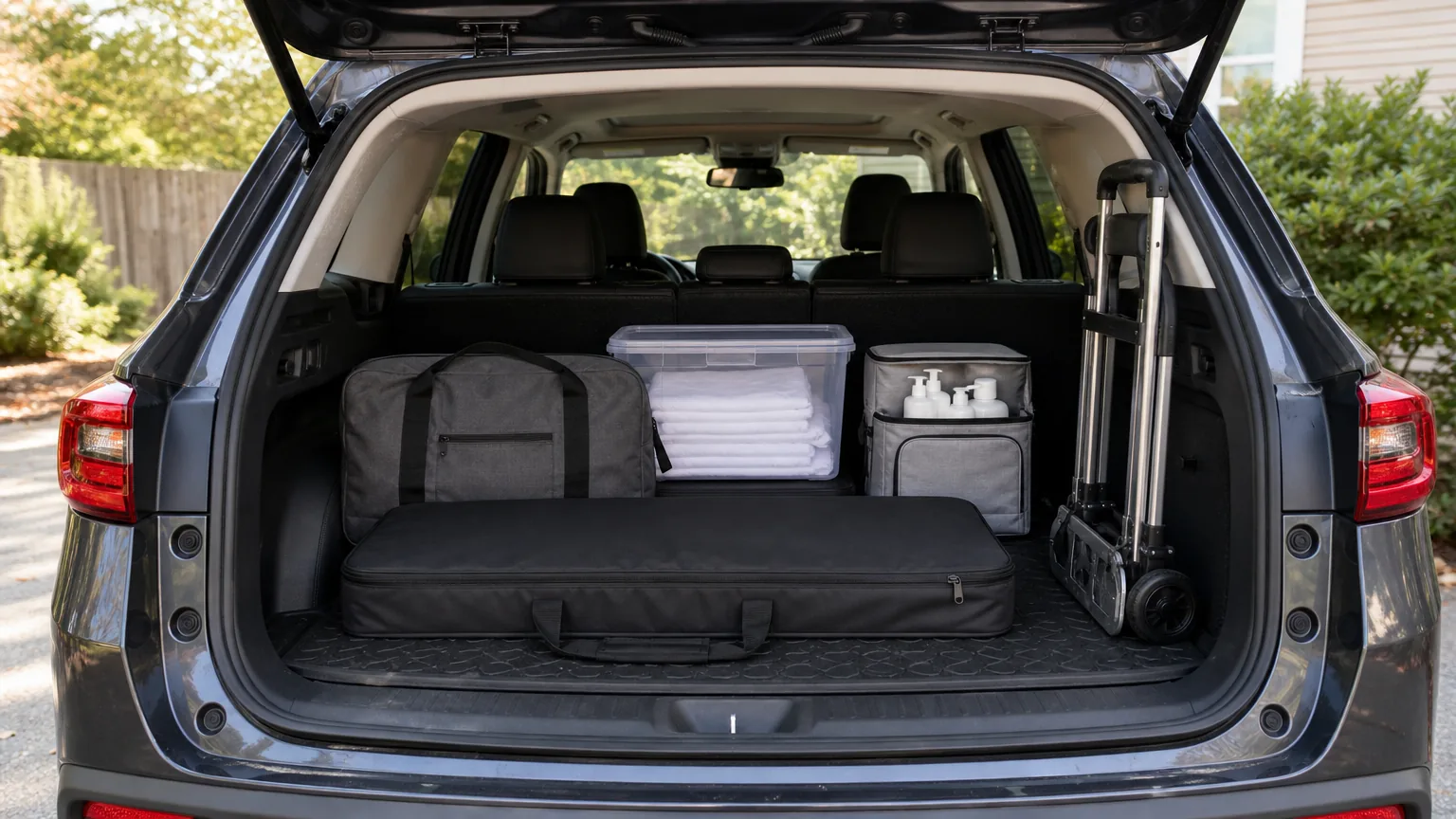
The table and cart go in last and come out first, closest to the hatch, because they move at every stop. Behind them sits the session kit: a single soft-sided bin or duffel holding sheets, face cradle cover, bolster, lotion or oil in a leakproof holster, sanitizer, hand towels, and a music source. One bin, one trip, no rummaging in a client’s driveway. Deepest goes the standing stock: the linen reserve, the laundry bag for used sheets, cleaning supplies, and the paperwork folder. That deep zone is restocked at home, not on the road.
A load-out checklist beats memory, especially on a six-stop day. Run it once in the morning against a written list, and check the same list at the end of every session before you drive off, because the item most often left behind is the one you were still using when the client started talking. Count the sheet sets: one fresh set per booking plus one spare is the standard, and used linens go straight into a closed laundry bag rather than back into the clean bin.
Heat, Cold, and What Lives in Your Trunk
A car is a terrible storage cupboard. Interior temperatures climb far above the outside air on a hot day and drop below it on a cold night, and everything you carry has an opinion about that.
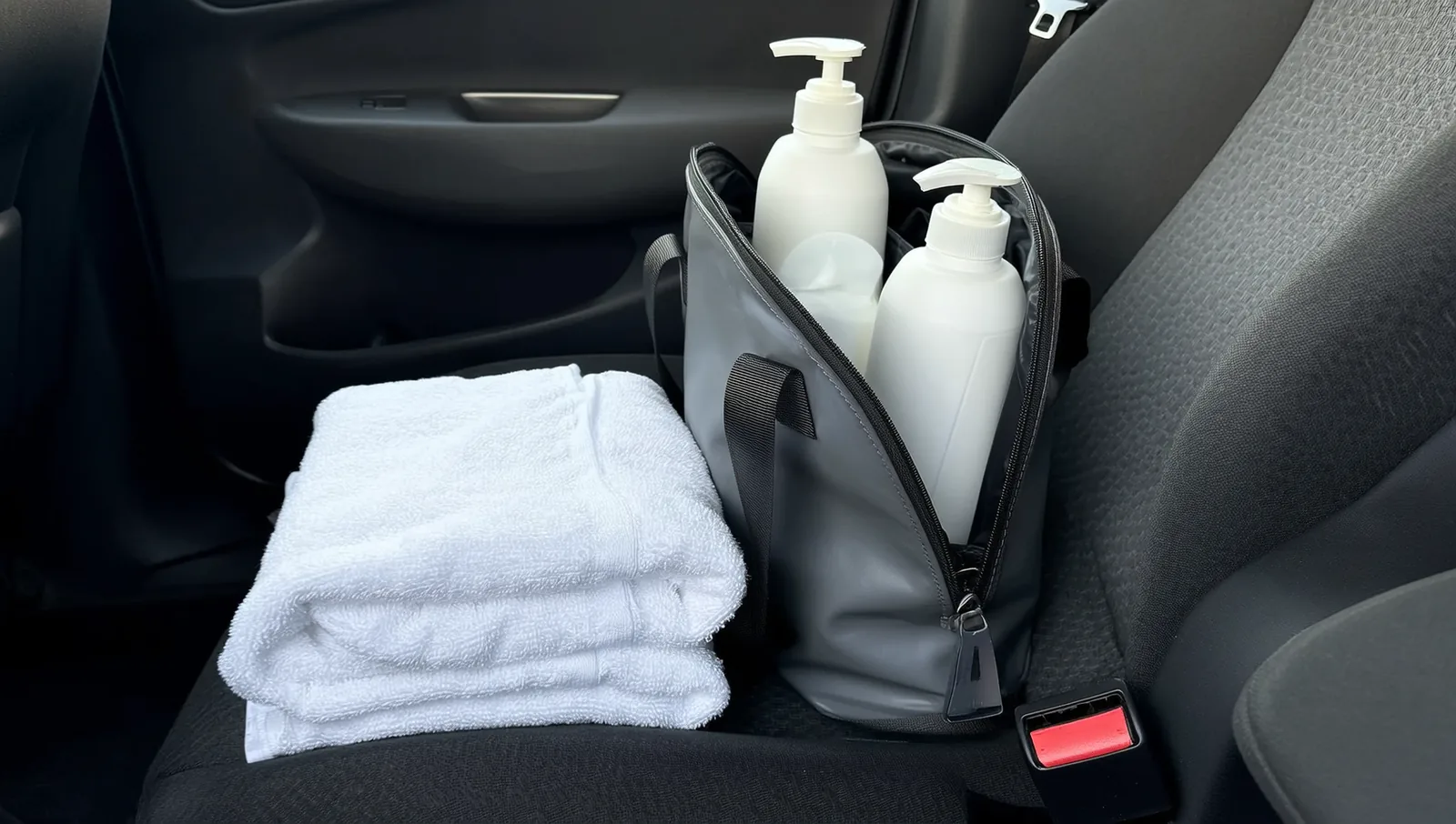
Oils and lotions are the first casualty. Heat accelerates the oxidation that makes an unrefined oil go rancid, and a rancid oil smells wrong the moment it hits a client’s skin. Keep working bottles in an insulated cooler bag, buy in smaller quantities that turn over faster, and store the reserve stock indoors rather than in the vehicle. Cold is the mirror problem: lotion pulled from a freezing car makes for an unpleasant first contact, so plan to warm bottles in the footwell heater or against your body before the session starts.
Linens should never be left in a hot car overnight, especially if there is any residual damp from humidity, and they should never share space with a laundry bag of used sheets. Electronics, meaning phones, card readers, and speakers, do not tolerate a summer dashboard. Anything with a rechargeable battery comes inside with you at the end of the day. And a table left in a baking car will have hot vinyl, so it needs a few minutes with the sheets on before a client lies down.
Parking and Building Access: The Unbilled Fifteen Minutes
The gap between the arrival time on your calendar and the moment your hands touch the client is where a mobile schedule quietly falls apart. Parking, elevators, front desks, gate codes, and dogs all live in that gap.

Solve it at booking, not at the door. Your intake or confirmation flow should collect the things you cannot improvise: where to park and whether it is free, the building or gate access code, the unit number and floor, whether there is an elevator, whether stairs are involved and how many flights, and whether pets will be loose. Apartment buildings, gated communities, and hotels are the reliable time sinks, and hotels in particular may require you to check in with a front desk before going up. Corporate and event bookings add their own layer, including loading docks, security passes, and freight elevators, which the on-site and corporate contract playbook covers in detail.
Access information is also safety information. Knowing the address, the floor, and the exit route before you arrive is part of the same discipline as the client vetting and check-in protocols every solo mobile therapist should run. Text the client when you park, not when you leave the last appointment, so your arrival is expected and your walk to the door is short.
Routing: Clusters, Dead Miles, and Honest Buffers
A dead mile is any mile you drive that no client is paying for. The single highest-leverage habit in mobile practice is clustering: grouping appointments by geography so a day runs as a tight loop rather than a set of unrelated spokes out of your home base.
The practical version is to assign days or half-days to areas. North side on Tuesdays, downtown on Wednesdays, south county on Thursdays. Publish that structure in your booking system so clients self-select into the right slot instead of you rearranging a whole day around one outlier. When a request lands outside its cluster, the answer is a different day rather than a heroic cross-town drive.
Then buffer honestly. A sixty-minute session is not a sixty-minute block. It is roughly fifteen minutes of setup, sixty of hands-on, fifteen of teardown, and then drive time, which means a realistic block is closer to two hours door to door for a session within a cluster. Build the drive from the previous stop, not from home, and add a margin for traffic rather than assuming the optimistic navigation estimate. Four to five sessions is a full day for most working mobile therapists; six is possible in a dense cluster and punishing anywhere else.
Charging for the Drive: Zones, Flat Fees, or Folded In
Three models dominate, and each is defensible.
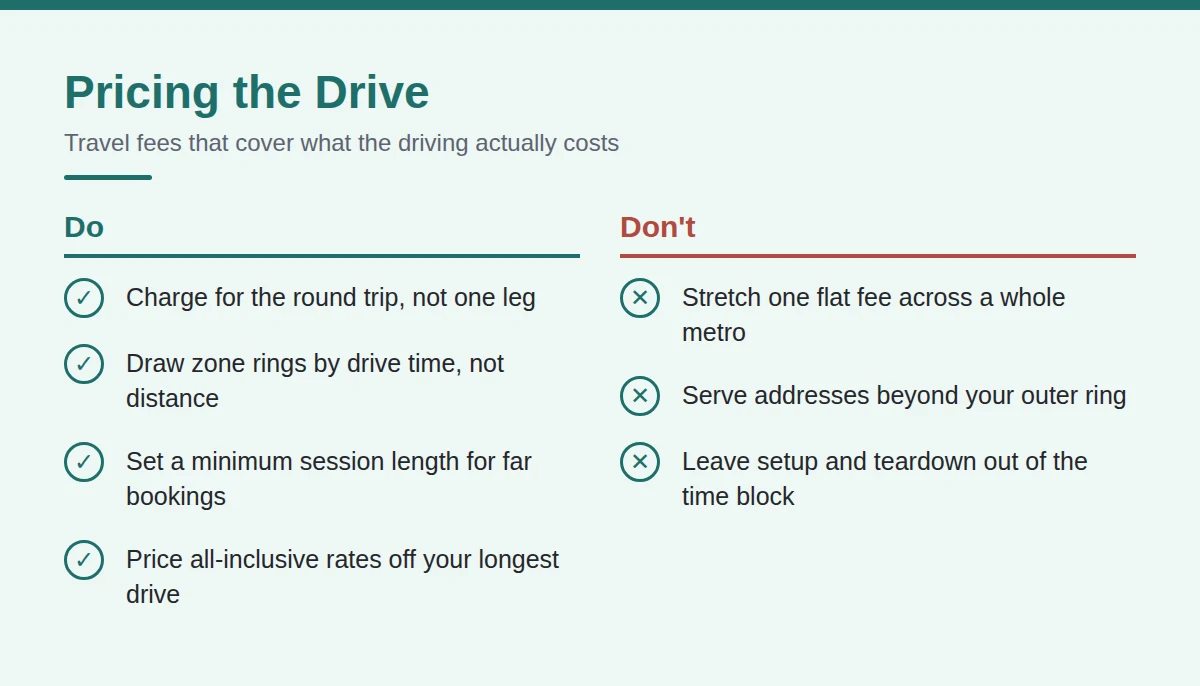
A flat travel fee, commonly twenty to forty dollars anywhere inside a defined service area, is the simplest to quote and the easiest for clients to accept. It works when your area is genuinely compact. Stretch it over a wide metro and your close-in clients subsidize your far ones.
Tiered zones price the drive in bands: no fee inside the inner ring, a moderate fee in a middle ring, a higher fee in the outer ring, and no service beyond it. Zones are more honest about your costs, they steer demand toward the profitable center, and they give you a clean way to say no to a two-hour round trip without saying no to the client. Draw the rings by drive time rather than straight-line distance, because thirty minutes of highway and thirty minutes of city traffic cost you the same hour.
Folding travel into a single all-inclusive rate reads best on a website and suits a premium positioning, but it only works if the rate is set against your longest realistic drive. Whichever model you choose, the client-facing side of this decision is covered in our breakdown of how mobile massage services are priced and what the travel fee covers.
Two rules apply across all three. Charge for the round trip, not the outbound leg. And set a minimum session length for distant bookings, because a thirty-minute massage forty minutes away is a loss dressed up as a booking.
When the Day Goes Wrong
Cars break down, snow falls, and a highway closes. Write the policy before you need it. Decide in advance what weather cancels a day, and put a severe-weather clause in your cancellation policy so neither side is improvising in a storm. Keep roadside assistance current, since it is cheap and a tow with a table in the back is not the moment to be shopping for coverage. Keep the tank above a quarter, keep the spare inflated, and keep a small kit in the car with a phone charger, water, a flashlight, and a first aid kit.
Then build the fallback list: the clients you can reach quickest to reschedule, a text template you can send one-handed, and a rule for how late is too late to arrive. Notifying a client twenty minutes out that you are running fifteen minutes behind costs you nothing and buys enormous goodwill. Arriving unannounced and flustered costs you the rebooking.
Log Every Mile
Business mileage is one of the largest deductions available to a mobile therapist, and it is the one most often lost to bad records. The IRS sets a standard mileage rate each year, which reached seventy cents per business mile for 2025, and the current figure is worth confirming before you file. On a practice that drives fifteen thousand business miles a year, that is a five-figure deduction sitting in your odometer.
Claiming it requires a contemporaneous log, meaning records kept at or near the time of the trip rather than reconstructed in April. Each entry needs the date, the destination, the business purpose, and the miles. An automatic tracking app is the least painful way to do this, and it takes about a minute a day. Know the rules on commuting: driving between client appointments is deductible business travel, while ordinary commuting is not, and having a qualifying home office changes how the first and last trips of the day are treated. Talk to an accountant about your specific setup, since this interacts with your business structure and with the choice between the standard rate and actual expenses. If you are still building the foundations of the practice, the year-one roadmap for a new mobile business covers where mileage tracking fits alongside structure, insurance, and pricing.
The Practice Runs on the Logistics
Nobody books you because your cargo bins are well organized. But the therapists who last a decade in mobile work are almost always the ones who solved the driving day early: a vehicle that loads without wrecking their back, a kit that comes out in one trip, a route that loops instead of zigzags, a travel fee that actually covers the drive, and a mileage log that survives an audit. The massage is the part clients see. The logistics are the part that decides whether you are still doing it in ten years.
Sources
- SDVoyager on what coordinating a mobile practice across a whole metro really takes
- Town Square Delaware for an LMT on transporting equipment and grouping appointments geographically
- Internal Revenue Service with the standard mileage rates published each year
- IRS Publication 463 on what a deductible car expense record has to contain
- American Massage Therapy Association for career and practice-building resources for working therapists
Further reading
- The Mobile Massage Equipment Buyer’s Guide: Tables, Chairs, and Everything In Between
- Understanding the Price Range of Mobile Massage Services
- Personal Safety for Mobile Massage Therapists: A Comprehensive Protocol
- Self-Care and Injury Prevention for Mobile Massage Therapists
- Launching a Mobile Massage Business From Scratch: Your First Year Roadmap