Abdominal Massage for Constipation in Older Adults: Evidence, Screening, and Home Care
Published on November 1, 2026
The Complaint Nobody Books For
Ask an older client how they are sleeping and you will hear about their back. Ask how they are eating and, sooner or later, you will hear about their bowels. Constipation is one of the most common complaints of later life. The National Institute on Aging says about one older adult in three has occasional symptoms, and the authors of a 2024 review protocol put chronic constipation at roughly 16 percent of men and 26 percent of women aged 65 and over, climbing to 26 and 34 percent among those 84 and older.
The causes pile up with age. Stroke, Parkinson’s disease, diabetes and dementia all make it more likely, and so does the medicine cabinet: certain painkillers, iron supplements, antacids containing aluminum or calcium, diuretics, some blood pressure drugs, some antidepressants and some allergy medicines. Add less walking, less fluid and less fiber, and a therapist who visits older adults will meet this problem every week, usually mentioned in passing and often with some embarrassment.
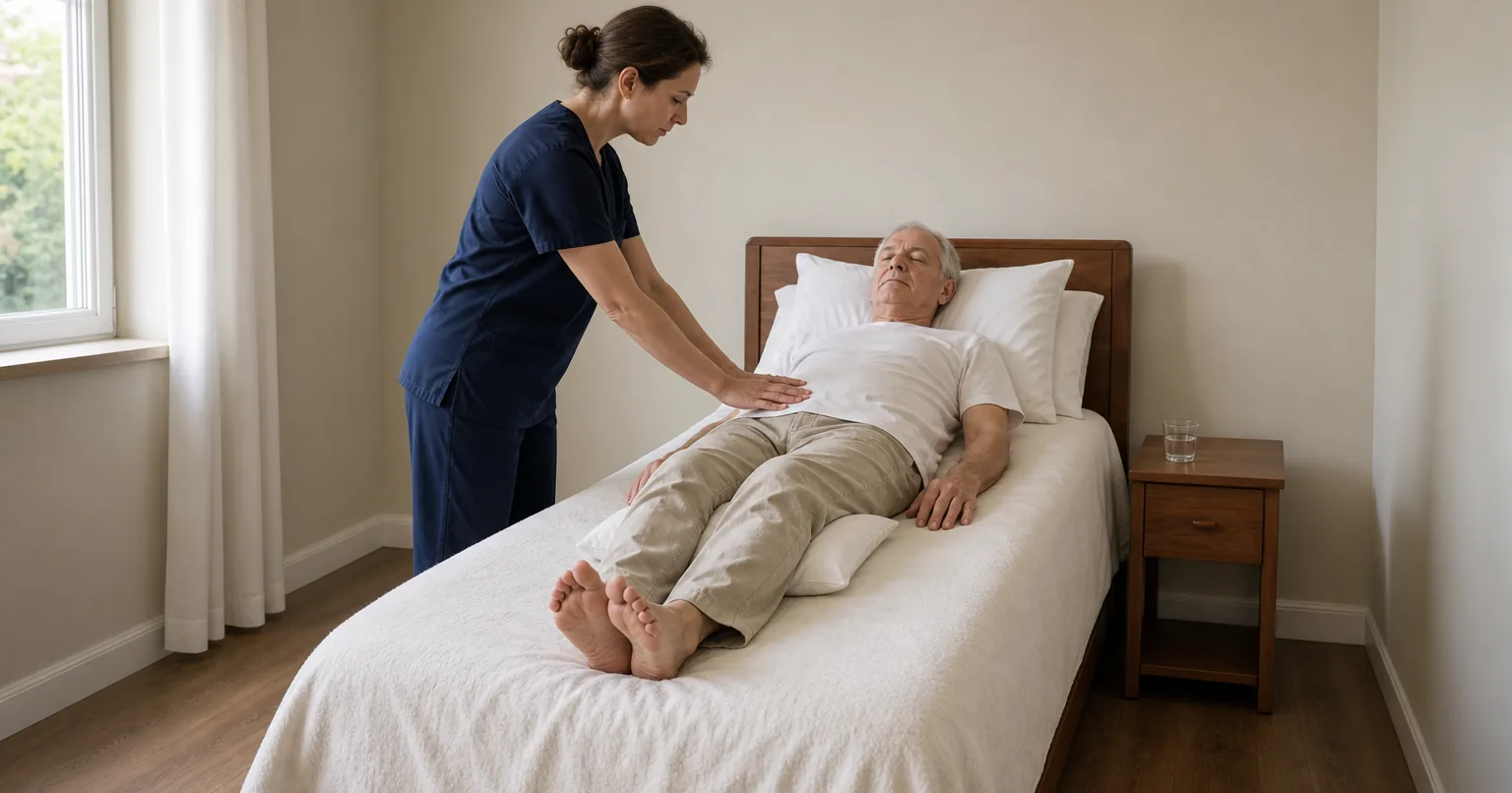
Abdominal massage is an old answer to it, and the research has grown a good deal in the past few years. This guide covers what that research does and does not show, who needs a doctor before anyone works on their abdomen, how to position someone in a home bed or recliner, and how to teach the routine to the family, which is where most of its value lies. One line holds throughout. Massage supports a bowel plan that the doctor runs. It does not replace laxatives, fiber, fluids or a diagnosis.
What the Evidence Says Now
The study behind this article is a protocol, not a result. In January 2024, Yuan and colleagues published in BMJ Open their plan for a systematic review and meta-analysis of abdominal massage for chronic constipation in people aged 65 and over. They registered it with PROSPERO (CRD42023408629), committed to searching ten databases for randomized trials up to 30 December 2023, and named their outcomes in advance: bowel frequency, symptom scores, quality of life, laxative use and adverse events. Their own introduction conceded that studies focused specifically on older patients were lacking.
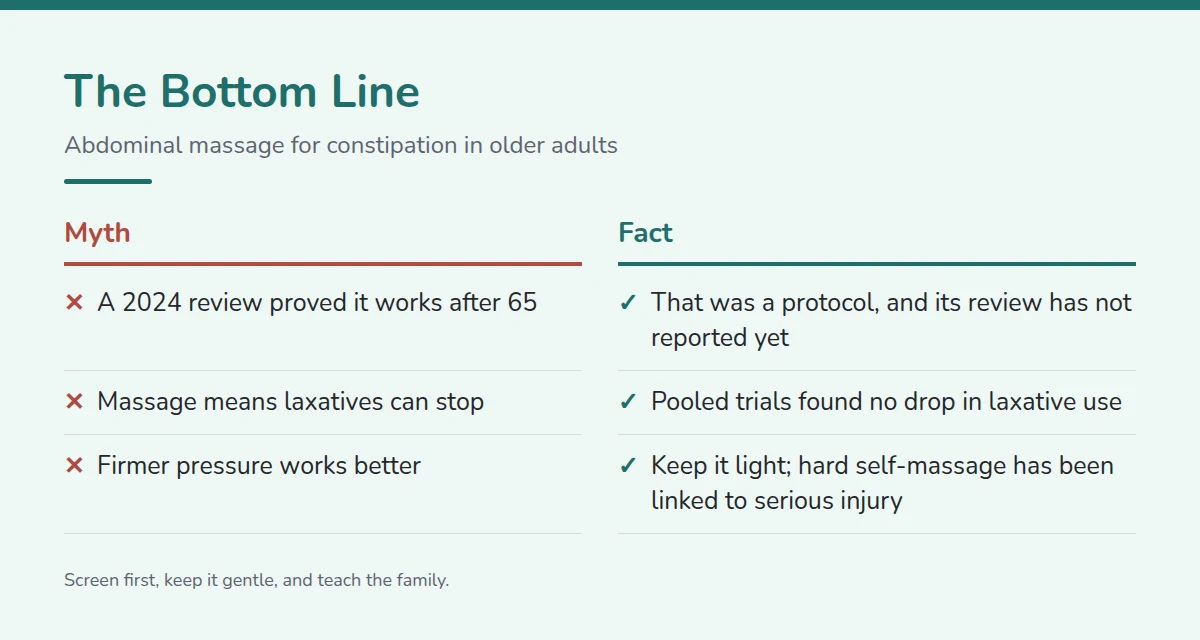
As of this writing, the finished review has not appeared in PubMed. The pooled answer that protocol promised is still pending, and anyone who cites it as proof that abdominal massage works for older adults is citing a plan.
Other teams have pooled the trials in the meantime. Xu and colleagues, writing in Frontiers in Medicine in 2025, gathered 41 randomized trials of drug-free constipation treatments involving 3,005 people aged 60 and over. The 11 abdominal massage trials, taken together, outperformed their comparison groups, and across the drug-free treatments, courses longer than four weeks did better than shorter ones. The authors were frank about the weaknesses: regimens and treatment times varied widely, results were highly inconsistent from trial to trial, some showed signs of publication bias, and large, high-quality trials are still needed to confirm the effect.
The broadest pooled estimate comes from Huang, Chiao and Chien in the International Journal of Nursing Studies. Across 23 studies and 1,431 adults of all ages, abdominal massage added about one and a half bowel movements a week on average, shortened gut transit time by roughly 21 hours, and improved symptom scores. It did not significantly reduce laxative use.
The Trials in Older Adults
The trials in older adults are mostly small, and most were run in a single nursing home or hospital. Four are worth knowing, because their participants look most like the clients a mobile therapist sees.
- In a Turkish nursing home, Çetinkaya and Ovayolu randomized 61 residents and gave the massage group 15 minutes of abdominal massage once a day, five days a week, for a month. Scores on the Constipation Severity Instrument fell from 40.6 to 16.0 in that group, and on a visual analogue scale the massage group improved significantly more than residents who had routine care only.
- Birimoglu Okuyan and Bilgili, also working in a nursing home, followed 35 residents over 65 for eight weeks. The massage group had 30 minutes a day, five days a week, after a meal and under the supervision of a member of the research team, and finished with better constipation-related quality of life than an untreated control group.
- In Iran, Assadollahzadeh and colleagues randomized 105 women aged 60 to 75 to Thai abdominal massage, prunes, or routine care for eight weeks. The massage was given by a trained family member rather than by clinical staff. It eased constipation severity and pain and improved stool consistency more than prunes or routine care did, while the prune group reported the largest gain in quality of life.
- Fekri and colleagues studied 68 older adults in hospital after a stroke. A 15-minute massage twice a day for ten days, paired with lifestyle advice, lowered constipation scores and abdominal girth compared with usual care. The researcher gave the first massage, and the patient’s main caregiver gave the rest.

Two patterns stand out. Most of these trials gave massage at least five days a week, and in two of the four, a family member or caregiver ended up doing it. Neither looks like a weekly professional visit, which matters for how you build the service. Look, too, at who appears in the protocol’s definition of the intervention: massage performed by nurses, nurse aides, caregivers or doctors. This is mostly a nursing literature, and massage therapists rarely appear in it.
Where the Evidence Runs Out
Start with how far the field has come. When Edzard Ernst reviewed it in 1999, he found four controlled trials, none free of methodological flaws. There are dozens now, but most are still small and single-site, and none can blind the participants, who always know whether they were massaged. The Thai massage trial, for example, analyzed only the women who completed every session, which tends to flatter a result.
One of the most rigorous trials in this literature was not in older adults, and it is sobering. In the AMBER trial, McClurg and colleagues randomized 189 people with multiple sclerosis at 12 UK hospitals to abdominal massage plus bowel advice, or advice alone. After individual training, the massage group did it daily for six weeks. The main outcome, a bowel dysfunction score at 24 weeks, did not differ significantly between the groups. Bowel movements rose by about 0.6 a week more than with advice alone, the feeling of complete emptying improved, 85 percent of those interviewed carried on massaging afterward, and no adverse events were reported. Still, the intervention was not cost-effective. A carefully run trial found a much smaller gain in bowel frequency than the pooled estimate, which is a caution about the small ones.
Laxatives are the second limit. Huang’s analysis found no significant drop in laxative use, so nobody should be told that massage means they can stop a prescribed bowel medicine. That decision belongs to the prescriber.
Safety is the third. The trials report few harms, but when Lin and colleagues reviewed 25 trials in 2025, they noted that most did not report adverse events at all, so “no harms reported” partly means nobody counted. One case report shows what can go wrong. At a trauma center in Tokyo, Mori, Ai and Otomo treated a 68-year-old man with years of constipation, and radiation treatment for prostate cancer three years earlier, who came in with sudden abdominal pain. Surgeons found a 5 cm tear in the tissue that anchors his transverse colon and about 1.5 liters of blood in his abdomen. He had a habit of massaging his own belly to relieve constipation and had done it hard the day before. The authors could not completely rule out another cause, such as a small ruptured aneurysm, but the lesson for anyone teaching this technique is plain: harder is not better.
So the defensible sentence to a client or family is this. In small trials, abdominal massage done most days eased constipation in older adults, and across adult trials it added about one and a half bowel movements a week. It works alongside the bowel plan rather than replacing it, and the review built specifically around people over 65 has yet to report.
Screening: Who Needs a Doctor First
Constipation is a symptom, not a diagnosis, and the National Institute on Aging notes that it can be a sign of more serious illness, including colorectal cancer. A new change in bowel habits needs a medical evaluation before it needs a massage therapist. If a client or family describes a change nobody has looked at, that is a referral, not a booking.
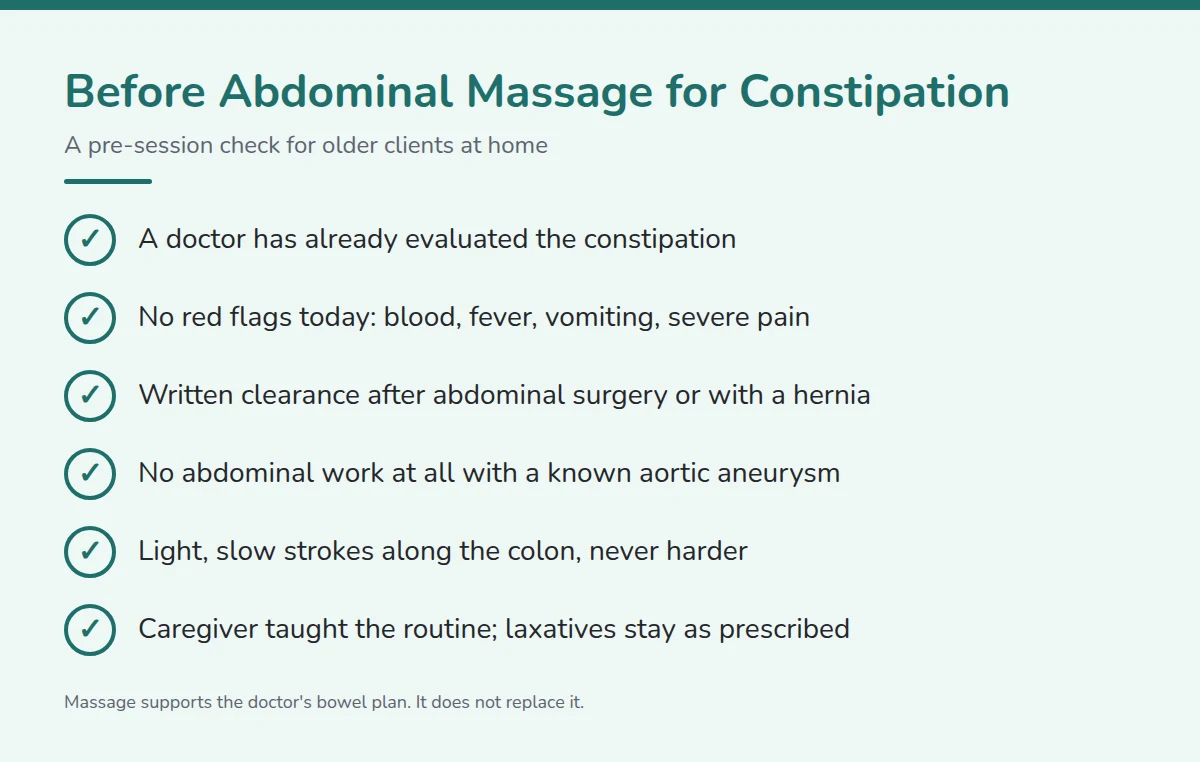
Do not massage, and advise prompt medical care, when constipation comes with any of these:
- blood in the stool or bleeding from the rectum;
- constant or severe abdominal pain;
- vomiting or fever;
- sudden constipation with cramps and no gas or stool passing, which MedlinePlus says needs a call to the provider right away and no laxatives in the meantime;
- watery leakage after a long spell of constipation, which MedlinePlus lists as a possible sign of fecal impaction rather than ordinary diarrhea;
- weight loss without trying, or new lower back pain.
Get the doctor’s clearance in writing before any abdominal work when any of these apply:
- Recent abdominal or pelvic surgery. Wait for the surgeon’s go-ahead.
- A hernia, including a bulge at the navel or along an old incision. Never press on it. MedlinePlus says to contact the provider right away about a painful hernia that cannot be gently pushed back in, or one that comes with nausea, vomiting, fever or discoloration.
- Inflammatory bowel disease, diverticulitis, or cancer or radiation treatment in the abdomen or pelvis.
- Anything in or on the abdomen, such as a feeding tube, a stoma or a peritoneal dialysis catheter. Our guide to massage for dialysis fatigue covers that exit site.
- Blood thinners, which call for lighter pressure because of bruising, as our guide to mobile massage in aged care explains alongside the rest of a frail-client screen.
Aneurysm gets its own rule, because it is the condition most easily missed. With a known abdominal aortic aneurysm, do no abdominal work at all. NHLBI notes that an aortic aneurysm may cause no symptoms at all, and lists a pulsating or throbbing feeling in the stomach area among the ones it can cause. The US Preventive Services Task Force recommends one-time ultrasound screening for men aged 65 to 75 who have ever smoked, so ask older male clients whether they have had that scan and what it showed. If you ever feel a pulsing mass under a flat hand, stop and refer. In a client known to have an aneurysm, sudden severe pain in the belly, chest or back with light-headedness or a racing heart is a 911 call.
It also matters whom the trials left out. The Thai massage trial excluded women with open wounds, ulcers or skin conditions on the abdomen or recent abdominal trauma, and required participants to be mentally alert. A nursing home trial by Faghihi and colleagues excluded people with dementia, previous abdominal surgery, or scars and skin disorders on the abdomen. The evidence above does not describe those clients, so be more cautious with them, not less.
Scope: What a Massage Therapist Does and Does Not Do
Gentle external abdominal massage, positioning and comfort, and teaching a family a home routine as self-care education all fall inside a massage therapist’s work. Several things fall outside it:
- deciding why someone is constipated, which is a diagnosis;
- recommending, stopping or changing laxatives, stool softeners or any other medicine (if the trouble started around a new prescription, suggest the client mention it to the prescriber, and leave it there);
- anything internal, since enemas, suppositories, digital stimulation and manual removal of stool are nursing and medical procedures;
- claims about detoxing or cleansing the colon.
Scope rules differ by state, so check your own practice act; our licensing and scope of practice guide explains how to read one. Licensed massage therapy is also different from unlicensed bodywork sold online with digestive or detox claims, and families should know the difference before they let anyone in. Carry professional liability insurance that follows you into clients’ homes. With an older client on a long medication list, it is not optional.
Abdominal work sits close enough to sensitive areas that consent has to be specific and renewed at every session, using the approach in our guide to consent and draping in the client’s home: name the area, say what you plan to do, ask, and check in as you go.
Setting Up in a Home Bed or Recliner
You usually do not need the table. Getting a frail older adult onto and off a portable table is a fall risk, and abdominal work is easier in the client’s own bed, a home hospital bed or a recliner.

- Position. On the back or semi-reclined, with pillows under the knees so the abdominal wall softens. Raise the head and shoulders on pillows for anyone with reflux or who gets breathless lying flat.
- Home hospital bed. Raise it to a height that spares your back, lock the wheels, lower only the rail on your working side, and put it back up before you step away.
- Recliner. Footrest up, knees supported, and a low stool for you alongside.
- Before you start. Ask the client to empty their bladder, and make sure the route to the toilet is clear or a commode is close by, since the session may prompt a bowel movement.
- Timing. Not straight after a heavy meal. The Thai massage trial ran its sessions about two hours after breakfast.
- Draping. Uncover only the area between the lower ribs and the hip bones, with the sheet folded down to the hip bones and a towel across the chest. Some clients would rather keep a thin cotton shirt on; the strokes work through it without oil, and it is the easiest version for a family member to learn.
The Technique, Kept Gentle
- Warm your hands, rest them flat on the belly for a few breaths, then begin with slow, broad strokes.
- Follow the path of the large bowel: up the client’s right side from just inside the right hip bone, across beneath the ribs, and down the left side. Looking down at the belly with the head at the top, that is clockwise.
- Work small, slow circles along the same path, then finish with broad strokes again.
- Keep the pressure light enough that the client breathes and talks easily and the belly stays soft under your hand. Never press into a firm, tender or pulsing spot, and stop at any pain.
- Fifteen to twenty minutes matches what most trials gave. Afterward, let the client lie still for a minute, then sit up slowly before standing.
Teaching a Caregiver the Routine
Here is the practical problem with the evidence. Most trials gave massage five days a week or more, and a weekly mobile visit cannot deliver that dose. The person who already lives in the house can, and two of the trials above relied on exactly that.
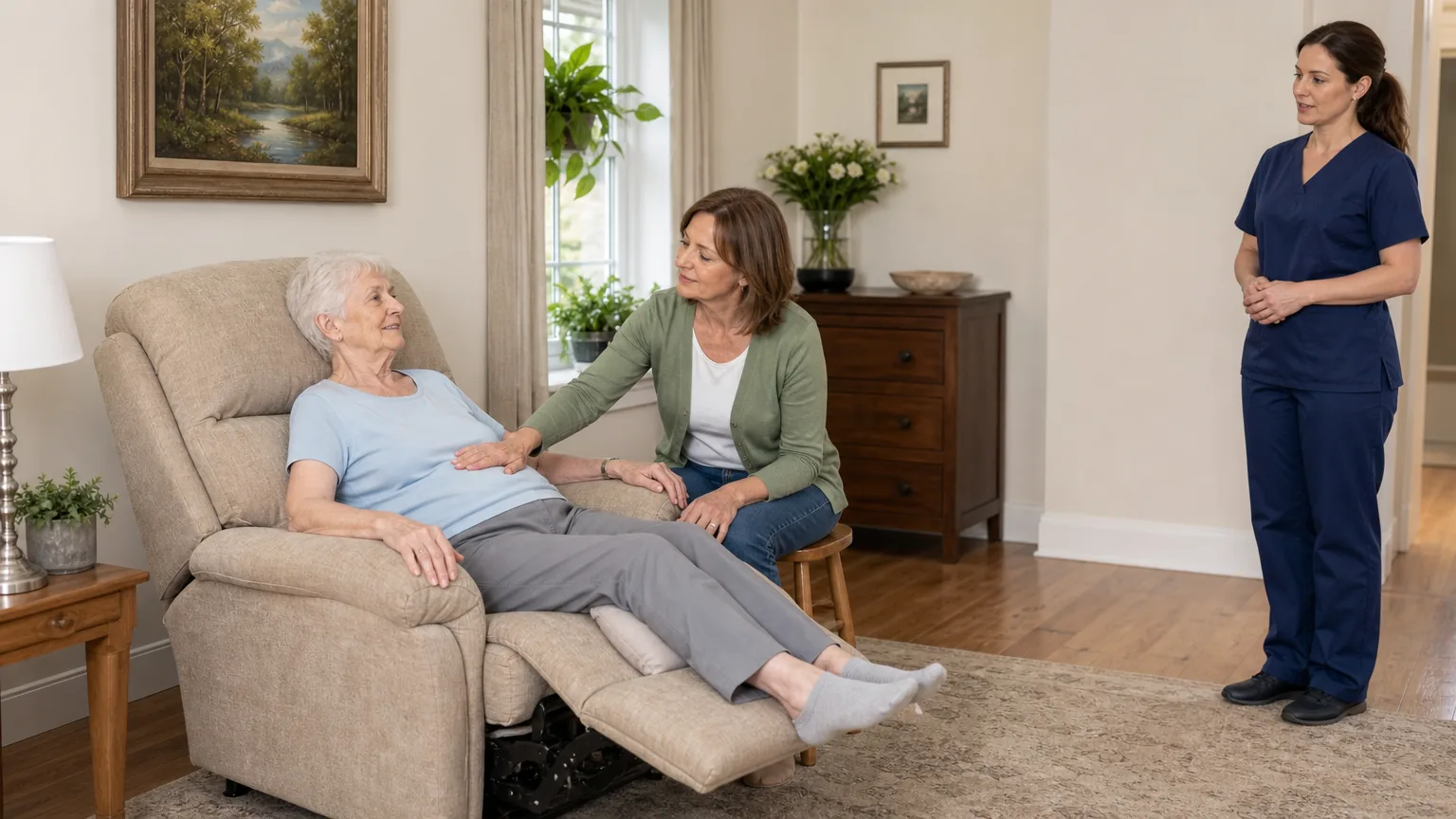
The Thai massage trial’s training is a good model to copy. The researcher taught family members over two or three in-person sessions with hands-on demonstrations, sent them home with a printed guide illustrated with pictures, and had each one perform the full routine while the researcher watched before they started. Weekly follow-up calls, with retraining where needed, kept the technique on track. A mobile version runs the same way:
- Give the first session yourself while the caregiver watches.
- Talk them through the path while they try it, guiding their hands.
- Leave a one-page picture guide showing the path and the stop signs.
- Ask for a teach-back, with the caregiver performing the whole routine while you watch.
- Check the technique at the next visit, and correct it.
Teach the stop rules as carefully as the strokes. Light pressure only, never harder. Skip it on any day with a red flag from the list above, and call the doctor. Stop if it hurts. Never change a laxative because the massage seems to be working. A simple bowel diary helps everyone, and Çetinkaya’s nursing home trial and the AMBER trial both used one: the date, whether a bowel movement happened, what it was like, and any laxative taken. The family can take it to the next appointment.
If the person has dementia, consent works the way the aged-care guide describes. They keep a veto at every session, and a hand pushed away means stop.
Opioid pain medicines, widely used in hospice and palliative care, are a well-known cause of constipation, and Huang’s analysis found benefit in opioid-induced constipation as well as in everyday functional constipation, with a smaller effect in constipation caused by neurological conditions. In that setting the routine has to fit inside the care team’s bowel plan; our hospice and palliative massage guide covers working alongside that team. Price the teaching visit as a full session, and book a follow-up to check the technique.
The Honest Offer
Abdominal massage for constipation in older adults is a modest tool with a growing evidence base: small trials, encouraging pooled results that vary widely between studies, one large negative trial in a younger group, and a review designed for people over 65 still to come. What a mobile therapist can honestly offer is a screened, gentle session at home, and a family who knows how to do it safely between visits.
That is worth offering. Constipation in later life is common, miserable and rarely discussed, and a therapist who takes it seriously, knows the red flags and knows when to stop is doing useful work.
Sources
- Yuan and colleagues on the registered review of abdominal massage for constipation in people 65 and over
- Xu and colleagues pooling 41 trials of drug-free constipation treatment in adults aged 60 and over
- Huang, Chiao and Chien with a meta-analysis of abdominal massage for chronic constipation in adults
- Lin and colleagues on how few abdominal massage trials report adverse events
- Çetinkaya and Ovayolu for a month of daily abdominal massage in nursing home residents
- Birimoglu Okuyan and Bilgili testing eight weeks of abdominal massage in a nursing home
- Assadollahzadeh and colleagues comparing family-delivered Thai abdominal massage with prunes in older women
- Fekri and colleagues on caregiver-continued abdominal massage after stroke
- McClurg and colleagues reporting the AMBER trial of abdominal massage in multiple sclerosis
- Faghihi and colleagues for a nursing home trial of abdominal massage with olive oil
- Ernst for the 1999 review that found four flawed trials
- Mori, Ai and Otomo describing a mesenteric tear after forceful self-massage
- National Institute on Aging on constipation causes and warning signs in older adults
- NIDDK with the symptoms that mean see a doctor right away
- MedlinePlus on fecal impaction and overflow leakage
- MedlinePlus for when a hernia needs urgent care
- NHLBI on aortic aneurysm and rupture symptoms
- US Preventive Services Task Force with its aneurysm screening advice for older men who have smoked
Further reading
- Mobile Massage in Aged Care: Bringing Wellbeing Home to Seniors
- Ethics, Consent, and Draping in the Client’s Home: A Professional Boundaries Guide
- State Licensing and Scope of Practice: A Mobile Therapist’s Compliance Guide
- Hospice and Palliative Massage at Home: A Mobile Therapist’s Guide
- Massage for Dialysis Fatigue: Working With Clients Whose Week Is Already Spent