Minnesota's New Massage Therapist Registration: What Mobile Therapists Need to Know Before 2028
Published on October 10, 2026
Three Cities, Three Rulebooks
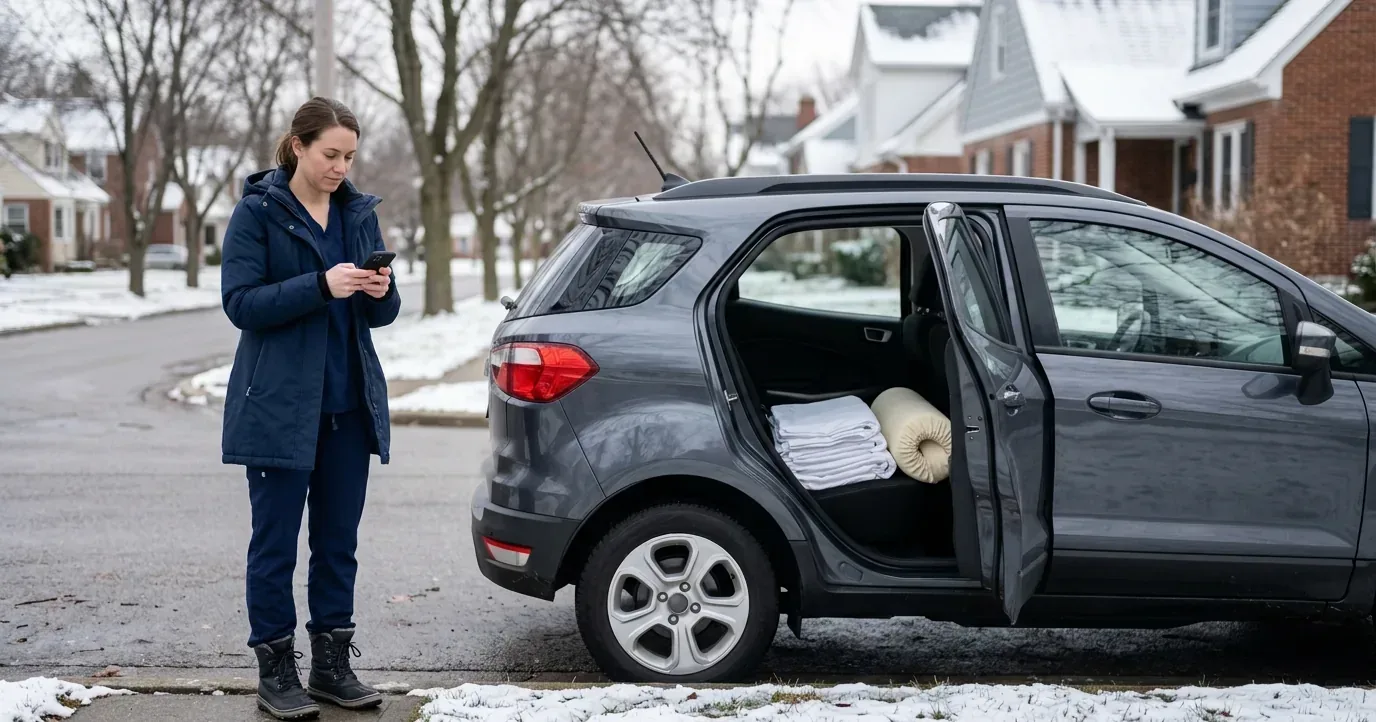
A mobile therapist whose service area spans the Twin Cities can work under three different licensing systems in a single day. St. Paul licenses the individual practitioner, and its license expressly covers massage given at an off-site location, which for a mobile therapist means every client’s home. The city asks for proof of education, $1 million each of general and professional liability coverage with the city named as an additional insured, and a license that expires when your insurance does and renews every year. Bloomington also licenses the individual, but its application asks for 600 hours of training, $1 million of professional liability coverage, an ID photo taken in person, proof that you live in one of twelve listed counties, and a letter from a Bloomington-licensed massage business you work with, unless you own one. Minneapolis, next door, licenses massage businesses at a location and says plainly that massage therapists do not need a license there.
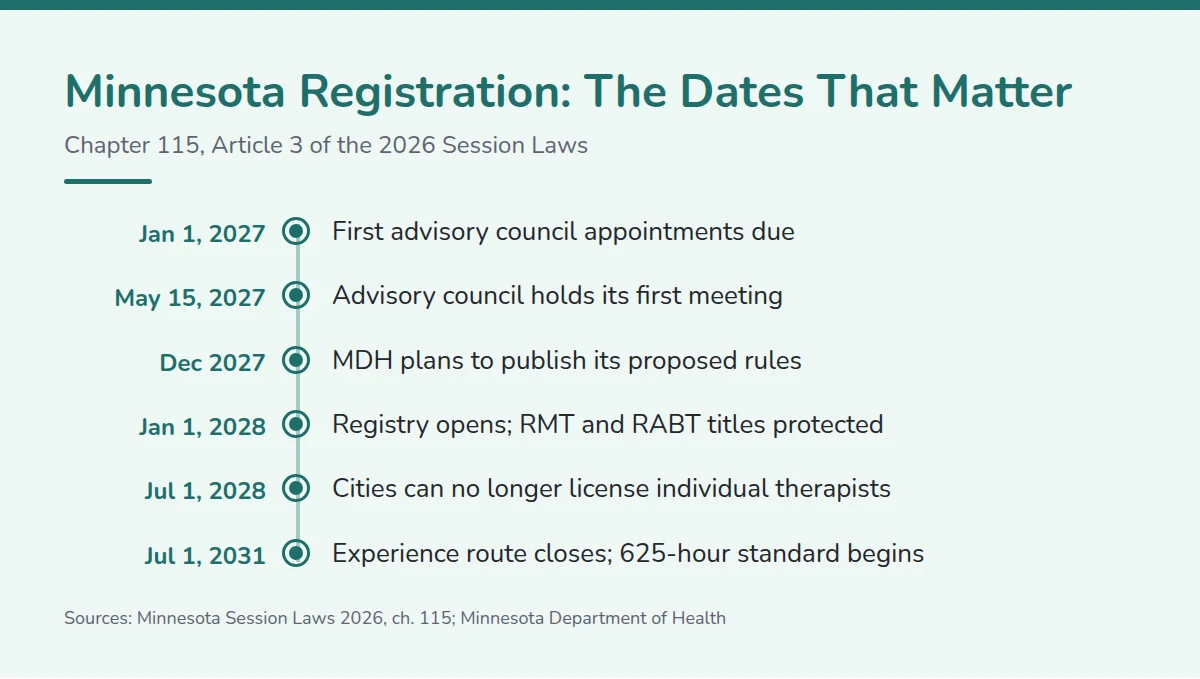
That patchwork now has an end date. Chapter 115 of the 2026 Session Laws, signed on May 27, 2026, creates a voluntary state registration for massage therapists and Asian bodywork therapists, run by the Minnesota Department of Health (MDH). It reserves the titles “registered massage therapist” and “RMT” for people on the registry, and from July 1, 2028 it bars cities from licensing or regulating individual therapists. Cities keep the power to license massage businesses.
Minnesota has never licensed massage therapists statewide, and earlier pushes for full licensure failed. Therapists have practiced under the state’s law for unlicensed complementary and alternative health care practitioners, with cities writing their own rules on top. Registration does not make unregistered practice illegal. What it changes is who oversees the individual therapist, what you may call yourself, and how many local permits a mobile practice has to carry. This guide covers what the law does, who qualifies, what it costs, what happens to your city licenses, and whether registering is worth it.
What the Law Creates
Article 3 of the chapter adds the Minnesota Massage Therapy and Asian Bodywork Therapy Act to state law, at sections 148.636 to 148.6377. The commissioner of health issues registrations, approves a credentialing exam, writes rules that include standards of practice and a code of ethics, and investigates and disciplines registrants. Asian bodywork therapists get a parallel track with their own definition, their own education subjects (traditional Chinese medicine theory among them) and their own protected titles.
Registration is optional. Massage stays on the list of complementary and alternative practices in Chapter 146A, and the new act says it does not restrict anyone practicing under that chapter, provided they do not use a protected title or advertise or imply that they are registered. If you do not register, your current duties continue, including handing every client a written client bill of rights before treatment. That document must state, in bold, that Minnesota “has not adopted any educational and training standards” for unlicensed practitioners.
The titles are protected from January 1, 2028. From that date no one may use “registered massage therapist,” “RMT,” “registered Asian bodywork therapist,” “RABT,” or any other term or title that may lead the public to believe they are registered, unless they are registered under the act. A registration from another state does not count for work in Minnesota. Before that date, check your business cards, website, booking profiles and email signature, including looser phrases such as “state registered.”
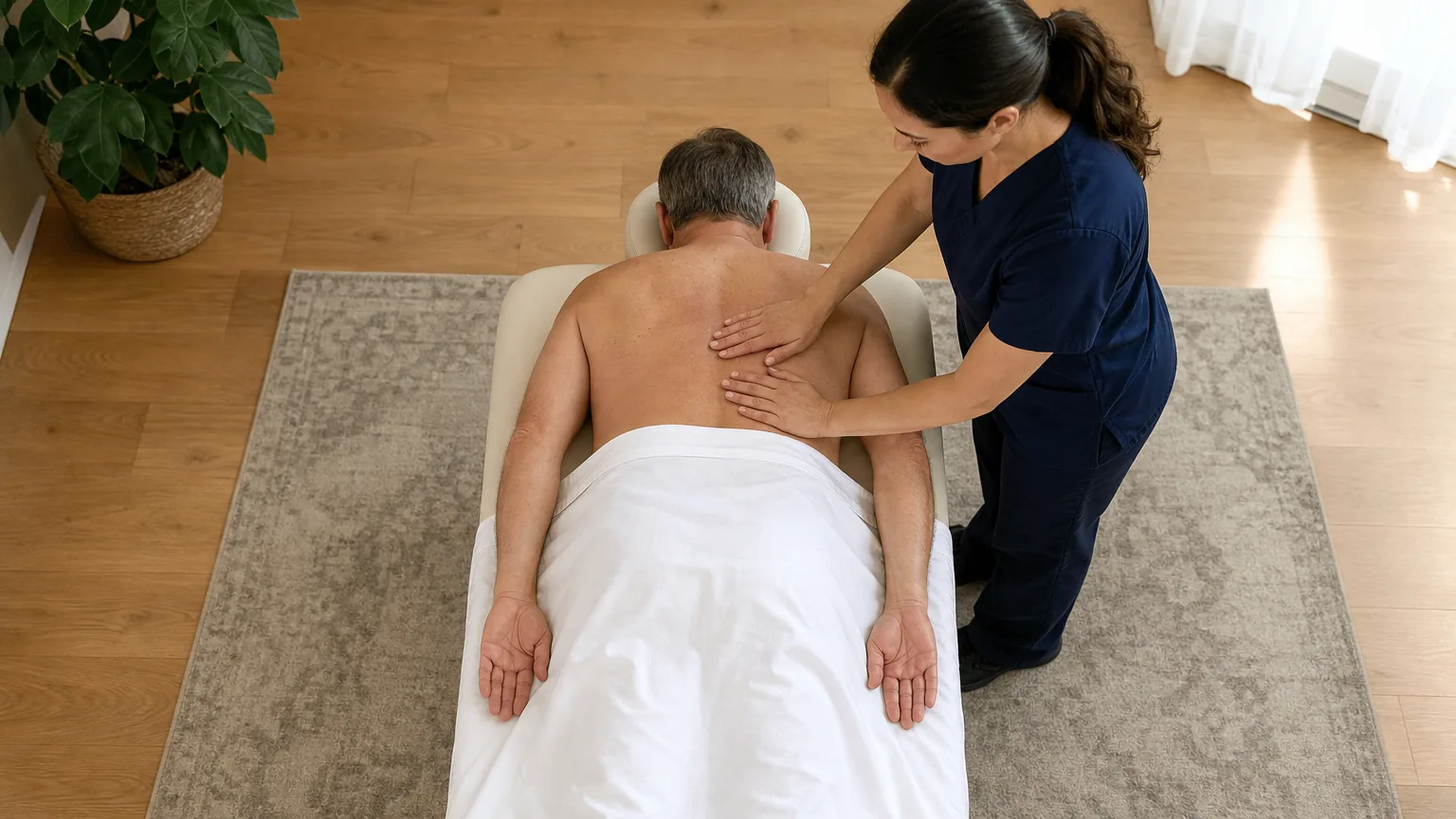
The definition of the work is broad, and so is the intake it expects. The act defines massage therapy as “the manual manipulation of the soft tissues of the body to promote, maintain, and restore health and well-being,” lists fourteen techniques it includes, and requires assessment through a health history and intake interview, observation of posture and movement, palpation, and range of motion assessment, with consultation with the client’s other providers when the client agrees. A mobile intake form that screens for contraindications needing physician clearance covers most of this already. Make sure your notes record what you observed as well.
The limits are spelled out. Registered practice does not include diagnosis, high-velocity thrust adjustments, needling, prescriptive exercise, traction for joint mobilization, injections, or device treatments such as laser, microwave diathermy, electrical stimulation, ultrasound, iontophoresis and phonophoresis. When a client’s condition is beyond that scope, a registrant must refer them to a licensed health care provider, though continuing to co-manage their care is allowed. With prescriptive exercise on the list, keep aftercare suggestions general and leave exercise programs to the physical therapist. Our state licensing and scope of practice guide covers how to hold those lines in a client’s living room.
A council will shape the standards. A five-member Massage Therapy Advisory Council will advise the commissioner on standards of practice and ethics, set educational requirements and approve schools. Two seats go to public members and three to registrants, at least two of them registered massage therapists. Members must have lived in Minnesota for three years, and no more than one may own or run a massage school. The first appointments are due by January 1, 2027 and the first meeting by May 15, 2027. Therapists appointed at the start need five years of experience and must register by January 1, 2028. MDH says applications for the council will open on the Secretary of State’s website.
Who Qualifies, and the Window for Experienced Therapists
The standard route asks for five things:
- A complete application listing your credentials anywhere, any refusal to license you, any disciplinary action, and any misdemeanor, gross misdemeanor or felony convictions.
- A postsecondary massage program from a school licensed by or registered with the Minnesota Office of Higher Education, covering anatomy, physiology, pathology, massage therapy, its history, theory and research, ethics, therapeutic communication and standards of practice, business and legal practice, and supervised practice in the safe use of equipment and supplies.
- A passing score on a credentialing exam that the commissioner approves and a national testing organization administers. The act does not name one, so wait for MDH to say which exam it accepts before booking.
- Professional liability insurance of at least $2 million per occurrence and $6 million in annual aggregate.
- A state and FBI criminal history check, plus the fees.
From July 1, 2031 the education bar rises. A program must then hold programmatic accreditation from an agency recognized by the U.S. Department of Education, or include at least 625 contact hours: 500 of instruction and 125 of supervised clinical practice.
The prior experience route is the one most working therapists will use. Until July 1, 2031, an applicant who can show at least two years of practice in the five years before applying can register without the education and exam proofs. Everything else still applies: the application, the background check, the insurance and the fee. Let a registration from this route lapse for more than two years, though, and it is canceled. Coming back then means meeting the full education and exam requirements.
The act does not say what counts as proof of those years, and MDH has not said either. Start the file now anyway: city licenses and renewals, certificates of insurance, Schedule C returns and 1099s, and booking records that show a steady practice. The bookkeeping habits in our money guide for solo therapists produce most of it as a side effect.
Two other doors exist. Therapists with a current, unrestricted credential from a jurisdiction whose requirements are at least equivalent can register by endorsement. And MDH may issue a $50 temporary registration on a complete application, valid until it decides the application or for 90 days, whichever comes first.
Some applicants will be turned away. The commissioner must deny registration to anyone convicted of labor or sex trafficking, criminal sexual conduct or a violent crime, to registered sex offenders, and to applicants with an unresolved complaint that would breach the act. MDH may set criteria for overcoming a conviction, but not when the victim was the applicant’s client. For someone deciding whether to let a therapist into their home, that list is part of what the title will mean.
What Registration Costs and Commits You To
Fees are capped in the statute: up to $640.50 for the initial registration and application, and up to $640.50 for each two-year renewal. A late renewal adds $50, inactive status costs $50 a year, reactivation is $50, a temporary registration is $50, and none of it is refundable. Background check fees come on top.
Insurance is the bigger change for many solo therapists. The registry requires $2 million per occurrence and $6 million in annual aggregate, at application and again at every renewal. St. Paul asks for $1 million of general and $1 million of professional liability, and Bloomington’s application asks for $1 million of professional liability. Pull your declarations page and read the aggregate line before assuming your current policy qualifies. Coverage is non-negotiable for any mobile therapist anyway; the registry simply sets the floor higher.
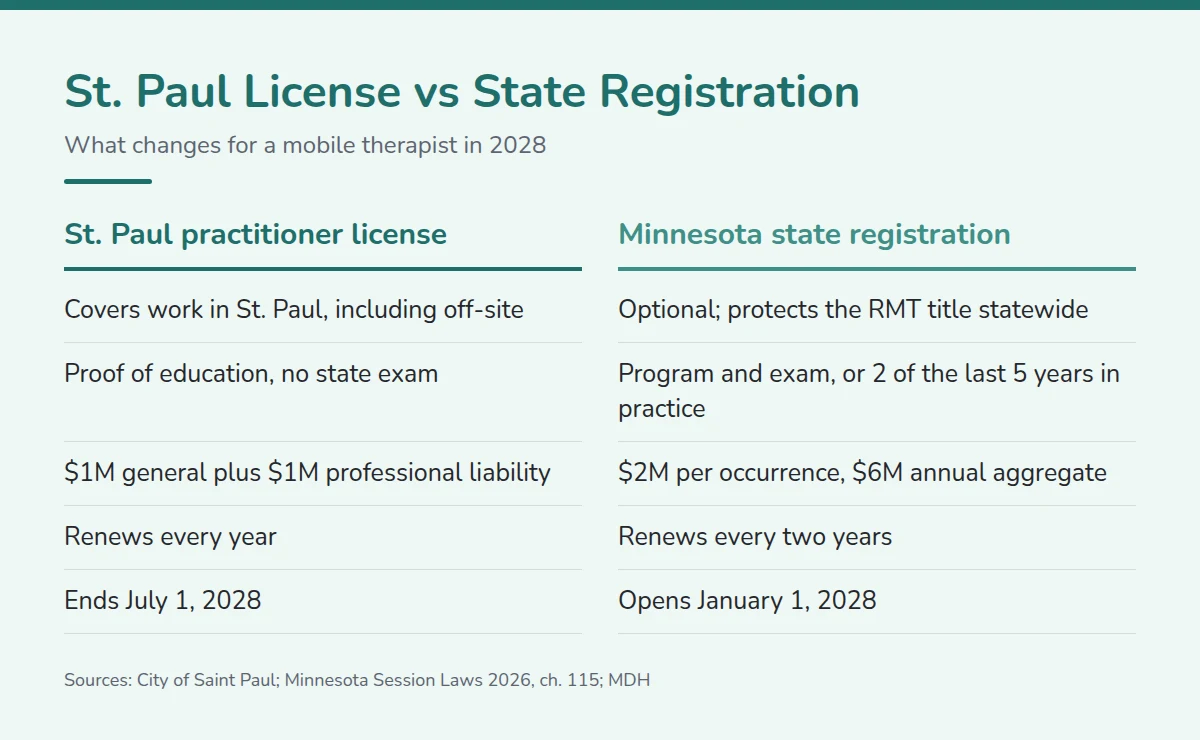
Renewal comes every two years and asks for the form, the fee and proof of insurance. The statute does not list continuing education hours, though the rules MDH writes could add requirements. Address changes must reach MDH within 30 days, and for most mobile therapists the home address is the business address.
Accountability is real. The act lists 23 grounds for discipline, from misleading advertising and sexual conduct with a client to poor record keeping, and penalties run from a reprimand to revocation, with civil penalties of up to $10,000 per violation. Registrants must report other therapists who violate the act, report discipline in another jurisdiction within 30 days, and tell MDH within 60 days about a malpractice judgment or settlement. Insurers report malpractice settlements and awards to MDH four times a year. From July 1, 2028, a therapist whose registration is suspended or revoked may not fall back on practicing under Chapter 146A in the meantime, and MDH’s office for unlicensed practitioners must share a named therapist’s complaint and discipline history with the commissioner on request.
What Happens to Your City Licenses
Until July 1, 2028, nothing changes locally. According to the League of Minnesota Cities, cities that license therapists may keep doing so until then. Renew every license your route requires. Letting one lapse in 2027 because a state law passed is how a therapist ends up explaining a missing license to a city inspector.
From July 1, 2028, cities lose the individual therapist. The act then preempts city licensing and regulation of massage therapists and Asian bodywork therapists, including background checks and examinations of a therapist or an applicant for a city credential. “Municipality” in the act covers counties, towns and cities. Practitioner licenses like St. Paul’s and Bloomington’s are the kind of credential that has to end.
The business license survives. Cities may still require a massage therapy establishment to hold a business license or permit, and may still run background checks on establishment owners who are not registered therapists. The League also reads the law as allowing a city to require state registration of every therapist working in a business as a condition of that business’s license. Put together, “voluntary” may not stay voluntary for therapists who also take shifts at a licensed spa or clinic, and a city’s owner background checks reach only owners who are not registered.
The open question is what counts as an establishment. The act does not define the word. Minneapolis’s three license types, commercial, single operator and home-based, are each tied to a location, which is the model the law leaves standing. A practice whose only premises are a car and the client’s home does not map neatly onto a location license, and how each city fits mobile work into its business rules is the real question for 2028. The League has told cities to review their ordinances, so expect rewrites. Our guide to anti-trafficking ordinances and outcall therapists covers how to read a draft before it passes. The definitions section is where mobile work is won or lost.
Is Registering Worth It?
For most established mobile therapists, yes, and mostly for practical reasons.
- The title. From 2028, “RMT” on a card or booking profile is a claim only the registry can back. For a client letting a stranger into their home, a state credential with a criminal history check behind it says more than a certificate on a website. The registry vets the therapist, not the client, so screening clients stays your job; our personal safety protocol covers how.
- Access. If cities make registration a condition of their business licenses, it becomes the price of working shifts in licensed spas and clinics. Corporate wellness buyers that want a simple screen will have one, too.
- Timing. The experience route closes on July 1, 2031. After that, every applicant needs a passed exam and a program that is either accredited or at least 625 hours long, which a graduate of a shorter program may not be able to show.
- Direction of travel. The American Massage Therapy Association and Associated Bodywork and Massage Professionals both say they will keep pushing for mandatory licensure, and ABMP describes registration as an easier transition if Minnesota adopts it.
The case against is mostly cost and exposure: up to $640.50 every two years, a background check, possibly a pricier policy, and MDH’s discipline and reporting rules. If you never use the title, never work inside a licensed business, and the cities you serve never demand it, you can legally keep practicing under Chapter 146A. Just do not drift into language that implies you are registered.
The deciding factors are your insurance and the places you work. If you already carry $2 million and $6 million in coverage and plan to practice in Minnesota for years, registering costs little beyond the fee. Either way, do not leave it until 2031.
The Rules Are Still Being Written
The statute tells MDH to adopt rules, including standards of practice and a code of ethics, and that work has started. MDH published a request for comments in the State Register on August 17, 2026, and its first comment window runs to October 16, 2026. It is assembling a rulemaking advisory committee of about 15 practitioners, instructors, clients and representatives of cities that license therapists, separate from the council in the statute. Its timeline has the committee meeting through spring 2027, a Notice of Intent to Adopt Rules in December 2027, and a possible hearing in spring 2028. MDH does not expect to circulate a draft before the rules are formally proposed.

Two practical points follow. Comments sent during the early window go to MDH but not into the formal record an administrative law judge reviews, so anything you want in that record must be submitted again once the rules are proposed. And on MDH’s own timeline, registration opens before the standards of practice and the ethics code are likely to be final. If you have views on how the rules should treat home visits, draping, documentation or working alone, the ground our ethics, consent and draping guide covers, this is the time to make them. MDH takes emailed comments throughout the process and offers email updates on its rulemaking page.
One note on dates. MDH, which runs the registry, gives January 1, 2028 as its start. Some association updates printed July 1, 2028, the day city licensing of therapists ends. Plan around MDH’s date and watch its page.
A Two-Year Plan for a Mobile Practice
- Keep every city license current through June 30, 2028.
- Build your experience file now, while the records are easy to find.
- Check your policy against the $2 million and $6 million minimums.
- Clean up “registered” language in your marketing before January 1, 2028.
- Follow the rulemaking, and comment again when the proposed rules are published.
- Ask each city you serve, early in 2028, how its business licensing will treat a practice with no premises after July 1.
For years, the bill of rights Minnesota requires massage therapists to hand clients has had to tell them, in bold, that the state has adopted no training standards for the person on their doorstep. From 2028, therapists who register can point to a state standard instead. Rules vary from state to state and the Minnesota details are still being written, so confirm everything here with MDH and each city you serve before relying on it.
Sources
- Minnesota Legislature with the full text of Chapter 115, including the Article 3 registration act
- Minnesota Statutes on the client bill of rights unlicensed practitioners must provide
- League of Minnesota Cities for what the new law means for city massage licensing
- Minnesota Department of Health on its rulemaking timeline and advisory committee and its formal request for comments
- American Massage Therapy Association on the bill’s passage and its continued push for licensure
- Associated Bodywork and Massage Professionals with a summary of the registration qualifications
- City of Saint Paul for its massage practitioner license requirements
- City of Bloomington with its individual massage therapist license application
- City of Minneapolis on why it licenses massage businesses rather than therapists and its three location-based license types
Further reading
- State Licensing and Scope of Practice: A Mobile Therapist’s Compliance Guide
- When Anti-Trafficking Massage Ordinances Hit Legitimate Outcall Therapists
- The Mobile Massage Money Guide: Business Structure, Bookkeeping, and Taxes for Solo Therapists
- Ethics, Consent, and Draping in the Client’s Home: A Professional Boundaries Guide
- Personal Safety for Mobile Massage Therapists: A Comprehensive Protocol